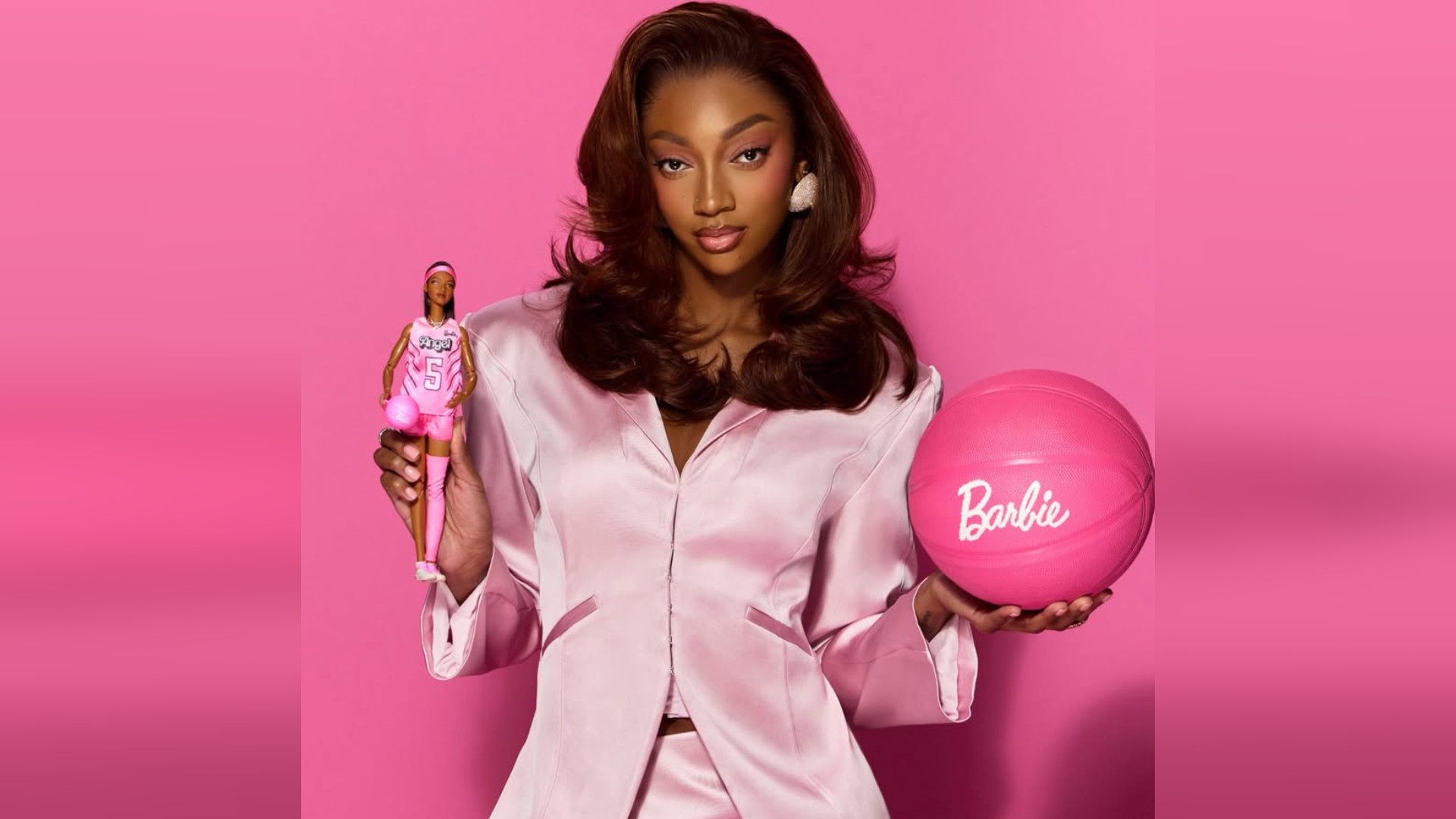
Angel Reese has just received her own Barbie, joining a remarkable lineup of Black women who have been honored in the same way
From the court to the toy aisle, “Bayou Barbie” has officially become a real Barbie.
Angel Reese has officially added another accolade to her impressive resume, and this one arrives in a much smaller package than an All-Star nod. Just before the 2026 WNBA All-Star Game, Mattel unveiled a Barbie doll that perfectly resembles Reese as part of the brand’s Role Models series, and the timing was impeccable. Reese has long embraced the nickname Bayou Barbie, a title she chose for herself well before this collaboration was even considered. This makes the doll feel less like a mere licensing agreement and more like a significant moment that has come full circle after years of anticipation.
The doll showcases remarkable attention to detail, including Reese’s number five jersey, her signature leg sleeve, and headband, creating an unmistakable resemblance to the Atlanta Dream forward. It is adorned in a custom pink jersey that pays homage to both her professional number and her college number, a subtle yet significant detail linking her LSU legacy to her present journey in the league. The release became available at Target, Walmart, Amazon, and the official Mattel shop for approximately $38, coinciding with a matching Reebok sneaker collaboration that is set to launch soon after. In discussing the release, Reese expressed that she has consistently followed her own path and has not allowed anyone to restrict her potential. She emphasized that her current goal is to motivate others to recognize their own strength to conquer doubt and recover from any challenges they face. For a player who has dedicated her career to embodying that kind of confidence, both on the court and beyond, the message aligns seamlessly with the doll it accompanies.
Reese’s doll adds to an expanding and truly remarkable collection of Black women who have been honored in Barbie form throughout the years. Observing this lineup collectively narrates a compelling tale about representation finally aligning with those who truly merit recognition.
Misty Copeland made history in 2016 when she became the first Black woman to be honored with her own Barbie as part of the brand’s Sheroes program, recognizing her achievement as the first African American woman named principal dancer at the American Ballet Theatre. Her doll donned a bespoke red and orange costume inspired by her breakout role in Firebird, with Copeland taking a personal interest in ensuring that every detail, including the muscular dancer’s build, accurately represented her.
Gabby Douglas became a Barbie in the same year she made history at the 2012 Olympics, where she became the first African American gymnast to win gold in the individual all-around competition. She later reflected on the honor as something she was still attempting to comprehend, acknowledging that she never envisioned being regarded as the type of role model that people now see her as.
Naomi Osaka became a part of the Role Models series in 2021, featuring her doll in the precise outfit she donned during her journey at the 2020 Australian Open. Osaka expressed her desire for young girls everywhere to feel empowered to dream big, a message that resonates from someone who made history as the first Asian player to be ranked number one in the world.
Ibtihaj Muhammad made history in 2017 when she inspired Barbie’s first hijab-wearing doll, recognizing her as the first Muslim American woman to compete at the Olympics while wearing a hijab. The doll was crafted to embody an entirely new type of Shero for young girls who had never encountered a Barbie that resembled them before.
Simone Biles, regarded as one of the greatest gymnasts ever, joined the lineup as part of a larger group of female athletes celebrated by Barbie, with her doll embodying her distinctive power and grace.
Even beyond the realms of sports and entertainment, Barbie’s Inspiring Women line has created a platform for historical figures such as Madam C.J. Walker, celebrated as the first self-made Black female millionaire in America, and Ida B. Wells, acknowledged for her contributions as a journalist and co-founder of the NAACP. The 2015 Oscars honored Zendaya with a doll modeled after her natural locs, years before she achieved her current level of fame. This look initially sparked public backlash but ultimately transformed into a symbol of pride.
Angel Reese’s inclusion on a list that features gymnasts, ballerinas, tennis champions, journalists, and entrepreneurs signifies more than just the launch of a new toy. It reveals an expanding understanding of who qualifies as a role model deserving of admiration for future generations to aspire to. For every little girl who grows up seeing a doll that resembles her, dressed in a jersey or a leotard or a hijab rather than merely a ball gown, that representation subtly transforms her perception of what she can achieve.
Reese’s doll arrives at a time when her impact extends well beyond the realm of basketball, encompassing her fashion influence and her podcast, Unapologetically Angel. In this platform, she candidly addresses the challenges of public criticism while remaining authentic to her identity.