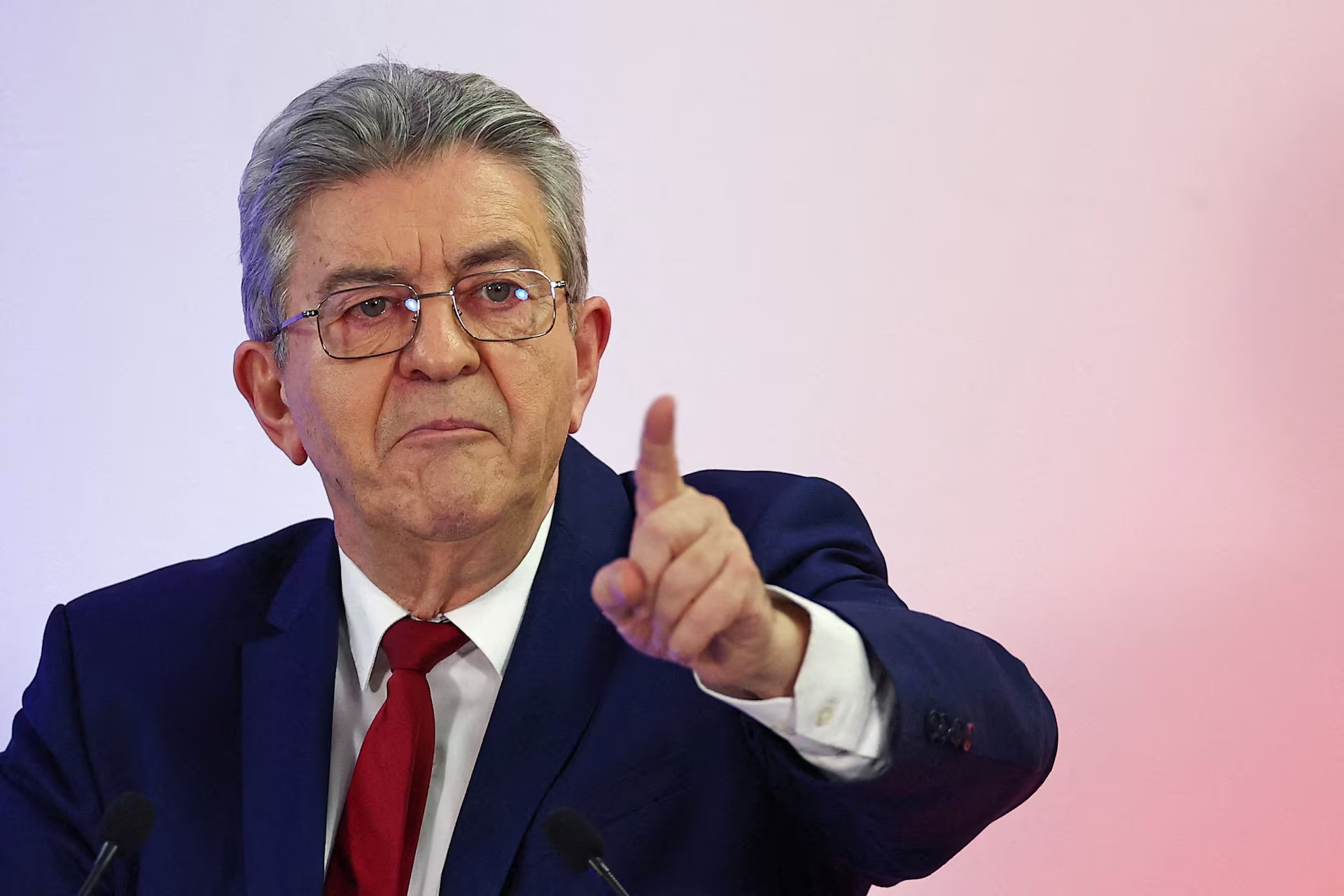
France’s political class has faced significant turmoil recently, as it seeks to address the nation’s growing debt burden. Far-left presidential candidate Jean-Luc Melenchon presents a straightforward yet deeply polarizing proposal: to cancel it.
Melenchon, leader of the France Unbowed party (LFI), has renewed his demands for the central bank to eliminate its holdings of French debt. “All we have to do is take the 18% held by the Bank of France and chuck it in the fire,” he stated during his campaign.
Melenchon has not yet provided specifics about his plan, but the main concept is that this operation would enable France to lower its headline public debt ratio, which currently exceeds 116% of GDP, thereby allowing for increased public spending.
His unconventional approach to addressing France’s fiscal challenges is included in a set of policies that are resonating well with certain voters.
A poll on Monday indicated that Melenchon is set to compete in a run-off against far-right leader Marine Le Pen in the upcoming presidential election, surpassing mainstream candidates.
The concept is not original. Recently, during the COVID-19 pandemic, certain economists and politicians urged the European Central Bank to cancel government bonds it had purchased from commercial banks to support the eurozone economy.
Nonetheless, similar proposals have faced rejection previously, as policymakers contend that they would result in a central bank essentially funding a government, a practice explicitly prohibited by European Union treaties, while also undermining market confidence.
Melenchon’s latest call is eliciting a comparable response of backlash.
Prime Minister Sebastien Lecornu, who has taken office as France’s fifth prime minister in less than two years following the ousting of two predecessors due to attempts to control the deficit, characterized the proposal as “fraud in its purest form” and cautioned that it would negatively impact households and businesses.
With France needing to borrow record sums, Lecornu cautioned that even considering the idea could unsettle investors. “If France, which needs to raise 310 billion euros ($361 billion) this year, were to go back on its own commitments, who would still be willing to lend to us? At best, lenders—if they agree to lend at all—will demand exorbitant interest rates,” Lecornu stated on X.
Melenchon’s team has not yet provided a response to the request for comment.
TAXPAYER RESPONSIBLE
The Bank of France chose not to provide a comment; however, its former governor, Francois Villeroy de Galhau, has previously stated that canceling government bonds on its balance sheet would compel France to relinquish the euro, resulting in a significant loss for the central bank that would ultimately fall on the French taxpayer.
Not everyone, however, has hesitated at the idea.
Matthieu Pigasse, an investment banker with left-leaning views, recently secured a mandate to restructure Venezuela’s substantial debt and has expressed his support for Melenchon.
During the summer conference of the LFI party last weekend, Pigasse stated that bonds held at the Bank of France could be canceled “without any economic or financial impact.
His remarks ignited a heated discussion on X with former IMF chief economist Olivier Blanchard, who described the debate as “idiotic.
Blanchard stated that if the Bank of France were to cancel French bonds, it would cease to earn interest or profits that would typically be returned to its sole shareholder, the French state. This would make the action insignificant in bookkeeping terms and undermine the confidence of private investors.
He recognized that France’s deficit was excessively large, stating that “proposing false solutions, raising false hopes, is … irresponsible.