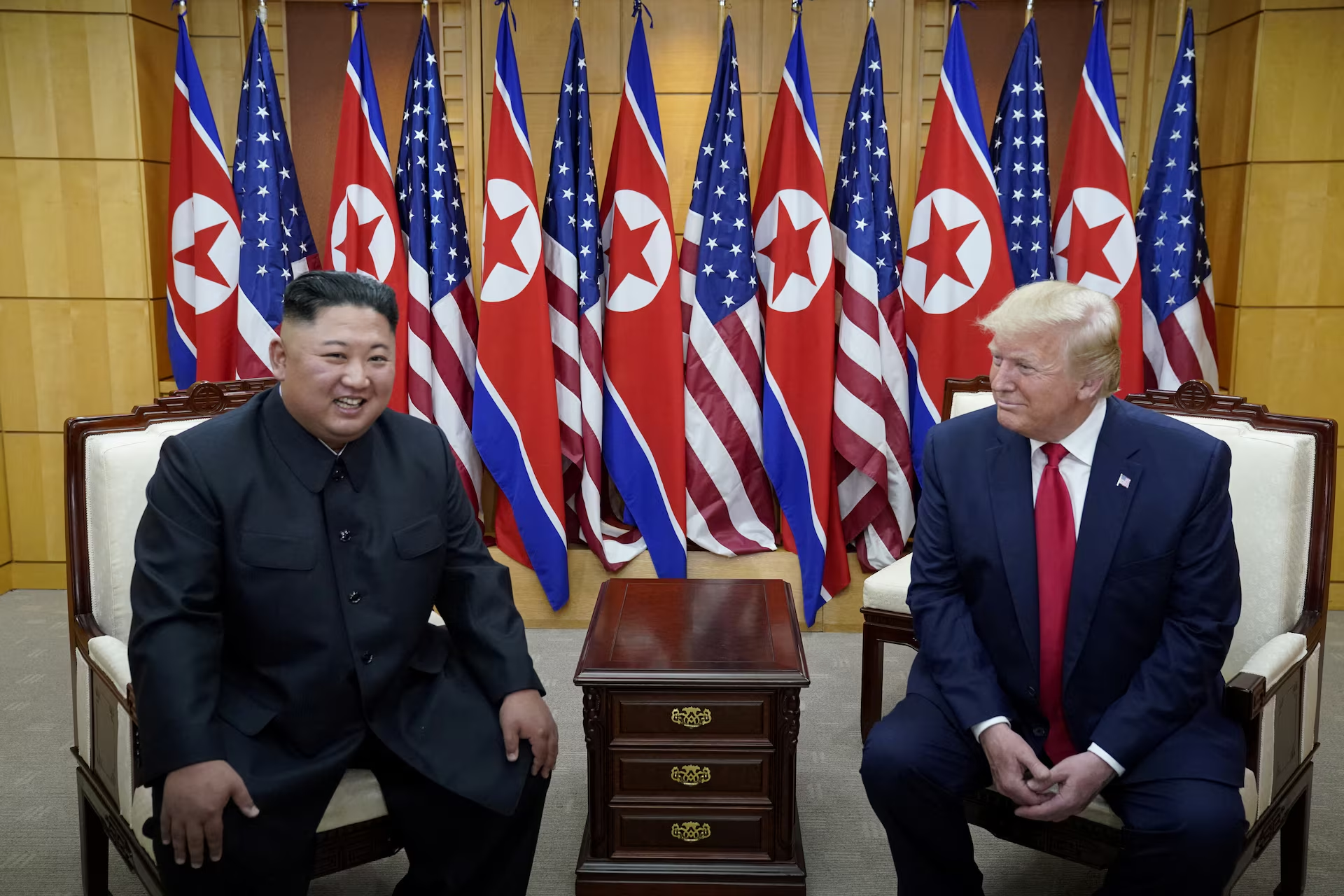
Trump is seeking another meeting with Kim Jong Un; North Korea asserts a cautious stance
U.S. President Donald Trump has expressed his desire to meet with North Korean leader Kim Jong Un later this year. However, his overtures have elicited a cold response from Pyongyang, indicating that it will impose stringent conditions for holding such a meeting, even though the two men share an “excellent” relationship.
Earlier this week, Trump unexpectedly reduced joint U.S. military exercises with South Korea, stating that they were “hostile” to North Korea. On Wednesday, he expressed his anticipation of meeting Kim later this year.
Trump is keen to resume discussions with North Korea and achieve a victory on the global front,according to a person familiar witht the conversations between U.S. and South Korean officials.
There is currently no foreseeable conclusion to the nearly six-month conflict in Iran, and Trump’s overtures to North Korea occur in the context of Pyongyang dispatching troops and equipment, including missiles, to aid Russia in its war against Ukraine.
South Korea has shown a private openness to Trump’s strategy; however, officials in Seoul continue to harbor reservations regarding the reduction of joint military exercises with the United States, according to the source.
Trump might attend the Asia-Pacific Economic Cooperation summit in Shenzhen later this year, which could lead to a meeting in the region if North Korea shows willingness for renewed engagement, according to the source.
A spokesperson from the U.S. State Department stated that the United States is open to dialog with North Korea without any preconditions. The president and Kim Jong Un will reconvene at a suitable moment.
The White House chose not to provide a comment. South Korea’s presidential office did not respond to a request for comment; however, its foreign ministry referenced a previous statement expressing hope that Trump’s remarks would foster meaningful dialog with Pyongyang.
North Korea’s response thus far, while commending the “excellent personal relationship” between Kim and Trump, indicates that it perceives their personal rapport as distinct from any interaction with the U.S., according to Lim Eul-chul, a professor at Kyungnam University’s Institute for Far Eastern Studies.
Personal ties will never be permitted to undermine national security interests or initiatives to enhance military capabilities,” Lim stated. In essence, Pyongyang is indicating that personal diplomacy has boundaries and will not take precedence over strategic priorities.
Kim Yo Jong, the influential sister of Kim, has rejected the reduction of the Ulchi Freedom Shield exercise, asserting that its ongoing nature remains aggressive and that the U.S. policy toward North Korea continues to be hostile. She also denied that Trump and Kim had any contact, although she characterized the personal relationship between the leaders as “excellent.
On Thursday, North Korea launched approximately 10 ballistic missiles off its east coast, as reported by South Korea’s military. Analysts suggest the launch may have been a protest against the ongoing U.S.-South Korea exercises. In her statement, Kim Yo Jong remarked, “If the U.S. side attempts to promote the measures they have taken this time as some kind of ‘goodwill gesture,’ they will not get the answer they desire,” according to the state news agency KCNA.
THE CONDITIONS IN PYONGYANG
North Korea has clearly outlined the conditions that would render a meeting compelling, and these represent significant challenges for the U.S. to fulfill, stated Jenny Town, a senior fellow at the Stimson Center in Washington.
These conditions would entail significant alterations to U.S. policy regarding North Korea, aimed at eliminating aspects that Pyongyang perceives as antagonistic, acknowledging its nuclear status, or at the very least, stating that denuclearization is no longer a priority for Washington, she noted. “How inclined Trump is to agree to these conditions to facilitate the meeting within the timeframe he has established remains uncertain,” she remarked.
The spokesperson for the State Department stated that the U.S. “remains committed to the complete denuclearization of North Korea.
Trump conducted a remarkable series of summits with Kim in 2018 and 2019; however, the diplomatic initiatives faltered due to U.S. demands for North Korea to relinquish its nuclear arsenal.
Trump has repeatedly referred to North Korea as a “nuclear power,” even as his administration has maintained its call for the country’s denuclearization and does not officially acknowledge it as a nuclear-weapon state.
Kim now has diminished motivation to agree to a meeting compared to during Trump’s first term, when he was seeking relief from sanctions. North Korea has increasingly aligned itself with China and Russia, as the expansion of trade with these nations has contributed to its economic growth.
North Korea has options and is fostering relationships with states that demand no sacrifices but offer only mutually beneficial outcomes,” Town added. “There is minimal motivation for him to hasten back into negotiations where there is an expectation for him to yield anything, especially something he views as vital to the nation’s defenses.
Still open to discussions.
North Korea’s response seems carefully crafted to maintain the potential for diplomacy, according to Hong Min, a senior research fellow at the Korea Institute for National Unification, who referenced a statement by Kim Yo Jong. “The primary aim seems to be fostering a more flexible U.S. stance,” Hong observed, pointing out that Pyongyang likely chose not to mention Iran to avoid provoking Trump. “Kim Yo Jong’s statement seems more like a strategy to influence Trump’s perceptions, guide his understanding of North Korea, and prepare the way for potential future discussions between the U.S. and North Korea,” he remarked.
The statement was notably critical of Japan, as its military buildup and security connections with the United States and South Korea have increasingly drawn the attention of Pyongyang’s displeasure.
Pyongyang is proposing a U.S.-North Korea framework that sidelines South Korea and positions Japan mainly as a military adversary, Hong noted.
U.S.-North Korea relations might be entering a stage of reciprocal exploration and communication,” he stated.