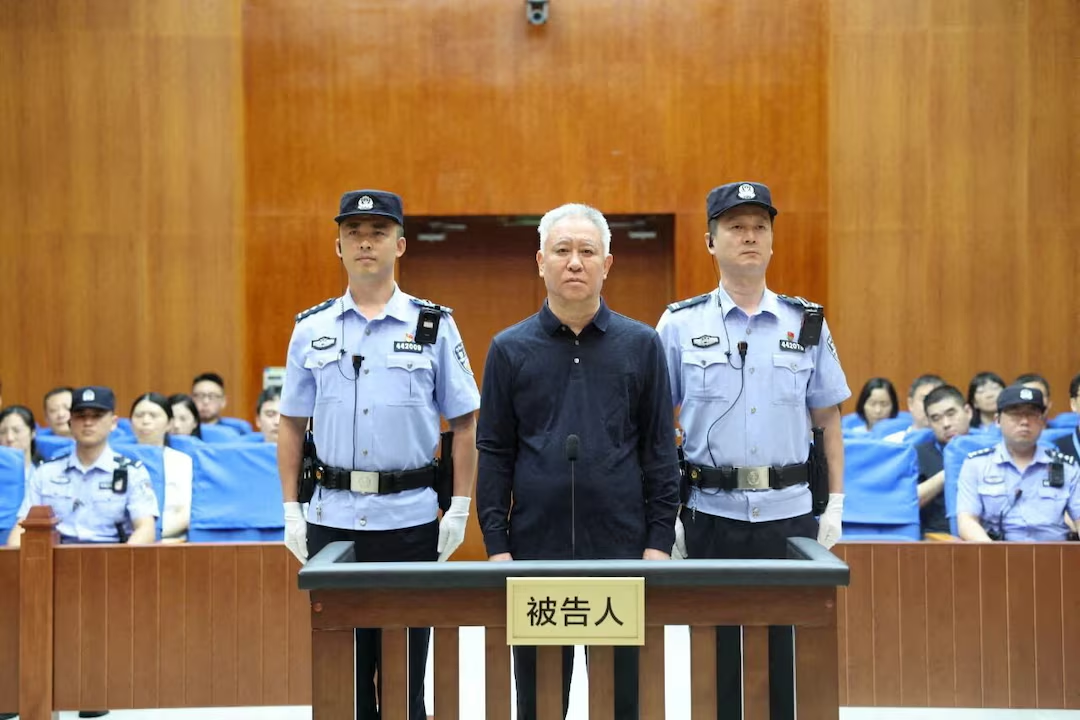
Hui Ka Yan, the founder of Evergrande, has received a life sentence following his conviction for various financial offenses in China.
Hui Ka Yan, the founder of Evergrande, has received a life sentence from a court in Shenzhen, China, almost five years following the collapse of the property giant, which caused significant upheaval in the nation’s property sector and financial markets.
The Shenzhen Intermediate People’s Court issued the sentence on Thursday, directing the confiscation of all of Hui’s personal property.
Hui, 67, who was formerly recognized as Asia’s wealthiest individual, entered a guilty plea in April to eight charges. These charges encompass misuse of funds, fundraising fraud, the illegal acceptance of public deposits, unauthorized loan extensions, fraudulent securities issuance, and bribery.
The court determined that Hui and Evergrande had engaged in grave financial misconduct involving substantial amounts of money, resulting in considerable economic damage and serious social repercussions.
Evergrande faced a fine of 8.82 billion yuan, approximately $1.31 billion. Additionally, its primary mainland property subsidiary, Evergrande Real Estate Group, incurred a further fine of 7 billion yuan. This results in total fines amounting to 15.82 billion yuan, or around $2.3 billion.
Five additional senior executives from Evergrande received prison sentences that varied from six to 18 years. On Thursday, Chinese state broadcaster CCTV reported that the courts sentenced a total of 56 individuals associated with the company.
The court determined that Evergrande had participated in extensive financial fraud, which involved inflating assets and hiding liabilities. Investigations revealed that the company inflated its revenue by approximately $80 billion in 2019 and 2020 by prematurely recognizing property sales.
Evergrande amassed over $300 billion in liabilities prior to defaulting on its debts in 2021, marking it as one of China’s largest corporate failures and a significant emblem of the nation’s ongoing property crisis.
The company’s collapse resulted in significant losses for homeowners, investors, and creditors, while issues related to wealth-management products sparked protests from investors who claimed they had lost their savings.
In January 2024, a Hong Kong court ordered Evergrande into liquidation due to its inability to provide a feasible restructuring plan. Its shares, listed in Hong Kong, were subsequently delisted.
The liquidation process has progressed at a sluggish pace, with creditors encountering significant obstacles in their efforts to recover funds. Reuters reported that creditors had recovered approximately $255 million from claims totaling around $45 billion.
Hui established Evergrande in the 1990s and grew it into one of China’s largest property developers by employing a bold expansion strategy that relied significantly on borrowing. In 2017, at the peak of his financial success, his estimated worth reached $45.3 billion, as reported by Forbes.
His fortune crumbled as Evergrande’s financial troubles intensified, marking the downfall of the empire he had constructed during China’s property boom.
The life sentence comes after a distinct regulatory action in 2024, during which China’s securities regulator fined Hui and imposed a lifetime ban from the securities market due to findings that Evergrande had inflated its revenue and engaged in securities violations.
Hui’s statement signifies a significant decline for a businessman who was once at the forefront of China’s property boom, as creditors persist in their attempts to reclaim billions of dollars lost in Evergrande’s downfall.