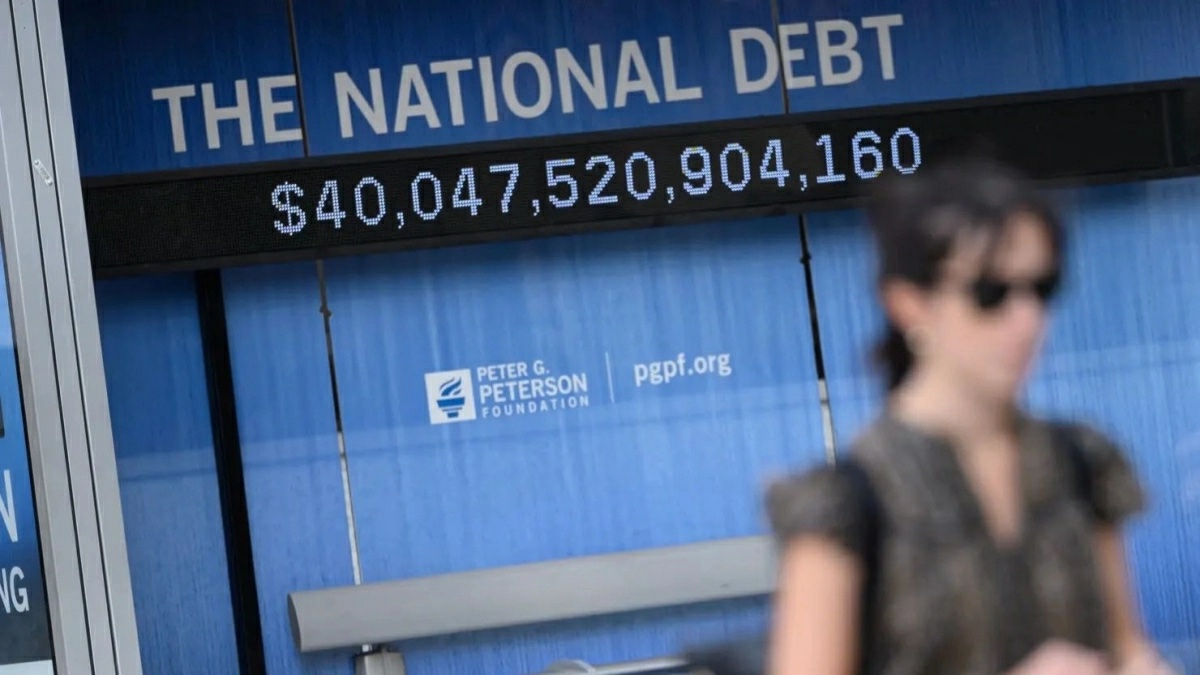
US national debt reaches $40 trillion after experiencing a twofold increase over the past ten years
The US national debt has now reached $40 trillion, having doubled in the past decade. This surge raises concerns about increasing borrowing costs and the state of the government’s finances.
The US national debt has more than doubled over the past decade, now totaling $40 trillion (£29.4 trillion), according to Treasury figures.
The debt was nearly $20 trillion in 2016. The increase is indicative of years of substantial expenditure during both the Trump and Biden administrations, coupled with escalating interest payments that have consistently contributed to the overall total.
The Congressional Budget Office (CBO) projected that total borrowing would reach $39.6 trillion by the conclusion of fiscal year 2026.
The quicker-than-anticipated increase has heightened worries regarding the pace of government borrowing and its implications for future interest expenses.
The CBO indicated that the US is approaching its $41.1 trillion debt ceiling, with projections suggesting that debt could rise to approximately $64 trillion by 2036.
The total of $40.05 trillion, recorded on 18 August, encompasses all outstanding Treasury bonds, bills, and notes, underscoring the magnitude of US borrowing under two presidents.
As the federal government increases its spending to address budget deficits, consumers are encountering elevated interest rates and inflation.
The interest rate on 30-year bonds, utilized for raising funds from investors, hit 5.34% on Tuesday, marking its highest level in nearly 20 years.
Those rates, referred to as yields, affect the borrowing costs for the US government, companies, and consumers. They influence mortgages, car loans, and credit cards.
The recent increase in bond yields has been influenced by elevated oil prices associated with the US-Iran conflict, as investors express concerns regarding inflation.
Concerns exist regarding government debt and the substantial sums being borrowed by technology companies to advance artificial intelligence (AI), coupled with uncertainty surrounding the timing and magnitude of returns.
Although everyday individuals may not feel the impact right away, challenges in handling the debt could ultimately lead to disturbances comparable to those seen during the 2008 financial crisis, as noted by economics professor David Jacks.
The pace of America’s growing debt is accelerating, and at some point, the bills will come due, stated Jacks from the National University of Singapore.
The Treasury Department announced on Wednesday that it would increase its buyback operations by at least double, from $2 billion to $4 billion, from September 9 to November 4.
It was stated that the intervention demonstrated a “desire to provide greater liquidity support” for longer-term bonds.
The borrowing costs over 30 years decreased to 5.18% after the announcement.
John Canavan, lead analyst at Oxford Economics, stated that the decision to increase purchases seemed to be an “attempt to provide relief” on long-term borrowing costs, which had been under “significant pressure from rising oil prices, inflation risks, and heavy supply due to global sovereign and corporate borrowing needs.”
However, he stated that, considering the magnitude of the existing Treasury debt, the rise in government buybacks was “unlikely to offer significant long-term relief.”
Rene Albrecht, a senior analyst at DZ Bank in Germany, expressed that the US government is concerned about the long-term implications of “pain of 5% or higher yields,” as this would increase borrowing costs for both the government and the private sector.
“There are just three months remaining until the midterm elections,” Albrecht stated. The Treasury has had to use its tools to address the recent increase in yields.
Economist Mohamed A. El-Erian stated that, in addition to the bond market’s response to lower long-term borrowing costs, the actions taken by the Trump administration might be part of a larger strategy aimed at maintaining control over interest rates, referred to as “yield curve control.”
While the move can help bring down longer-end yields in the immediate and short term, thereby lowering mortgage and other borrowing costs, he noted in a social media post that it risks collateral damage and unintended consequences.
The US’s debt compared to its annual economic output, referred to as the debt-to-gross domestic product (GDP) ratio, stands at 125.8%, as reported by the International Monetary Fund (IMF).
It ranks among the highest ratios in the world’s largest economies.
According to IMF figures, the debt-to-GDP ratio for the UK stands at 103.6%, while for China, it is at 106.9%.
Japan holds the highest debt burden among the major economies globally, boasting a debt-to-GDP ratio exceeding 200%.
The US offers longer-term fixed mortgage options compared to countries like the UK.
The current average interest rate on 30-year fixed mortgages stands at 6.67%, as reported by finance firm Freddie Mac. Borrowing costs for homeowners have increased, yet they still fall below the levels seen in 2023, when these deals averaged 7.7%.
Minutes released on Wednesday by the Federal Reserve, which sets US interest rates, indicated that concerns regarding inflation had intensified among policymakers at its most recent meeting.
The minutes indicated that there were “several participants” who supported increased rates last month. The central bank maintained its benchmark interest rate within the 3.50%-3.75% range for the fifth consecutive time.
Numerous participants indicated that rate hikes would probably be essential if inflation did not decrease, while others proposed that interest rates were insufficient to return price increases to the Fed’s 2% inflation target.
The Fed is anticipated to maintain its policy rate at the same level during its September meeting, following recent data indicating a slight easing of inflation and an unexpected reduction in jobs by firms in July.