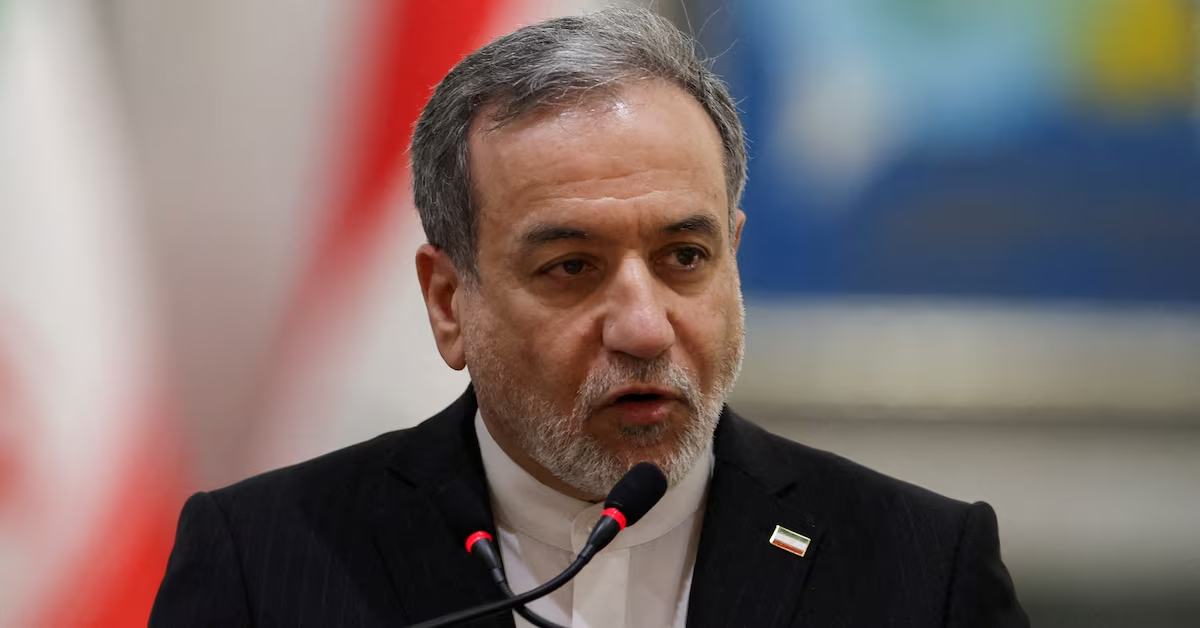
Iran reports that there has been no advancement in the efforts to revive the interim peace agreement with the United States
Iran and the United States continue to be at odds regarding efforts to establish a lasting resolution to the conflict in the Gulf. A senior Iranian source indicated that there has been no advancement in discussions aimed at revitalizing the interim agreement reached in June or setting a timeline for its implementation.
The comments dealt another setback to expectations for a quick resolution to the crisis, coming on the heels of attacks on shipping in the region on Tuesday that drove oil prices up.
The agreement reached in June announced an “immediate and permanent termination of military operations on all fronts,” but soon fell apart, with U.S. President Donald Trump stating it was “over” on July 7 and Iran’s foreign ministry declaring it “suspended” a week later.
The U.S. has accused Iran of not honoring an agreement related to the reopening of the crucial Strait of Hormuz shipping route. Tehran asserts that Washington has failed to uphold its commitments, such as lifting the blockade of Iranian ports and releasing frozen Iranian assets. “One of the matters currently under discussion through mediators is the U.S. rejoining the interim agreement and establishing a timeline for fulfilling its commitments. There has been no progress whatsoever on this issue,” the Iranian source stated.
There was no prompt response from Washington.
Thousands of individuals have lost their lives in the conflict, primarily in Iran and Lebanon, following the attacks on Iran initiated by the U.S. and Israel on February 28.
Iran has targeted U.S. assets and infrastructure in various countries, including Oman, Jordan, Kuwait, Israel, the United Arab Emirates, and Saudi Arabia.
BOTH SIDES INCREASE THEIR RHETORIC.
The June interim ceasefire agreement established a 60-day timeframe, which could be extended by mutual consent, during which Iran and the U.S. were anticipated to finalize a deal that would restrict Tehran’s nuclear program and lift U.S. sanctions.
The Iranian source refuted a report on Wednesday from Turkey’s Anadolu news agency, which cited Pakistani government sources claiming they had consented to extend the 60-day periIran sees no period as having begun, so there is no discussion of an extension.end. The United States breached the interim agreement just 48 hours after it was established and subsequently withdrew from it a few days later,” the source informed Reuters.
In the last two days, both Iran and the United States have intensified their rhetoric.
On Tuesday, Mohsen Rezaei, Iran’s leading security official, stated that the Strait of Hormuz would stay closed unless the U.S. agreed to Iran’s terms for concluding the conflict.
On Monday, Trump issued a new demand for Iran to provide compensation for the lives lost over 50 years of wars, attacks, and protests.
During the conflict, Trump has shifted between making threats of escalation and asserting that a peace deal is on the horizon.
Speaking to reporters following a visit to Ohio on Tuesday, Trump stated, “Iran is going fine, going just absolutely fine.
We have been the dominant force in the Middle East for 50 years, or even 51 if you consider it closely… and now we are no longer in that position.
ASSAULTS ON MARITIME TRAFFIC
The Strait of Hormuz, a narrow waterway situated between Iran and Oman, serves as the entrance to the Gulf and was responsible for managing a fifth of the global oil and liquefied natural gas flow prior to the war.
Benchmark Brent crude futures have risen significantly since the onset of the war in February, reaching a high of $126 a barrel, approximately 75% above pre-war levels. The volatile trading patterns indicate worries about potential disruptions to Gulf oil supplies and fluctuating signals regarding peace negotiations.
Those concerns intensified further on Tuesday due to distinct assaults on shipping. Those concerns intensified further on Tuesday due to distinct assaults on shipping.
At the southern end of the Red Sea, four crew members lost their lives in an attack by Iran-backed Houthis on a small cargo ship in the Bab el-Mandeb Strait on Tuesday. This marks the first deadly strike on shipping by the group since the onset of the war.
The U.S. military reported that a U.S. Navy MH-60 helicopter launched two Hellfire missiles to incapacitate the steering gear of a Panama-flagged cargo ship.
The ship disregarded multiple warnings to cease its violations of a naval blockade on Iranian ports, according to the U.S. Central Command. Maritime sources informed Reuters that the vessel struck a location off the coast of Pakistan while navigating into the Gulf of Oman.
Brent futures increased by 35 cents, or 0.4%, reaching $89.26 a barrel on Wednesday, marking a potential sixth consecutive day of gains.