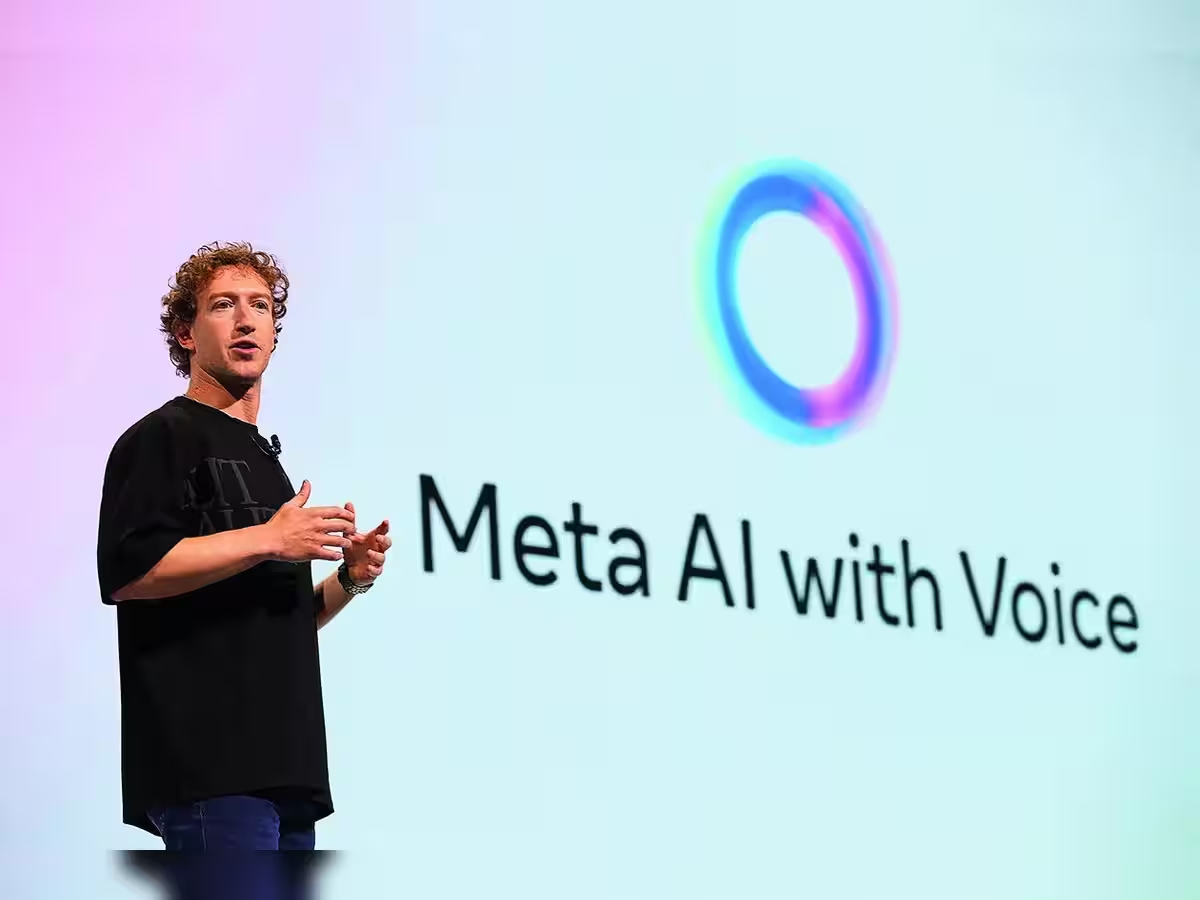
Meta has introduced a new AI model, with Zuckerberg advocating for an open-weight initiative
Meta Platforms CEO Mark Zuckerberg urged for reduced U.S. restrictions on open-source AI to enhance competition against Chinese counterparts, as the social media company unveiled a new open-weight model on Monday, with promises of more to come in the near future.
The new model, Muse Glimmer, is more compact than the leading AI models from competitors and is specifically designed to perform agentic tasks on a Mac or PC using a single graphics card, targeting the demand for AI systems that operate directly on users’ devices.
We have even larger models on the way,” Zuckerberg stated in a video post that accompanied his 14-page essay titled “The Future is for Everyone,” where he advocated for the widespread dissemination of AI instead of allowing it to be controlled by a select few. The idea that AI poses such a danger that the only secure route is through an extreme concentration of power appears fundamentally flawed.
Zuckerberg’s statement represents a recent endorsement for open-weight AI, which is increasingly being embraced as businesses become concerned about rising AI costs and recent cybersecurity issues related to models from Anthropic, OpenAI, and Meta.
Open-weight models are generally more affordable than the top models from companies such as OpenAI and Anthropic. They also include core components that are publicly accessible for straightforward customization, in contrast to closed models that companies maintain entirely under their control.
Those controls are receiving attention following the incident where Hugging Face, the AI coding collaboration, was compromised by a rogue OpenAI model. In response to the attack, they had to resort to utilizing a Chinese open-weight model, as closed-source models impose restrictions on cybersecurity applications.
Chinese startups are at the forefront of the competition for open-weight models, with Moonshot’s Kimi K3, Alibaba’s Qwen3.8-Max, and DeepSeek’s V4-Flash matching the performance of leading U.S. systems. In contrast, the top models from U.S. developers OpenAI, Anthropic, and Alphabet’s Google are proprietary.
Shares of Meta, which have declined approximately 10% this year, saw an increase of nearly 3% in premarket trading on Monday.
Reevaluating policies is essential to advance open-weight initiatives.
Meta is set to release the weights of Muse Spark 1.2, its most advanced model, developed by a dedicated superintelligence team established last year to regain its position in the AI race.
The company had consistently championed open models and was one of the few U.S. tech firms to release such models prior to the unfavorable reception of its Llama 4 last year, which necessitated a shift in strategy.
In a comprehensive AI essay released on Monday, Zuckerberg introduced a new $1 billion fund designed to alleviate concerns regarding the effects of its data center expansion by providing assistance to communities.
Growing local opposition to data centers has emerged as a pivotal election issue in the U.S. and represents a major obstacle for Big Tech’s efforts to establish the necessary infrastructure for AI development. “One notable disadvantage that the U.S. faces compared to countries like China is the increased difficulty in building infrastructure here,” Zuckerberg, whose company plans to invest up to $145 billion this year on AI infrastructure, stated.
Zuckerberg emphasized the necessity for the U.S. to reconsider its policies if domestic companies are to take the lead in open-weight models. This includes aspects related to data usage and distillation, which is a technique that uses the outputs of a strong AI system to train a smaller model that can perform similar tasks with much less computing power.
He stated that Meta would establish a governance framework to empower its independent directors to approve the safety standards for releasing models.
Foreign labs currently hold several advantages here since American labs have to comply with many additional restrictions on training data,” Zuckerberg said, referring to open-source models. “U.S. policy must reduce this additional friction if we want American open-source models to lead over time,” Zuckerberg said, adding that restricting access to foreign open-source models was not an effective solution.
Earlier this month, PresidTrump’smp’s administration informed AI developers that it will not subject open-weight AI models to voluntary safety tests, as reported by two sources familiar with the discussions.