Lebanon’s Aoun is set to meet with Trump at the White House, aiming to create pressure on Israel
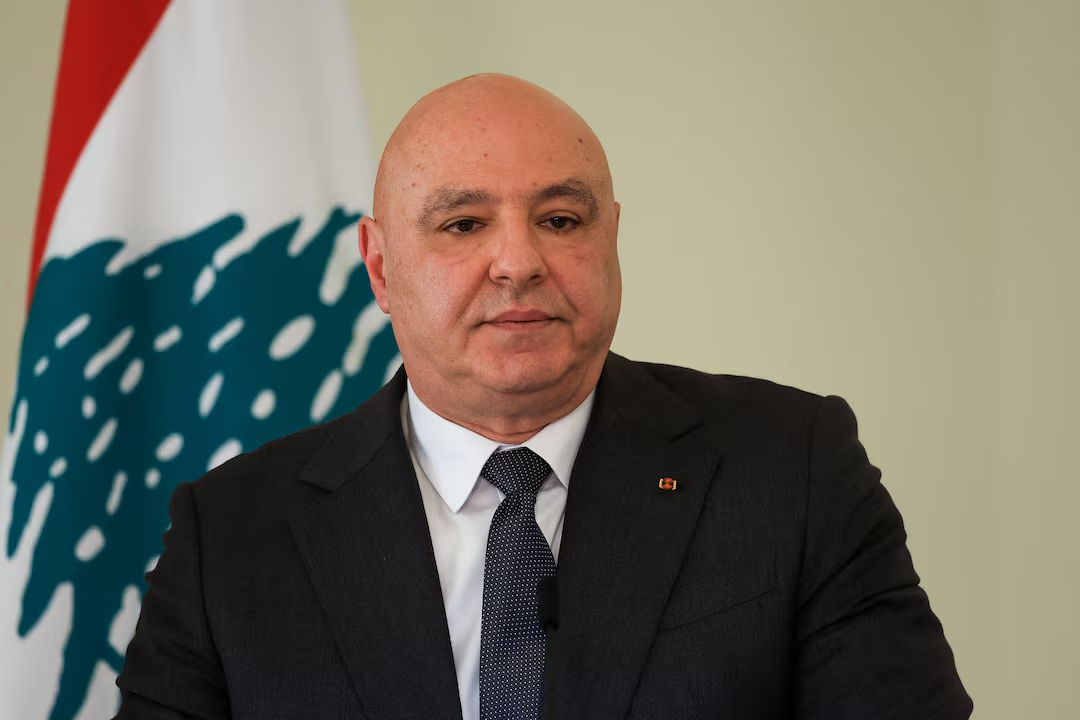
Lebanese President Joseph Aoun is set to visit the White House this week for his inaugural meeting with U.S. President Donald Trump, where he will present a strategy aimed at disarming the Iran-backed militant group Hezbollah and facilitating Israel’s withdrawal from Lebanon.
Aoun, who previously held the position of commander of Lebanon’s U.S.-backed army before his election as president last year, is the first Lebanese head of state in nearly two decades to visit the White House, where he will meet Trump in person for the first time.
Tuesday’s meeting arrives at a pivotal time for Lebanon: Israeli forces are occupying a significant portion of the southern region, hundreds of thousands of Lebanese are still displaced due to Israeli strikes, and Hezbollah has staunchly opposed the government’s direct negotiations with Israel, as well as attempts by the state to disarm it.
In remarks released by his office last week, Aoun stated that he would request Trump to “apply the necessary pressure on Israel” to enforce a U.S.-brokered agreement made on June 26 between Lebanon and Israel. That agreement seeks to neutralize Hezbollah, facilitate a gradual withdrawal of Israeli forces, and lay the groundwork for amicable relations between the two nations.
A Lebanese official stated that Aoun would provide Trump with a written proposal regarding the decommissioning of Hezbollah’s extensive arsenal. The official stated that Aoun believes that only Trump has the necessary leverage to pressure Israel into withdrawing its troops and assisting Lebanon in restoring its sovereignty.
SEEKING THE DISARMAMENT OF HEZBOLLAH
Aoun, 62, assumed the presidency last year, just prior to Trump commencing his second term in the White House. The U.S. expressed its approval of Aoun’s election.
Aoun is a Maronite Christian, in accordance with Lebanon’s sectarian power-sharing system that mandates the prime minister to be Sunni Muslim and the speaker of parliament to be Shi’ite Muslim. Aoun, a dedicated career soldier, has been wounded twice and still bears a shrapnel injury.
His ascent mirrored a significant change in the power dynamics in Lebanon, subsequent to a catastrophic Israeli assault on Hezbollah in 2024 and the removal of Hezbollah’s Syrian ally, President Bashar al-Assad—transformative occurrences that diminished the group’s influence and its previously unchallenged control over the state.
During his swearing-in ceremony, Aoun pledged to uphold “the state’s right to a monopoly on arms.
His presidency’s first year was characterized by a government effort to achieve the disarmament of Hezbollah, an organization established by Iran’s Revolutionary Guards in 1982 that has engaged in multiple conflicts with Israel.
Lebanese troops have been deployed in southern Lebanon to gather Hezbollah weapons caches, adhering to a ceasefire established after the 2024 war and facing no resistance from a diminished Hezbollah.
A fresh conflict ignites
However, early in the second year of his term, a new conflict broke out when Hezbollah launched an attack on Israel on March 2, in support of Iran, which was facing aggression from the U.S. and Israel.
Hezbollah’s attack prompted a vigorous Israeli air and ground offensive that has resulted in the deaths of over 4,300 individuals, as reported by Lebanon’s health ministry, including nearly 800 children, women, and medical personnel.
The toll makes no distinction between civilians and combatants. Hezbollah has yet to provide a toll for its fighters.
Following the onset of the war, Aoun promptly initiated direct discussions with Israel, a watershed moment for a nation that has faced repeated invasions by Israel since 1978. It resulted in the most significant in-person interactions in decades between the two nations.
It also positioned him as the target of intense criticism from Hezbollah and its supporters.
Aoun has taken a firm stance, condemning Hezbollah for starting the conflict and asserting that Iran’s interests are devastating Lebanon.
He has yet to agree to Trump’s request for a meeting with Israeli Prime Minister Benjamin Netanyahu.
A former member of the armed forces
Aoun was born in Sin al-Fil, a suburb located in eastern Beirut. His family originally comes from southern Lebanon. His initial military assignment was as a platoon commander in the army rangers in 1985, amidst Lebanon’s civil war that spanned from 1975 to 1990.
Shortly after his promotion to commander, he led a campaign to defeat Islamic State militants at the Syrian-Lebanese border.
He guided the army through the turmoil that ensued after Lebanon’s financial collapse in 2019, which ravaged the Lebanese currency following years of state corruption and poor governance.
At that moment, Aoun cautioned that the crisis would result in the downfall of the Lebanese army, “the backbone of the country.”
In a rare political statement for an army commander, he expressed criticism towards the ruling politicians regarding the collapse, highlighting that soldiers were experiencing hunger alongside the rest of the population and questioning the politicians, “What do you intend to do?
Aoun’s election concluded a two-year presidential void that followed the 2022 end of the term of Hezbollah ally Michel Aoun, who is not related to him.
He has committed to addressing long-overdue economic reforms and has promised justice for the victims of the Beirut port explosion that occurred in 2020.