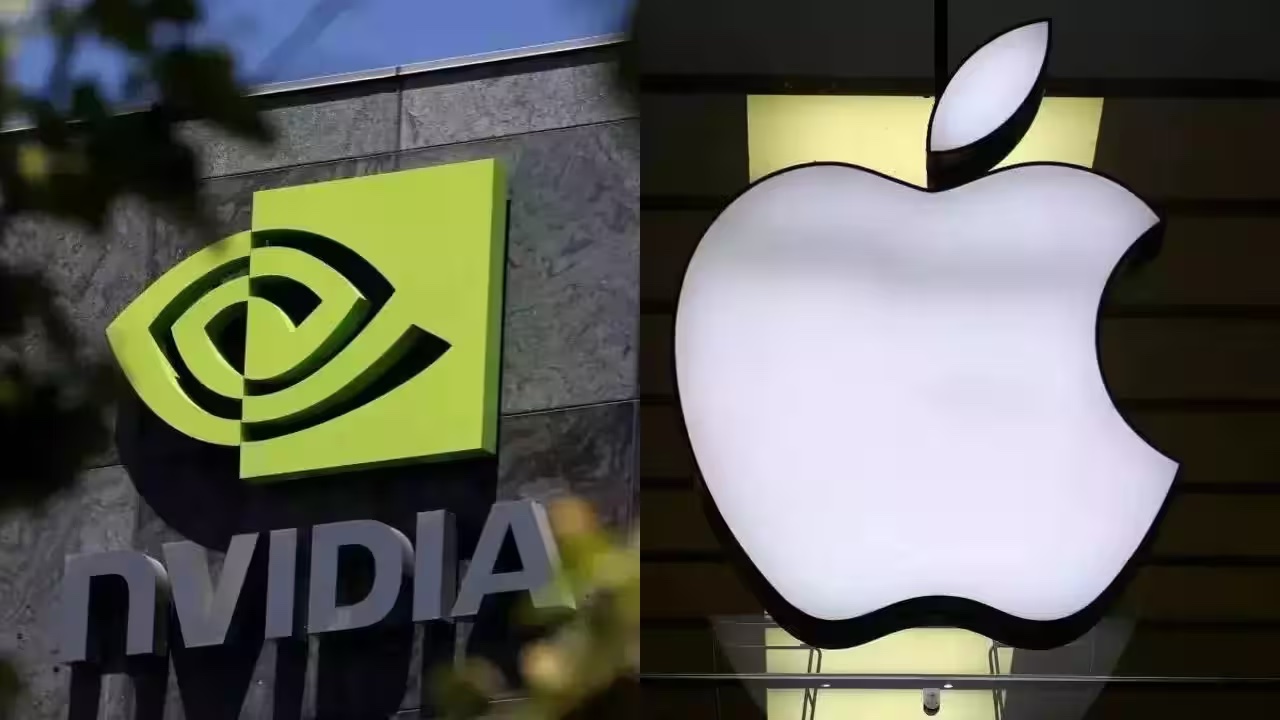
Apple has regained the title of the world’s most valuable company, surpassing Nvidia as investors expanded their confidence beyond AI chipmakers to focus on ecosystem-driven growth.
Apple has surpassed Nvidia to claim the title of the world’s most valuable publicly traded company, signifying a notable shift among the leading technology firms as investors expand their attention beyond the conventional beneficiaries of the artificial intelligence surge.
On Friday, Apple’s market capitalization was around $4.88 trillion, with its shares remaining mostly stable. In contrast, Nvidia’s valuation decreased to approximately $4.86 trillion after a 3.5 percent drop in its stock price.
The change concludes Nvidia’s nearly year-long dominance and signifies Apple’s resurgence to the number one spot for the first time since April of last year, highlighting a shift in investor sentiment regarding the generation of AI-related growth throughout the technology sector.
Analysts indicate that the recent market shift demonstrates increasing confidence in Apple’s capacity to capitalize on artificial intelligence within its ecosystem, rather than relying on substantial investments in AI infrastructure.
“Apple was previously viewed as a slow mover in the AI race due to its lack of investment in model development, but the perception has shifted,” stated Toni Meadows, Head of Investment at BRI Wealth Management.
She added, “Apple is less exposed to capex intensity and is better positioned to monetize AI through services, ecosystem lock-in, and hardware upgrades.” The re-rating indicates a belief in the sustainability of earnings rather than a speculative advantage from AI.
For a company that had long been considered lagging behind its competitors in the AI race, this milestone underscores Apple’s commitment to positioning itself as a more formidable force in artificial intelligence. It may also shape views on Tim Cook’s legacy as CEO as he approaches his departure in September. Cook is anticipated to transfer leadership to hardware chief John Ternus.
Last month, Apple introduced a highly anticipated revamp of its Siri voice assistant, framing the enhanced platform as a crucial element of its strategy to close the gap with significant tech competitors and rising AI startups.
Industry analysts suggest that Apple possesses a considerable edge due to the extensive personal data stored on iPhones, potentially enhancing Siri’s intelligence and ability to provide tailored responses. Nonetheless, realizing that potential poses a challenge, as the company has established its ecosystem with robust user privacy protections.
Even after losing the leading position, Nvidia continues to be one of the major beneficiaries of the AI spending surge. The chipmaker achieved a historic milestone in October by becoming the first company to exceed a $5 trillion market valuation, fueled by the increasing demand for its graphics processors that support a significant portion of today’s generative AI infrastructure.
Analysts warned that Friday’s ranking may not indicate a lasting change, pointing out that Nvidia could swiftly regain the leading position if investor sentiment enhances.
Benjamin Hall, Vice President of Alpha Research at Segal Marco Advisors, minimized the importance of the leadership transition.
I fail to observe any significant difference. Nvidia is expected to play a major role in whatever unfolds in the future,” he stated.
Hall also observed that investor interest is broadening beyond the so-called “Magnificent Seven” technology stocks, as AI spending generates opportunities throughout the semiconductor industry.
Memory chip manufacturers have become some of the most significant beneficiaries this year. Micron achieved a market valuation exceeding $1 trillion in May as investors acknowledged the rising significance of memory chips in AI infrastructure. Meanwhile, South Korea’s SK Hynix has garnered heightened investor interest following its recent Nasdaq listing.
“The new entrants to the market could shift the focus from the pure Magnificent Seven names to a broader range of names,” Hall added.
The broader semiconductor sector has seen heightened volatility in recent weeks. The Philadelphia Semiconductor Index has declined by nearly 19 percent from its peak as investors reevaluate the durability of the AI-driven rally, even though the index has outperformed Nvidia’s stock to date this year.