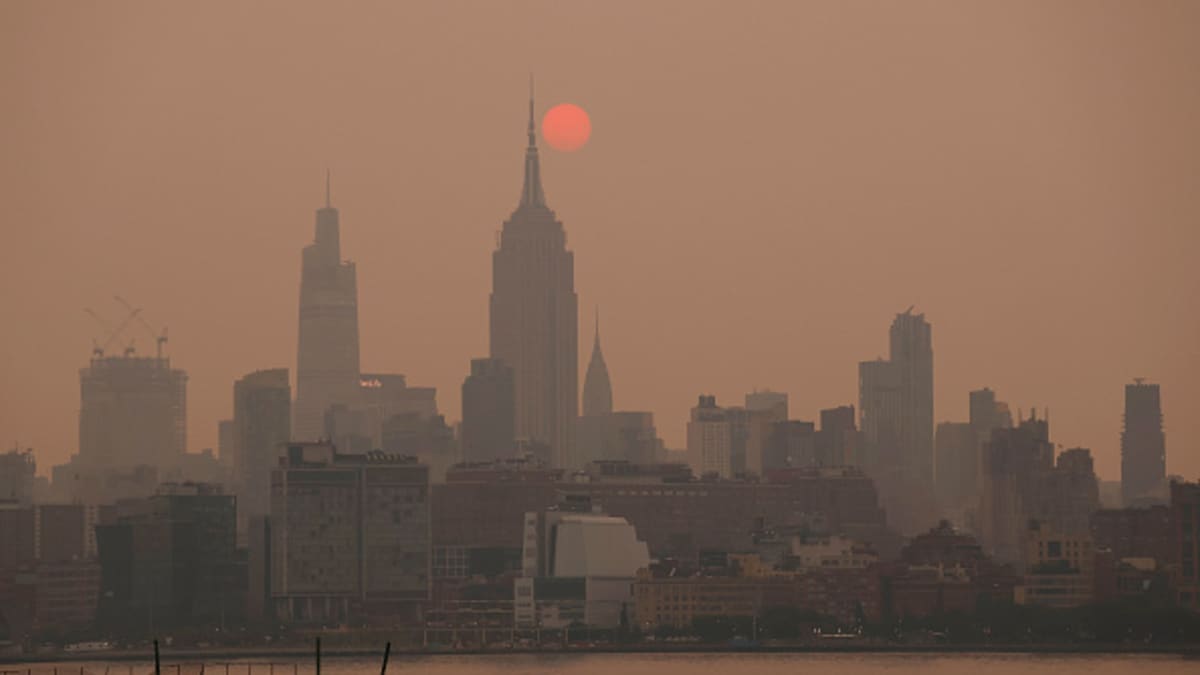
Wildfires in Canada waft dangerous smoke across US cities, causing cancellations, air quality alerts, and major public health issues across the US.
Hundreds of wildfires in Canada have caused smoke to migrate to regions of the United States, resulting in hazardous air quality advisories, event cancellations, and health concerns.
From Toronto and Detroit to New York and throughout New England, skylines were blanketed in a thick layer of smoke, and warnings about dangerous air quality were issued in several areas of the region.
Because of the health dangers associated with the smoke, officials shuttered beaches, canceled outdoor activities, including children’s summer camp events, and recommended locals to stay inside. The Black Keys’ Chicago performance was also rescheduled.
Thirty additional flames were recorded on Thursday, bringing the total number of wildfires in Canada to 858, according to the Canadian Wildland Fire Information System. Most of the fires remain uncontrolled.
One wildfire in northern Ontario caused the evacuation of surrounding First Nations communities. According to one chief, her town was “burnt to ashes.”
While lighter smoke higher in the stratosphere has traveled over the Great Lakes and into New York, creating hazy skies, the fires in northwest Ontario have thrown thick smoke into Thunder Bay and Toronto.
Several US cities, including Chicago, Grand Rapids, Pittsburgh, and Toledo, issued hazardous air quality alerts.
Governor Kathy Hochul of New York issued a warning to the populace of the worsening circumstances.
“We’re in a grave health situation right now,” she said, noting that heavy smoke was “blanketing” a large portion of the state and making it “very unhealthy to be outdoors” in many places.
She declared, “This is bad news for every New Yorker.” “There will be significant effects.”
On Thursday, conditions throughout the New York City metropolitan area were classified as “unhealthy,” while air quality in western New York reached the “very unhealthy” category. As smoke blanketed famous sites like the Statue of Liberty and the Empire State Building, many locals donned face masks.
The city extended its heat emergency preparations, triggered its air quality emergency protocols, and made hundreds of cooling centers and KN95 masks available.
Thunderstorms that are predicted to occur over Ontario in the next several days are unlikely to produce enough rain to considerably halt the fires, according to forecasters. There are worries that smog may reach New Jersey before Sunday’s World Cup final since northwesterly winds are predicted to carry smoke into northern US states over the weekend.
Detroit was named the most polluted large city in the world by air quality tracker IQAir on Thursday, followed by Minneapolis, Chicago, and Toronto.
After smoke hit Michigan for the third year in a row, four Republican congressmen wrote to Canadian Prime Minister Mark Carney, urging more effective wildfire control.
The lawmakers stated, “A year has gone by, the season has returned, and nothing has changed except that our patience has run out.”
In a statement on Wednesday, US Ambassador to Canada Pete Hoekstra commended both nations’ efforts to combat wildfires.
According to Laura Chasmer, a geography and environmental professor at the University of Western Ontario, climate change has increased the frequency of wildfires since 2015.
“This is linked to both the atmospheric drying of the surface and some of the extreme climate warming that we’ve been witnessing,” she stated.
According to Chasmer, significant flames have progressively moved eastward into Ontario, Quebec, and Atlantic Canada, affecting heavily populated places like Toronto and New York with smoke. Because it is “very difficult” to totally put out fires because of their magnitude and ferocity, she continued, Canada’s firefighting efforts are concentrated on keeping them from spreading to populations.
Carney responded to criticism from US politicians by stating that both the US and Canada must address climate change. His government is “in close communication” with the provinces and local communities, he continued.