Massive sorrow at Khamenei’s funeral underscores the firm hold of hardliners in post-war Iran
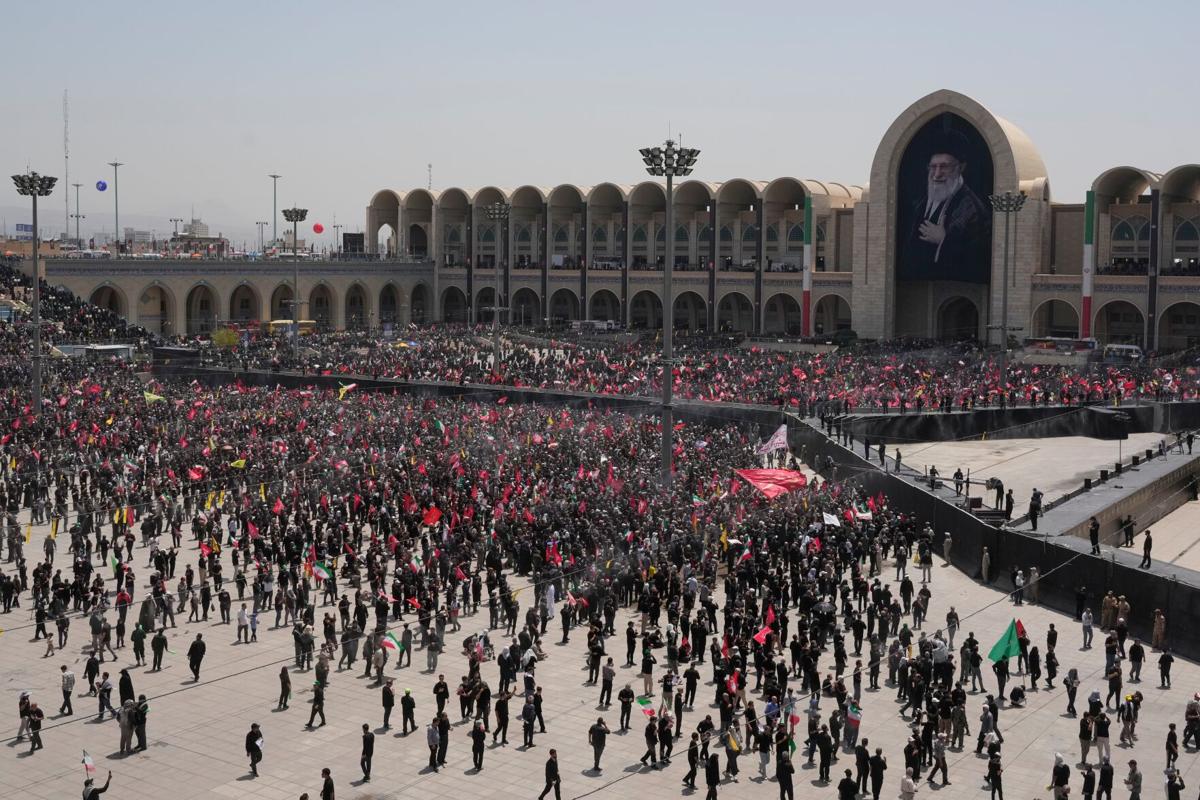
Tens of thousands of Iranians gathered at a large outdoor prayer complex in Tehran on Saturday to pay their respects to the coffins of Ayatollah Ali Khamenei, the supreme leader who was killed at the onset of the U.S.-Israeli war on Iran, along with his family.
Dressed in black and adorned with the red, white, and green flags of the Islamic Republic of Iran, mourners displayed portraits of Khamenei and his son and successor, Mojtaba.
In a demonstration of public loyalty to the Islamic Republic’s theocratic regime and revolutionary fervor, Iran is organizing a week of large-scale funeral processions for the supreme leader who was killed in February by the initial airstrikes of the conflict.
Following a day of lying in state indoors for senior Iranian leaders and foreign officials to pay their respects, Khamenei’s coffin was placed on display under glass outdoors, accompanied by the coffins of his daughter, son-in-law, daughter-in-law, and 14-month-old granddaughter.
There has yet to be any public sighting or image released of Mojtaba, the new leader, who is reported to have been injured in the attack that claimed his father’s life.
Mourners entered the expansive courtyard of the Imam Khomeini Grand Mosalla, striking their chests, lamenting, and brandishing the banners of the Islamic Republic. Women clad in black chadors donned white visors or carried umbrellas to protect themselves from the scorching mid-morning sun. “Let us wail!” a compere urged the crowds through a loudspeaker. Chants of “Death to America” resonated throughout the expansive prayer hall.
BLOOD FEUD
Everyone here has gathered to seek vengeance for the blood of our supreme leader,” Arash Rahimi, 40, expressed to Reuters amidst the crowd. Our leader has declared that we are embroiled in a blood feud with the United States. Our relationship with the United States will always be strained.
The funeral is occurring at a pivotal time for Iran, as its clerical leaders, supported by the military, are feeling strengthened after having endured the challenges while maintaining their governing structure.
The war has been halted for a ceasefire following an agreement with Washington, which the authorities claim will ultimately yield significant economic advantages, aligning with their portrayal of a triumph over a superpower.
Some among the mourners indicated a willingness to find common ground. “The United States … seeks specific objectives. We need to offer certain concessions; otherwise, they will resort to extreme measures against our officials,” said mourner Fattah Bayaz, 63, in an interview with Reuters.
Beyond the expressions of support for the leadership, it is still challenging to gauge the depth of public loyalty throughout a nation of 90 million individuals.
In the weeks leading up to the war, hundreds of thousands of Iranians took to the streets to protest against the government. The government responded brutally to these demonstrations, resulting in the deaths of thousands. However, there has been minimal or no visible indication of such dissent since the commencement of the U.S. and Israeli attacks.
During the war, over 3,000 individuals lost their lives, including numerous high-ranking politicians and military leaders from Iran. The devastation of military bases and significant infrastructure projects resulted in billions of dollars in damages.
Iran effectively targeted U.S. bases in the region, caused distress to the Gulf Arab nations hosting them, and reinforced its dominance over the Strait of Hormuz, leading to a surge in global energy prices that U.S. President Donald Trump claimed ultimately influenced his decision to pursue peace.
The interim deal reached last month involves the unfreezing of billions of dollars in assets held abroad, along with waivers from financial sanctions that had severely impacted Iran’s economy.
Shi’ite Martyrdom
In Iran’s theocratic system, Khamenei served as both the head of state and the leader of a revolutionary movement, acting as the earthly representative for Shi’ite Islam’s last imam, a revered figure who vanished in the ninth century.
His death in an enemy attack aligns with a longstanding tradition of martyrdom and ritual mourning, tracing back to the seventh century when the Prophet Mohammad’s grandson Hussein died in battle, a pivotal event that divided Islam into its Shi’ite and Sunni branches.
Burials in Islam are traditionally to be performed within a day of death; however, due to the risks associated with holding a large funeral during the war, it was delayed until after the interim truce agreement reached last month.
Khamenei’s coffin was revealed late on Thursday. On Friday, it was placed in state in the grand prayer hall constructed to honor his predecessor, Ayatollah Ruhollah Khomeini, where it will stay until Sunday evening.
Following what authorities are describing as a significant procession in central Tehran on Monday, the remains will be transported to the seminary city of Qom, the heart of Iran’s Shi’ite hierarchy, for ceremonies on Tuesday.
Following that, the body will be transported to Iraq for ceremonies in the two Shi’ite holy shrine cities of Najaf and Kerbala on Wednesday. The body will be buried near the tomb of a medieval Shi’ite imam in Mashhad on Thursday.
Authorities intend to mobilize millions of individuals for large processions in the upcoming days, providing transportation, food, and accommodation.