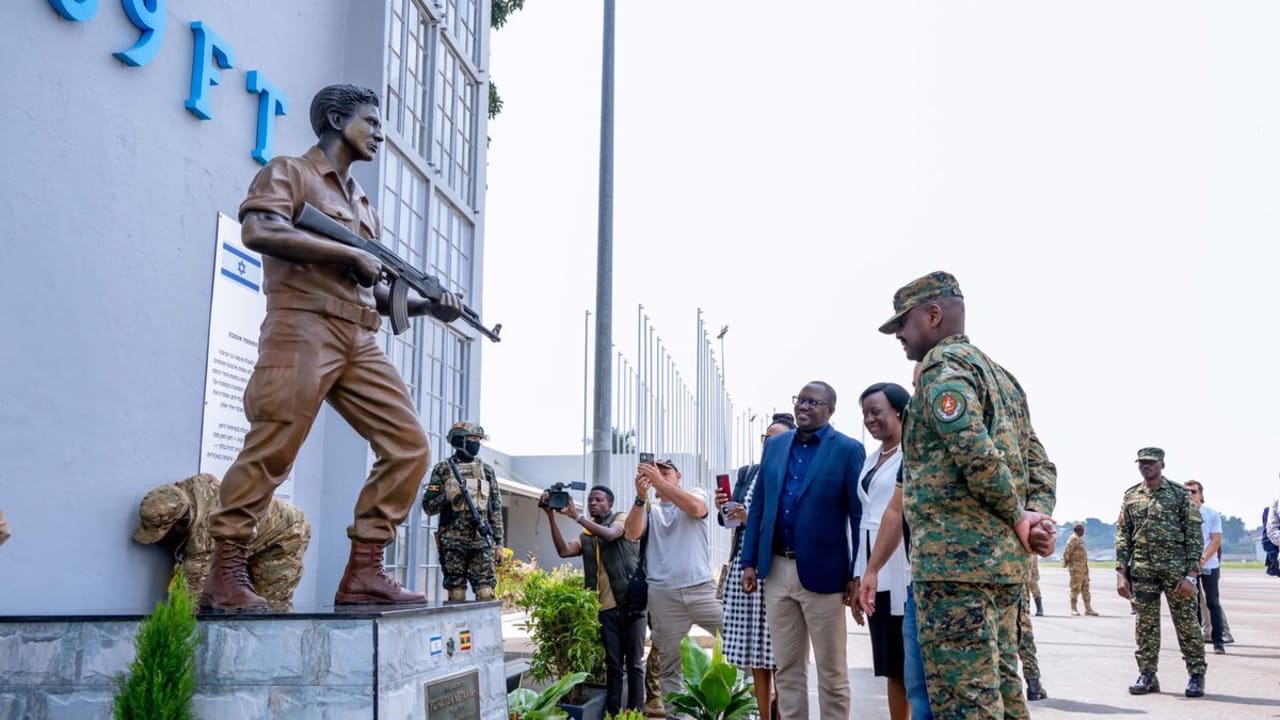
Uganda pays tribute to Yonatan Netanyahu, the Israeli commando who lost his life during the 1976 Entebbe raid, as both countries commemorate their strengthening relationship.
Uganda has revealed a statue honoring Yonatan Netanyahu, the Israeli commando who lost his life during the historic 1976 Entebbe rescue operation, portraying him as a symbol of bravery and sacrifice.
The monument, revealed outside the historic terminal of Entebbe International Airport where the rescue operation occurred 50 years ago, features Netanyahu advancing with a machine gun in his hands.
Uganda’s army chief, General Muhoozi Kainerugaba, stated that the statue was established to honor Netanyahu’s courage and dedicated service during one of the most important counter-terrorism operations in contemporary history.
He characterized the Entebbe raid as a pivotal event that influenced the relationship between Uganda and Israel, noting that the two nations have since forged a partnership grounded in mutual trust, respect, and cooperation.
Netanyahu was the sole Israeli soldier who lost his life during the operation that successfully rescued over 100 hostages after an Air France flight was hijacked by two Palestinian and two German militants and redirected to Uganda.
“May their memories continue to inspire future generations in the pursuit of peace, justice, and human dignity,” Kainerugaba stated.
Three hostages, Jean-Jacques Mimouni, Pasco Cohen, and Ida Borochovitch, lost their lives during the raid. Additionally, another hostage, Dora Bloch, was later killed at a hospital in Kampala, where she had been receiving treatment.
The hijackers and three accomplices who joined them in Uganda were killed during the operation, while at least 45 Ugandan soldiers also lost their lives in clashes with Israeli forces.
Acknowledging the loss of Ugandan troops, Kainerugaba stated that they had “fought valiantly” for what they believed was a justified cause. However, he also noted that the government of former Ugandan leader Idi Amin, which they served, was a brutal dictatorship that did not represent the Ugandan people.
The Entebbe operation commenced following the hijacking of an Air France Airbus A300 en route from Tel Aviv to Paris on 27 June 1976. The hijackers boarded the aircraft during its stop in Athens, then forced it to fly to Libya for refueling before diverting it to Uganda.
The militants requested $5 million and the liberation of 53 prisoners detained in Israel, France, Germany, Switzerland, and Kenya in return for the hostages.
On 30 June and 1 July, several hostages were released, yet Israeli and Jewish passengers continued to be held in captivity.
On July 3, 1976, Israeli commandos executed a landing at Entebbe after traversing through Kenya, initiating a rescue operation that concluded in under 90 minutes.
Israel celebrated the mission, but it significantly tarnished the reputation of Idi Amin’s government, which had backed the hijackers.
Israeli Prime Minister Benjamin Netanyahu, the younger brother of Yonatan, visited Entebbe in 2016 to commemorate the 40th anniversary of the raid. He remarked that he learned from his brother that overcoming terrorism necessitated “clarity and courage.”
Kainerugaba characterized the events of 50 years ago as a painful chapter in Uganda’s history, yet he noted that the relationship between Uganda and Israel has transformed into a close partnership.