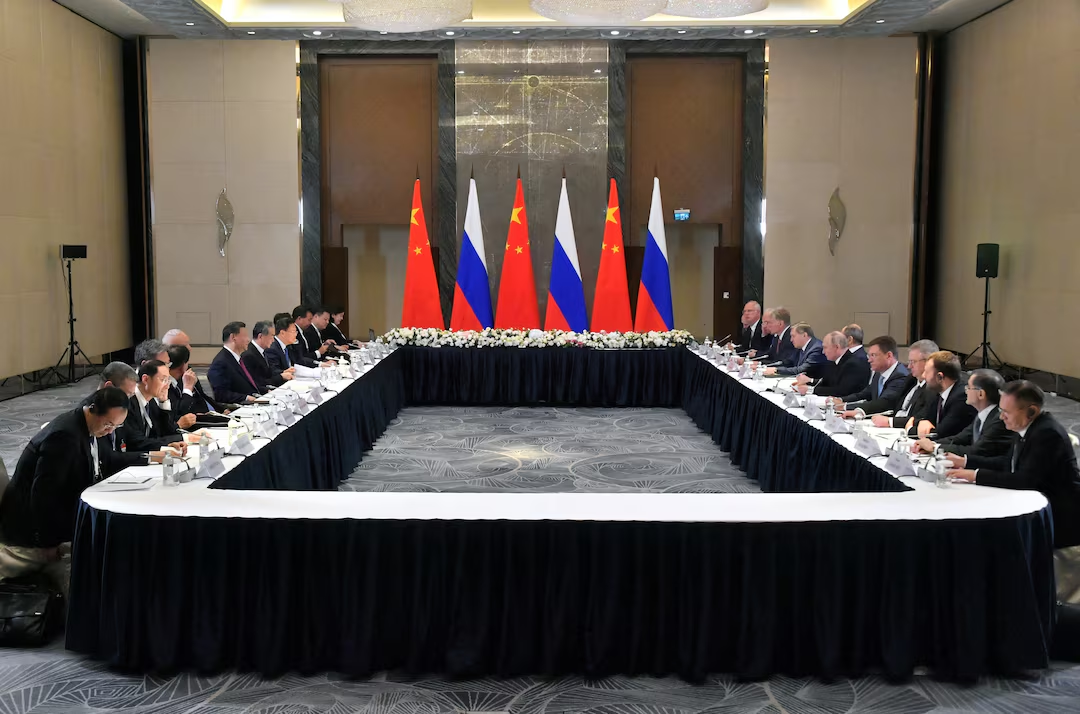
Reuters has learned that Russia quietly agreed to troops getting high-level military training from China. This shows that Moscow and Beijing are working together more on defense issues.
European officials and papers seen by Reuters indicate that Russia permitted high-level Chinese military training for its troops last year. The program was approved at the highest levels of government and included senior commanders from both countries.
Russian President Vladimir Putin’s administration reportedly approved the secretive work through Defense Minister Andrei Belousov. This shows that Moscow and Beijing are becoming more strategic partners, even though China says it will stay neutral in the Ukraine war.
The papers say that in August 2025, Belousov signed an internal order that let a group of Russian soldiers go to China to get specialized training at facilities run by the People’s Liberation Army (PLA).
One of the programs, which took place in Beijing over three weeks in November, was all about RCB (radiological, chemical, and biological) defense. Russian workers were taught how to find radiation, look for chemicals, stop pollution, and protect important infrastructure, such as ventilation systems.
Reuters looked at photos that allegedly show Russian troops going to classes taught by Chinese teachers, looking at a model nuclear reactor, and participating in real-life drills on nuclear, biological, and chemical defense.
European officials told Reuters that the fact that advanced RCB defense training was included showed how strategically important the exchanges were to both governments, especially since these skills are relevant to the war in Ukraine.
The defense ministries of both Russia and China did not answer to requests for comment.
China’s Foreign Ministry denied the claims, stating they were “entirely unfounded.” They also said that Beijing’s stance on the conflict in Ukraine has not changed. Authorities in China keep saying that their country is neutral and wants the war to end peacefully.
The new information comes after a report from Reuters, citing European intelligence reports that around 200 Russian soldiers trained in China in November, and some of them later went to fight in Ukraine.
The Kremlin wouldn’t say anything directly about that story because they said Western media was spreading false information.
The European Union has also confirmed the reported military cooperation. EU foreign policy chief Kaja Kallas said that Brussels had independently confirmed that the training took place and was now looking into what it meant. Beijing denied these claims, calling them false charges.
European countries are getting more and more worried about Russia and China’s growing military ties, especially since Russia is still at war in Ukraine. The EU has already put bans on several Chinese companies that they say are helping Russia’s military, but officials are still deciding if more needs to be done.
The papers say that on July 2, Russian Major General Rustam Khusainov and Chinese Senior Colonel Sun Dayun signed a deal that set up the training program.
The head of Russia’s lower house of parliament’s defense committee, Andrei Kartapolov, called the Reuters story “complete nonsense” and said that Russia’s armed forces had nothing to learn from China after years of fighting in Ukraine.
Even so, Russian military reports praised the quality of Chinese military equipment, simulators, and instructors. They also said that the PLA doesn’t have as much recent battlefield experience as Russian troops.
The documents named several high-ranking officers. They included Colonel General Rustam Muradov, who is deputy commander-in-chief of Russia’s land forces, Chinese Major General Li Jinsun from the PLA’s Military Academy of Radiological, Chemical, and Biological Defense, and Russian Major General Vitaly Gerasimov, who went to a separate course in Bengbu.