Vance and Rubio express contrasting views on Iran and Israel
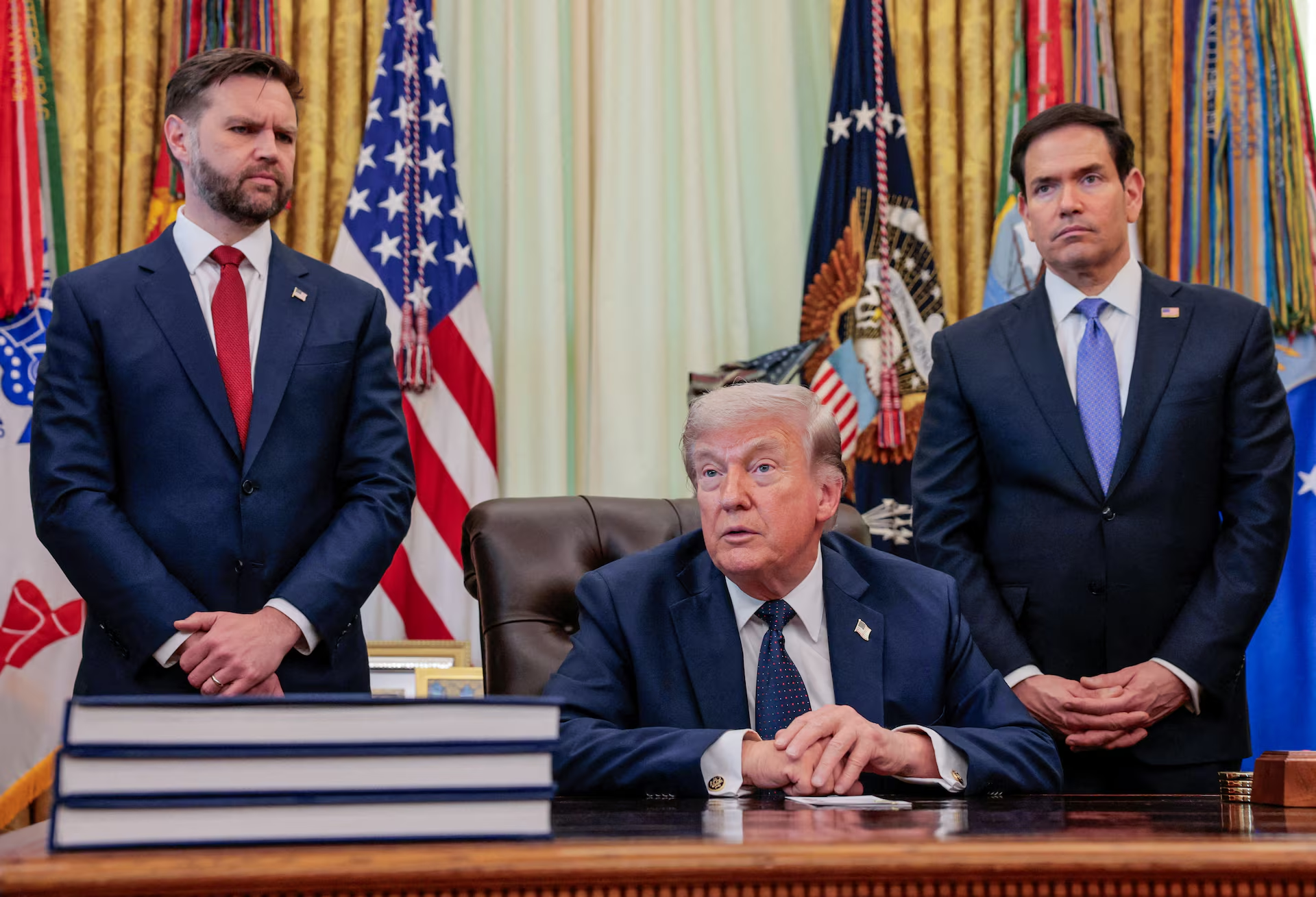
President Donald Trump has made significant efforts to showcase a cohesive stance on the Iran war; however, remarks from his vice president and secretary of state have occasionally differed in the past week, particularly regarding Israel.
Vice President JD Vance, addressing the audience at the White House last week, expressed strong disapproval towards Israeli critics of the preliminary U.S.-Iran deal. He proposed that the Israeli bombings of civilian infrastructure in Beirut, aimed at weakening Hezbollah, which has been launching attacks on Israel, were detrimental to U.S.-led peace initiatives.
Secretary of State Marco Rubio, who journeyed through the Gulf this week, defended Israel’s military campaign in Lebanon, consistently characterizing its actions as a warranted response to Hezbollah attacks. In response to Vance’s criticism, Rubio sidestepped the issue and instead recounted an attack by the Lebanon-based militia on an Israeli checkpoint that had occurred earlier in the week.
The contrast indicates that, despite the administration’s focus on unity, varying perspectives occasionally emerge—presenting a challenge for a White House whose political coalition is significantly split on foreign policy issues. It also provides an early glimpse into the future of the Republican Party, with Rubio and Vance both regarded as potential contenders for the 2028 presidential race.
In the past week, both Vance and Rubio were sent on significant trips abroad to advocate for the preliminary peace accord signed between Washington and Tehran on June 17.
Vance journeyed to Switzerland for discussions with Iranian officials. Speaking to reporters on Sunday, he conveyed a distinctly hopeful perspective regarding the status of discussions with Iran. He has also stated multiple times recently that Gulf states might finance Iran’s reconstruction.
He has often discussed the potential for a new, more collaborative relationship between Iran and the U.S., disclosing in an interview released on Thursday that the U.S. had invited an Iranian intelligence official to act as a deconfliction liaison with the Pentagon in Qatar.
Rubio, in the meantime, traveled to the United Arab Emirates, Kuwait, and Bahrain to provide reassurance to allies—some of whom worry that the interim U.S.-Iran agreement is overly favorable to Tehran—that their interests will be safeguarded.
On Tuesday, Rubio stated that he would not request Gulf allies to finance Iran’s reconstruction during his trip, noting that such a possibility was “far down the road. During a meeting with regional officials on Thursday, he stressed that any agreement must be solid in terms of U.S. interests and those of its allies.
While we seek an agreement, we are not willing to accept just any terms,” he stated. ‘UNIFIED SUPPORT FOR PRESIDENT TRUMP’
The White House firmly rejected any notion of disagreement between the two officials. “There is one camp—President Trump’s camp—and the entire administration is fully behind the President’s efforts to ensure Iran can never possess a nuclear weapon,” stated White House spokeswoman Anna Kelly.
State Department spokesman Tommy Pigott dismissed the notion of any foreign policy rifts between Rubio and Vance as a “tired and fake” narrative, asserting, “The entire administration is 100% in lockstep behind President Trump.
A separate spokesperson from the State Department further asserted that there was no disagreement between the two officials regarding Lebanon, emphasizing that the administration’s objective was to restore the sovereignty of the Lebanese government over its entire territory.
Some analysts and commentators remain skeptical.
Michael Rubin, a senior fellow at the American Enterprise Institute think tank, noted that Rubio and Vance expressed distinctly different perspectives. At their core, they embody distinct variations,” he stated.
The two officials hail from vastly different foreign policy backgrounds. Prior to assuming office last year, Vance often condemned foreign wars as a squandering of lives and resources. Rubio established his reputation as a “hawk” in the Senate, advocating for a more aggressive approach towards Iran, Russia, and Cuba.
Both individuals are regarded as possible successors to Trump and emerge from influential, rival factions within the Republican Party.
On one side are “neoconservatives,” whose supporters are more inclined to promote foreign intervention. On the other hand, there are Republican voters and policy professionals who contend that numerous recent foreign wars have been both costly and reckless.
According to a Reuters/Ipsos poll that closed Monday, only 52% of Republicans believe the current conflict has positioned the U.S. more strongly, indicating a division within the party between differing viewpoints.
Both Rubio and Vance have consistently backed all of Trump’s significant foreign policy choices, including his efforts to capture Venezuelan leader Nicolas Maduro, his military action against Iran in February, and his later commitment to pursue peace. Both have recently employed comparable talking points, stating that they will assess Tehran’s actions rather than its words as negotiations progress.
When a reporter inquired on Thursday about how his views on Iran contrasted with those of Vance, Rubio stated that they both followed Trump’s lead.
Everyone here supports the president,” he stated.