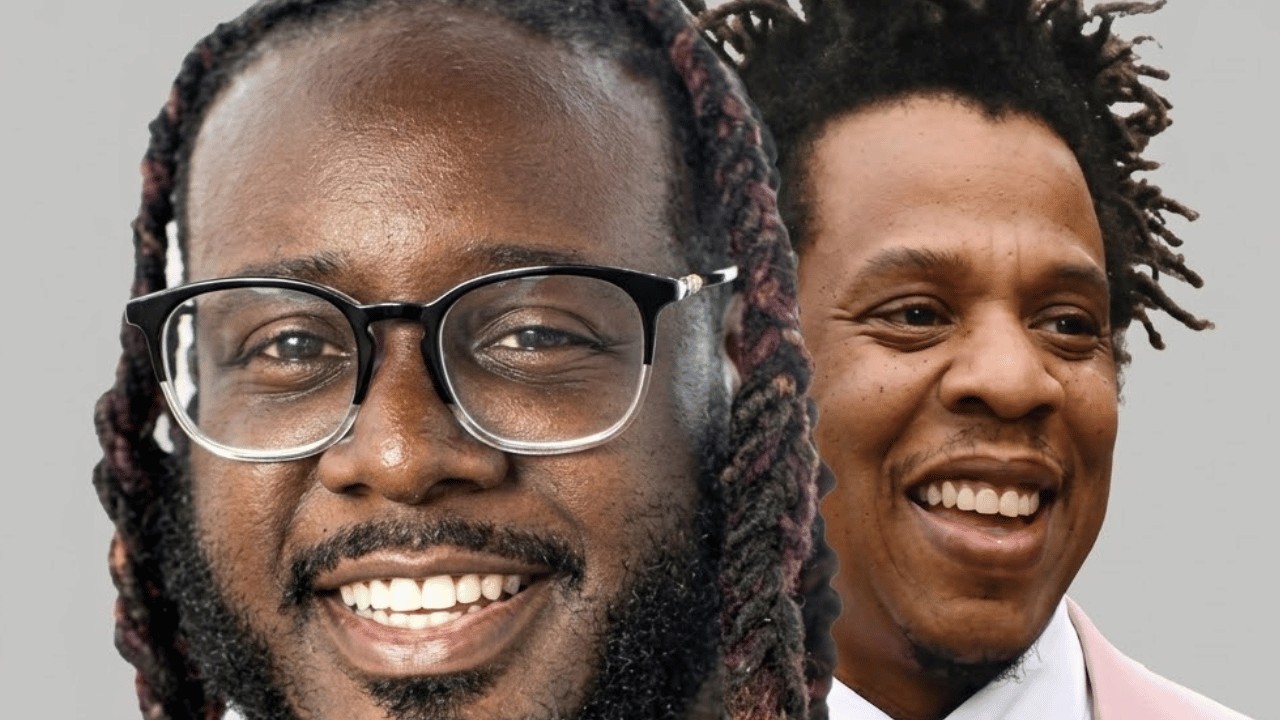
T-Pain reflects on one of the most discussed moments in hip-hop history with a more profound understanding. In his recent appearance on “ExpediTIously with Tip “T.I.” Harris,” the Tallahassee hitmaker shared his thoughts on becoming synonymous with Auto-Tune, the criticism that ensued, and the impact of Jay-Z’s 2009 single “D.O.A. (Death of Auto-Tune)” during that period. T-Pain expressed that the criticism was disappointing, as he has always been, and continues to be, a fan of Jay-Z.
“I’m a Jay-Z fan still to this day,” T-Pain expressed, noting that one of his favorite Hov tracks was “Can’t Knock the Hustle.” He encapsulated the reason for the sting of the moment: “And getting my hustle knocked wasn’t on my bingo card.”
During the interview, he acknowledged that hearing “D.O.A.” was “devastating” but noted that maturity allowed him to perceive it in a different light. “It wasn’t a directive to harm T-Pain,” he clarified. “It was as if someone said, ‘Hey, everyone.” I remain the same person I have always been. I’m still Jay-Z. Don’t get too caught up with that stuff over there. “It’s not going to last very long.”
The history dates back to 2009, when Jay-Z released “D.O.A.” during a time when hip-hop was engaged in a debate over whether Auto-Tune had transitioned from a creative tool to an overused gimmick. On the record, Hov rapped, “You n***as singin’ too much/Get back to rap, you T-Paining too much,” a line that brought T-Pain’s name to the forefront of the discussion. At that time, Pitchfork reported that Jay debuted the track on Funkmaster Flex’s Hot 97 show and subsequently performed it at Summer Jam, where T-Pain made a surprising appearance onstage with him.
Jay-Z later denied that the song was meant to directly attack T-Pain. In a 2009 interview with Hot 97, Hov remarked, “The guys who did it did it great.” T-Pain creates exceptional melodies. He also mentioned Kanye West and Lil Wayne as artists who effectively utilized the sound, stating, “Everybody can’t do it.” Let those guys handle it. They found their small space; let’s proceed.
That explanation did not diminish the impact. During a 2021 interview on “Drink Champs,” T-Pain expressed that he felt personally affected because he was regarded as “the face of Auto-Tune.” As he expressed it, “Whenever someone mentions Auto-Tune, I’m the one they think of.” When you claim that Auto-Tune is wack, I represent that sentiment.
The greater irony is that Auto-Tune did not originate with T-Pain. Berklee observes that Antares introduced the technology in 1997 as pitch-correction software, and Cher’s 1998 hit “Believe” played a significant role in transforming the robotic effect into a defining characteristic of pop music. However, T-Pain transformed Auto-Tune into a new era by using it as an instrument rather than as a means of concealment. ABC News later noted that he was not the first to utilize Auto-Tune, yet he transformed it into a fresh musical language within mid-2000s hip-hop and R&B.
The criticism lingered around him for years. The New Yorker noted in 2014 that Auto-Tune transformed into “something else in T-Pain’s hands,” while also highlighting how the criticism ultimately reduced him to a punchline. In 2022, T-Pain took to the stage at Wiscansin Fest to deliver an unreleased response to “D.O.A.” after years of reflecting on the moment.
Now, T-Pain conveys a sense of reflection rather than bitterness. Jay-Z may have proclaimed the “death” of Auto-Tune, yet the sound has persisted. It evolved, spread, and became integral to modern music’s essence—with T-Pain remaining a key figure in its development.