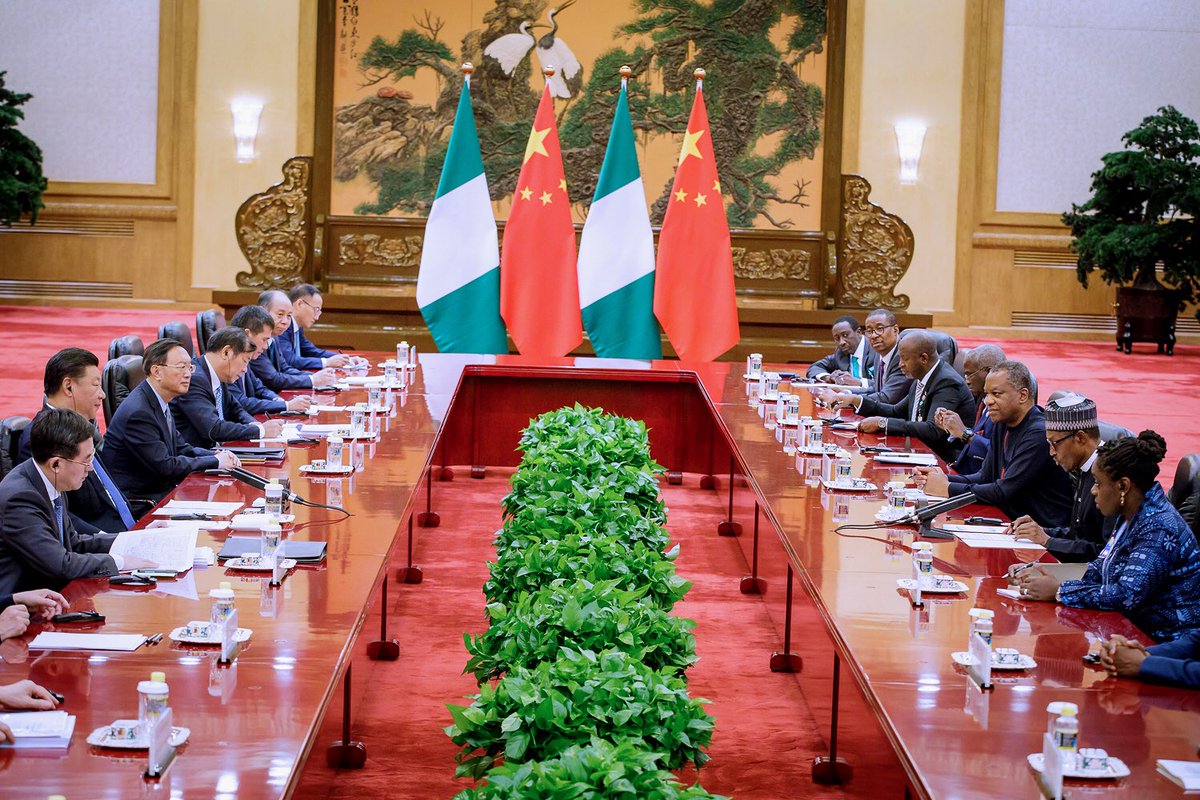
Nigeria has hosted a Chinese group to finalize plans for low-carbon energy projects.
A powerful Chinese delegation has arrived to finalize areas of cooperation, which has boosted the Federal Government’s green industrialization goal.
The Chinese delegation is headed by Wang Zuguang, Deputy Division Chief, Foreign Environmental Cooperation Center, Ministry of Ecology and Environment. He is in the nation to discuss with interested parties the procedures for starting a planned renewable energy project between China and Nigeria.
A primary concern of the delegation that visited the Environment, Science, and Technology Ministries is the seamless functioning of the Lekki Low-Carbon Demonstration Zone Initiative, which is the nation’s pilot project.
Speaking about the visit, Michael Ivenso, Director of Energy, Transportation, and Infrastructure at the National Council on Climate Change, stated that it was the result of an MOU signed between the Nigerian and Chinese governments, specifically the Federal Ministry of Environment and the Chinese Ministry of Environment, to strengthen South-South cooperation under the China-Africa.
In order to support industrial growth, he pointed out that China is helping Nigeria and other African nations adopt renewable energy and other sustainability-related projects. He added: “The MOU was signed in Baku during COP29, and the Chinese delegation is currently here to visit with the Honourable Minister of Environment to brief him on the project’s progress and what their wider ambition is in line with Nigeria’s own development ambitions.”
“You know, Mr. President has clearly stated his plan for green industrialization, and this is part of what the ministry is doing to support Mr. President’s agenda for Nigeria. In other words, our main goal is to help Nigeria move from a petroleum-based state to a much more sustainably linked and connected nation.
He disclosed that both nations have established a technical team that is presently collaborating to create what appears to be the project’s design since the MOU was signed in Baku. He stated: “The Lekki Free Trade Zone in Lagos has been selected as the pilot site to develop a replicable model that can be expanded to other industrial clusters and trade zones in the nation.”
It’s not a one-size-fits-all strategy, therefore the idea is that the lessons learnt from Lekki will now be applied. Indeed, we are aware of China’s considerable advancements in this field, but what suits them might not suit us. The strategy will be appropriate for its intended use, taking into account Nigeria’s unique needs and demands.
The study, which is part of the reason they are here, is really to scope out what is accessible, what are our policy initiatives, and what is really driving our objectives as a nation, Ivenso stated. Therefore, that project is already underway. Several meetings have taken place.
A group of Nigerian participants from the National Council on Climate Change and the Ministry of Environment had previously visited China as part of FOCAC to engage with our colleagues and truly see how we might make this a reality. It is now their turn to accompany us on a site inspection. Therefore, we will travel to Lagos from Abuja.
“To discuss how to further this, we’re visiting the Lagos State Government and the Lekki Free Trade Zone management.”
Ivenso said why the Ministry of Science and Technology is one of the locations the Chinese delegation would visit: “The Abuja Industrial Zone that they are piloting is the reason why that collaboration with Science and Technology is important.” It’s one of those instances where we can demonstrate to our Chinese counterparts that Nigeria takes this seriously, isn’t it? Furthermore, it isn’t Lagos. This type of intervention is perfectly suited to be implemented in other regions of the nation.
The paradigm that we established in Lekki will thereby be duplicated throughout the nation’s other industrial sectors.
The delegation includes representatives from China’s Ministry of Environment as well as academics from research and development departments at universities.