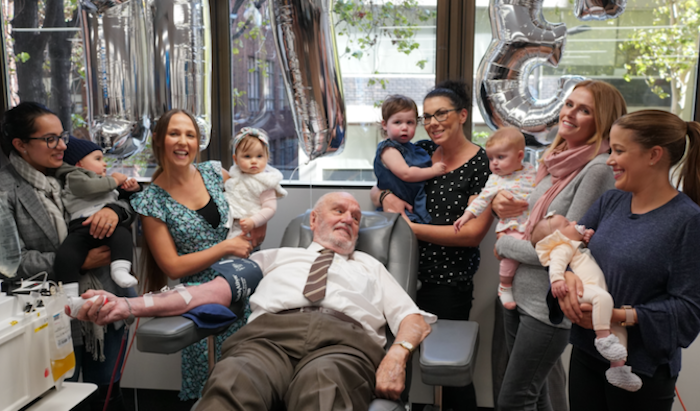
In February, James Harrison, an Australian blood donor who rescued millions of newborns with his plasma, died at the age of 88.
More than two million newborns were spared by the plasma of one of the most common blood donors in the world.
James Harrison’s family announced on Monday that he passed away in his sleep on February 17 in a nursing home in New South Wales, Australia. He was eighty-eight.
Harrison’s blood contains a unique antibody called Anti-D, which is used to create medication for pregnant women whose blood is at risk of attacking their unborn kids. Harrison is known in Australia as the “man with the golden arm.”
Harrison was honored by the Australian Red Cross Blood Service, which stated that he had promised to donate after receiving transfusions during a major chest operation when he was 14.
At the age of 18, he began giving his blood plasma, and until he was 81, he did it every two weeks.
He held the world record for the most blood plasma donations in 2005 until 2022, when a guy from the US surpassed him.
Harrison was “very proud to have saved so many lives, without any cost or pain,” according to her daughter Tracey Mellowship.
According to her, “he always said it doesn’t hurt and the life you save could be your own.”
Mellowship has also received anti-D vaccinations, as have two of Harrison’s grandsons.
She remarked, “James was pleased to learn that there were numerous families just like ours, thanks to his generosity.”
Anti-D vaccinations shield fetuses from hemolytic disease of the fetus and newborn, or HDFN, a fatal blood condition.
When the mother’s red blood cells are incompatible with the developing baby’s, the disease develops during pregnancy.
The mother’s immune system subsequently creates antibodies to combat the baby’s blood cells because it perceives them as a threat. The infant may suffer from severe anemia, heart failure, or even death as a result of this.
One in two infants with HDFN perished prior to the development of anti-D treatments in the middle of the 1960s.
Harrison’s blood’s high anti-D content is unknown, although some reports claim it was caused by the huge blood transfusion he underwent when he was 14.
The Australian Red Cross Blood Service, better known as Lifeblood, estimates that 45,000 women and their infants benefit annually from the less than 200 anti-D donors in Australia.
Lifeblood has been collaborating with the Walter and Eliza Hall Institute of Medical Research in Australia to replicate Harrison’s and other donors’ blood and immune cells in order to produce anti-D antibodies in the lab.
Lab-made anti-D may one day be used to aid pregnant women around the world, according to the researchers involved.
“Developing a novel treatment has always been a “holy grail,” according to David Irving, director of research at Lifeblood.
He pointed out that there aren’t many typical donors who can generate enough high-quality and high-quantity antibodies.