Algeria proclaims President Tebboune the victor of the election with 95% of the vote
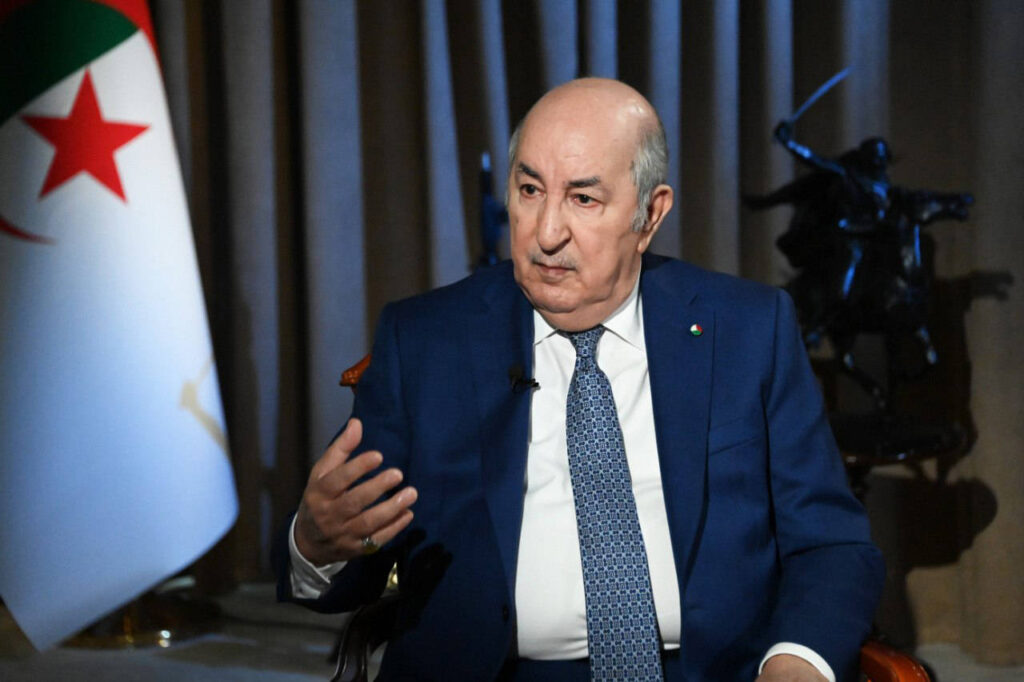
President Abdulmadjid Tebboune was proclaimed the clear winner of the election held on Saturday by Algerian authorities on Sunday. However, a rival candidate accused the authorities of irregularities in the count, and fewer than half of the registered voters cast ballots.
According to the official preliminary results, Tebboune received 95% of the vote, which was sufficient to prevent a second-round run-off. Abdelaali Hassani Cherif received 3% and Youcef Aouchiche received 2%. There was a 48 percent turnout.
Tebboune, who was supported by the military, encountered only nominal opposition from Hassani Cherif, a moderate Islamist, and Aouchiche, a moderate secularist. Both candidates were granted the endorsement of Algeria’s influential establishment.
The Hassani Cherif campaign claimed that polling station officials were under pressure to embellish results and that they had failed to deliver vote-sorting records to candidates’ representatives. Additionally, they alleged that proxy group voting had occurred.
“This is a farce,” declared Ahmed Sadok, Hassani Cherif’s spokesperson. He also stated that the candidate had received a significantly greater number of ballots than had been indicated, citing the campaign’s own regional tallies. It was not possible for Reuters to immediately verify those tallies or contact Tebboune’s or Aouchiche’s campaign for comment.
In his announcement of the results, the president of the electoral commission, Mohammed Charfi, stated that the organization had made every effort to guarantee fair competition and transparency for all candidates.
Algeria is expected to maintain its current governing program, which has resumed lavish social spending as a result of increased energy revenues since Tebboune’s re-election in 2019. This follows a period of reduced oil prices that followed his inauguration in 2019.
Unemployment benefits, pensions, and public housing programs have been promised to be increased, all of which were increased during his first term as president.
“As long as Tebboune continues to increase wages and pensions and preserve subsidies, he will be the most effective in my opinion,” stated Ali, a café patron in the Ouled Fayet district of Algiers, who requested that his family name not be disclosed.
First elected during the mass “hirak” (movement) protests that forced his veteran predecessor Abdulaziz Bouteflika from office after 20 years, Tebboune has supported a tough approach from the security forces, which have jailed prominent dissidents.
He was elected in 2019, which was indicative of the anti-establishment sentiment in Algeria at the time. The turnout was a mere 40 percent, a significant decrease from previous elections.
Ultimately, the Covid pandemic was responsible for the cessation of the protests, which had been ongoing for over a year and had attracted hundreds of thousands of individuals to the streets to demand the removal of the governing elite and an end to corruption.
“The rate of participation is exceedingly low.” Another Ouled Fayet resident, Slimane, 24, who also declined to disclose his family name, stated, “It demonstrates that the vast majority of individuals are similar to me.” “He did not vote because he has no confidence in politicians,” he stated.
Unemployment benefits
After years of depleting foreign exchange reserves, the 2022 Russian invasion of Ukraine increased European demand for Algerian gas and re-inflated energy prices, resulting in an increase in Algerian state revenue and the development of new hydrocarbons projects.
Although the majority of the funds are allocated to social assistance, Tebboune’s administration has also implemented economic reforms that are designed to fortify the private sector and generate employment opportunities.
Inflation is also high, and unemployment has decreased from its highs of approximately 14 percent during the pandemic. However, it remained above 12 percent last year.
Economic challenges encountered by ordinary Algerians may have contributed to the low turnout on Saturday.
Political analyst Farid Ferrari stated, “The disparity between rulers and the populace remains to be bridged, as evidenced by the 48 percent turnout in contrast to the 40 percent in 2019.”
Foreign policy is an area in which Tebboune’s reputation is inconsistent.
In spite of Algeria’s significant position as a gas provider in Europe, Morocco, its arch regional rival, has successfully convinced Spain and France to recognize its sovereignty over Western Sahara. In this region, Algiers supports the Polisario separatists. Some African and Arab states have also been won over by Morocco.
Concurrently, Algeria’s efforts to gain membership in the Brics group were unsuccessful when it expanded in January. The bloc instead extended an invitation to Egypt, Ethiopia, Iran, and the United Arab Emirates to join. Instead, Algeria became a member of the Brics development bank last month.
In addition, its endeavors to promote stability in the Sahel region of Africa were unsuccessful, as an attempt to mediate between opposing factions in Niger following a coup last year failed to yield any results.
Algeria, on the other hand, continues to be a significant military force in the region and appears unlikely to depart from its conventional approach of maintaining a balance between Russia and Western powers.