 "Where Africa Comes to Stay Informed."
US Edition
"Where Africa Comes to Stay Informed."
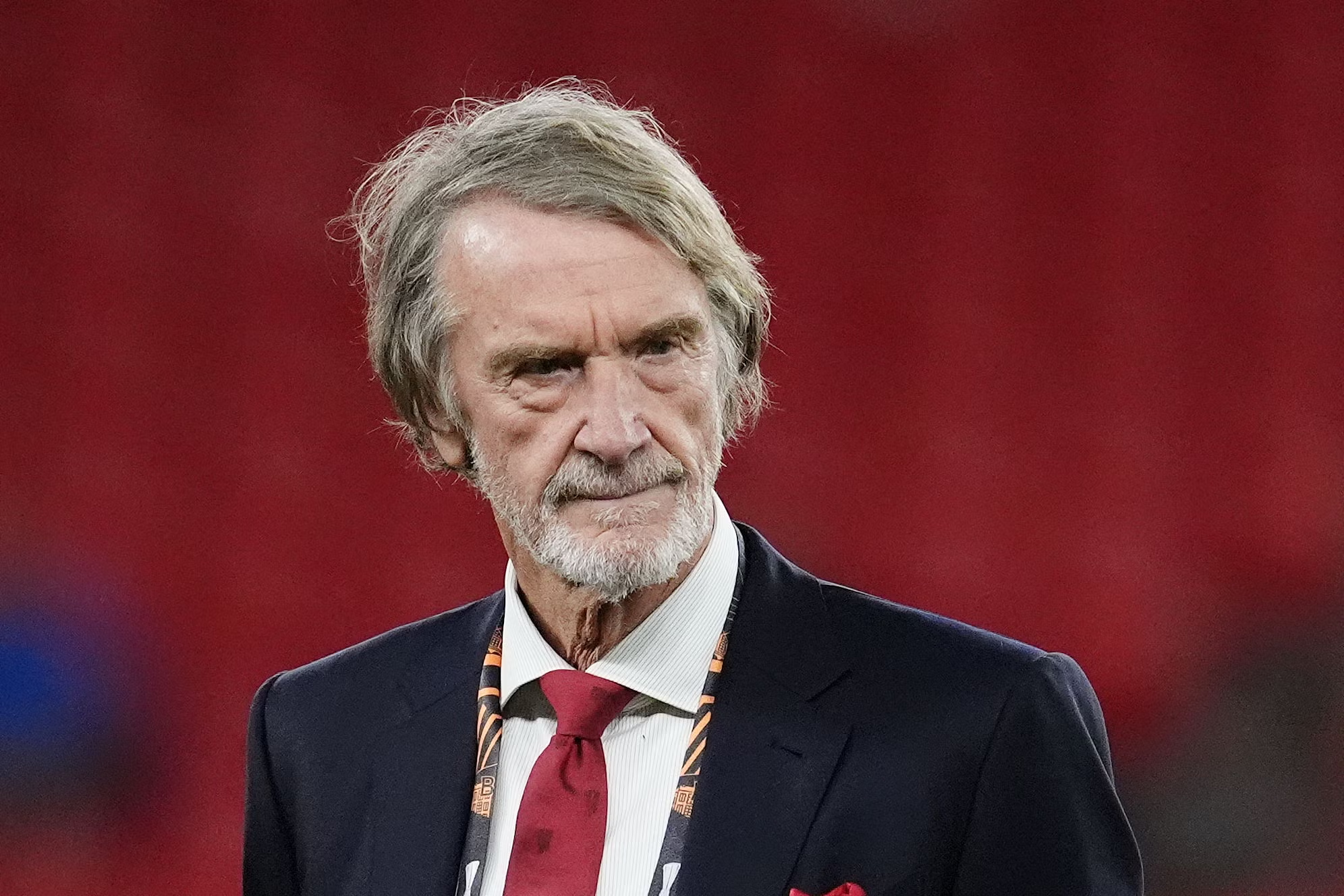
Sir Jim Ratcliffe — among the wealthiest people in Britain and a major shareholder in Manchester United — says his confidence in the country has gone, describing the UK as “on the slide”. The Ineos founder pins the decline on heavy taxation and immigration, and says the government's handling of energy amounts to “insanity” for not putting more money into North Sea oil and gas.
He went further on energy supply, cautioning that a harsh cold snap this winter could leave Britain able to “run out of gas” given how little is in storage. Ministers pushed back on that, insisting security of supply is not at risk and that growth remains the priority. “We have a diverse energy mix and are confident in our security of supply,” a government spokesperson said.
Ratcliffe, whose fortune is put at roughly £15bn, has drawn criticism before for what he has said about immigration. He campaigned for Brexit and has been a tax resident of Monaco since 2020.
In his telling, resentment of success is pushing well-off people out of the country. “In America they applaud people who create wealth,” he said. “Unfortunately the UK has got a bit of a green eye towards wealth at the moment.” He said a return home depends on things getting better.
He also went after tax policy on North Sea oil and gas, which he says is putting the industry's survival in doubt. Ineos runs the Forties pipeline, the route for roughly 30% of Britain's North Sea crude.
“You would expect [the government] to exploit our natural resources and we're clearly not doing that. We're shutting it down.”
“If you tax everybody to death, they're all going to leave. And that's what's happening.”
Ministers remain under pressure over whether to clear further work at the Rosebank and Jackdaw fields. Ratcliffe wants that development to proceed, calling it “absurd” that the country imports more energy than it has to. The government's answer is that oil and gas will still matter in Britain “for decades to come”, adding: “The transition to homegrown clean power is the only way to deliver energy and financial security for families and businesses.”
European storage levels are another worry for him, with a cold spell capable of straining British supply. “If we have a really sharp cold spell, then there is conceivably the possibility that we'll run out of gas and have to switch industry off… our storage is not full,” he said. Britain tends to lean on liquefied natural gas and imports from the continent rather than holding large reserves of its own.
Energy consultancy Cornwall Insight puts EU storage at around 69%, against a level nearer 85% at this stage in a normal year.
Adam Bell of the consultancy Stonehaven doubts it will come to a shortage. “We are down compared to where we normally would be but not what I'd regard as catastrophic,” he said. “The physical risk of running out of gas is relatively low, especially if Jackdaw gets the go ahead.” The bigger unknown, in his view, is American policy, since the United States ships LNG to Britain.
Ratcliffe was speaking in Denmark at the opening of the EU's first carbon capture and storage system, a project Ineos has put money into alongside Danish government and EU support. He said he had wanted to build carbon capture in the UK but found government support lacking.
The Department for Energy Security and Net Zero says £21.7bn has been committed to carbon capture and storage over 25 years, though nothing is running in Britain yet.
His criticism widened to immigration and welfare spending. Britain, he said, used to be “a fantastic place”. “We had the greatest empire in the world. We were a great people. We won two world wars,” he said.
Both immigration and the benefits bill are now too large in his assessment, and he accused politicians of ducking the problem. “Nobody's tough enough to deal with the immigration problem. Nobody's tough enough to deal with the benefits problem. But somebody needs to do it,” he said.


Comments
0