Trump states that the US is assuming partial control over Venezuela’s extensive oil reserves
President Donald Trump on Friday unveiled a groundbreaking initiative aimed at securing control over a significant portion of Venezuela’s extensive oil reserves. This strategy hinges on the belief that American companies can rejuvenate the struggling energy sector of the OPEC nation, simultaneously providing a fresh supply of crude oil to help reduce fuel prices in the United States.
Trump offered limited information regarding the agreement, stating merely that the U.S. had obtained majority control of over 65 billion barrels of Venezuela’s proven oil reserves via a partnership with private business.
The leader of the South American nation expressed enthusiasm for the agreement, stating that it would enhance the economy and increase government revenue.
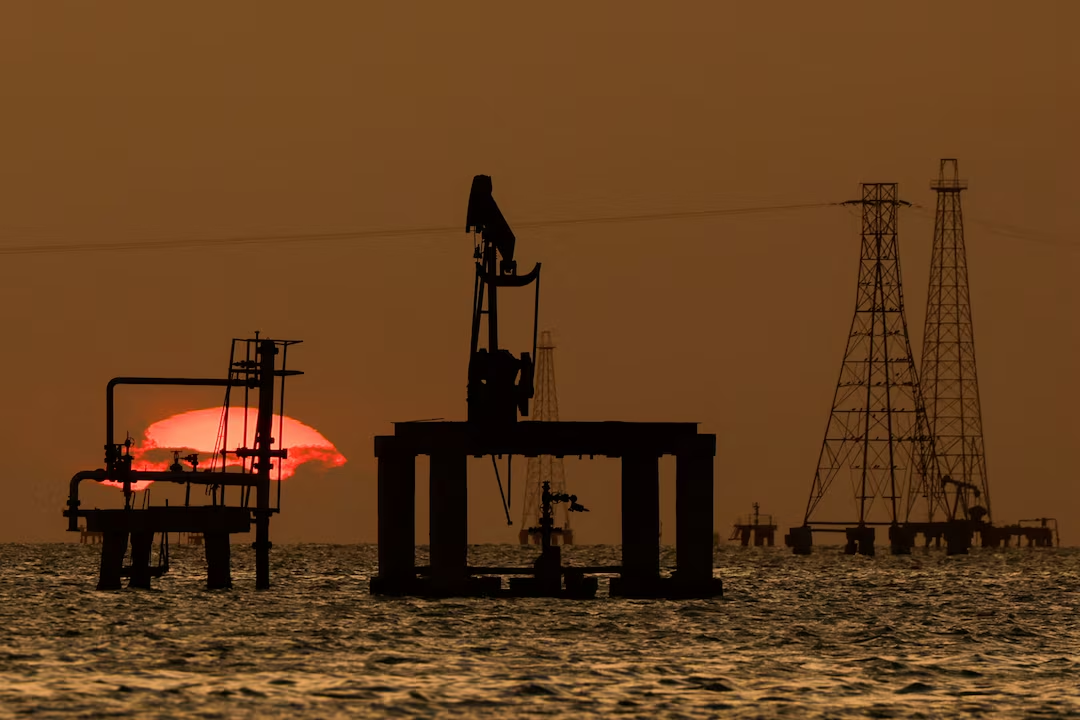
The new deal would signify a significant enlargement of the U.S. involvement in Venezuela’s oil sector as the Trump administration aims to rejuvenate the nation’s production and ensure a greater supply of crude for U.S. refineries. Venezuela possesses the largest proven oil reserves globally; however, its production stands at approximately 1.25 million barrels per day, significantly lower than its potential due to years of underinvestment, mismanagement, and sanctions.
RUBIO CALLS DEAL A WIN-WIN
“Under my direction, Secretary of State Marco Rubio and Secretary of War Pete Hegseth have collaborated closely with the Highly Respected Interim President of Venezuela, Delcy Rodriguez. Through a partnership with private business, we have achieved majority U.S. control of over 65 BILLION BARRELS of proven oil reserves in Venezuela, at no cost to the American taxpayer,” Trump stated on Truth Social.
The announcement came after weeks of negotiations between the U.S. and Venezuela regarding a deal that would provide American companies with long-term access to a set of Venezuelan oilfields and ensure a steady supply of crude to the United States.
Venezuelan officials are set to sign agreements next week that will grant new oil exploration and production rights to several companies, especially those based in the U.S.
Sources have informed Reuters that a lease model is being contemplated, with fields possibly auctioned to U.S. producers; however, this arrangement may encounter legal and constitutional hurdles in Venezuela, where the state maintains control over essential oil industry operations.
Trump did not reveal the details of the agreement, including the sectors or companies involved, nor how the United States would maintain majority control over the reserves. A list reviewed by Reuters indicates that the fields are located in the Orinoco Belt and Lake Maracaibo regions.
Rubio characterized the agreement as beneficial for both nations, stating on X that it would ensure a steady supply of affordable oil for the United States and contribute to reducing gasoline prices.
Rubio stated that the agreement would attract nearly $100 billion in private investment, create thousands of high-paying jobs, and aid in the reconstruction of Venezuela’s economy.
Rodriguez, who assumed the role of interim leader following the U.S. seizure of President Nicolas Maduro in January, announced late on Friday that the agreement would facilitate a substantial boost in production by developing 17 strategic fields, leading to tax revenue for the country amounting to $209 billion. “These investments will aid not only in the recovery and modernization of our industry but also in our country’s economic growth, the energy security of our hemisphere, and a more balanced presence in international markets,” she stated in a release.
LEGAL BASIS AND FINANCIAL STRUCTURE ARE UNCLEAR.
Analysts indicated that they required additional information regarding the legal and financial framework of the agreement before determining its potential to draw substantial investment.
It remains uncertain whether the agreement will lead to a decrease in gasoline prices in the near future, as the development of the necessary infrastructure for producing, transporting, and refining Venezuela’s heavy crude may require several years.
David Goldwyn, president of Goldwyn Global Strategies, stated that it remains uncertain if a U.S. government lease would have a legal foundation under Venezuela’s constitution and its new hydrocarbons law. He noted that there is “no precedent for having the U.S. government enter into a lease to operate oil fields.
Goldwyn also raised concerns about whether the plan would effectively tackle the challenges that have hindered investment in Venezuela for many years. He expressed difficulty in understanding how this type of arrangement could significantly boost investment, pointing to factors such as political uncertainty, an insufficient power grid, limited export capacity, and government control over the industry.
Following Maduro’s removal, Washington has been working to ensure a steady supply of Venezuelan crude for U.S. refineries while encouraging American investment in the nation’s oil sector.
The Trump administration faces mounting pressure as the midterm elections in November approach, aiming to address consumer worries regarding escalating gasoline prices. Cheaper oil supplies and expanded output could help.
The U.S. has been exploring options to replenish its Strategic Petroleum Reserve, the nation’s oil stockpile, including the potential for crude swaps with domestic producers.
In the 1970s, Venezuela nationalized its oil industry, placing the state-run PDVSA at the forefront. During the tenure of President Hugo Chavez, the government increased its control, compelling foreign producers to enter into state-led joint ventures and subsequently expropriating assets, which included projects managed by ExxonMobil and ConocoPhillips.
Under Maduro’s leadership, Venezuela’s production declined significantly.