Iran’s Parliament challenges Trump by approving a fee for ships passing through the Strait of Hormuz
Iran is taking steps to impose charges on authorized vessels for services in the Hormuz Strait, while Rezaei cautions Gulf states about participating in Trump’s economic campaign.
Iran’s parliament has taken steps to enhance Tehran’s authority over shipping in the crucial Strait of Hormuz, endorsing a measure that would permit the nation to impose charges on vessels from countries it permits to navigate the waterway, as the United States gears up to escalate economic pressure on Tehran.
The development occurred as Mohsen Rezaei, the newly appointed secretary of Iran’s Supreme National Security Council, delivered a pointed warning to Gulf countries regarding their potential alignment with Washington’s economic campaign. He threatened that Tehran would obstruct oil exports from the Persian Gulf if regional states chose to support the US.
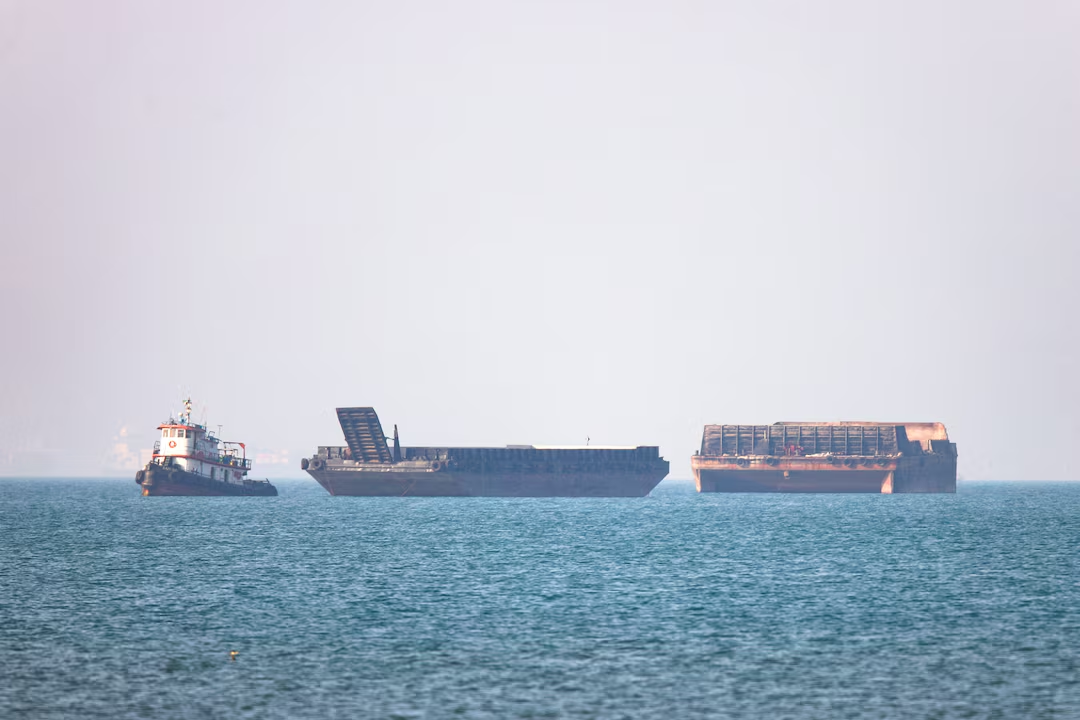
The recent actions have escalated the tensions in the conflict between Iran and the United States, leading to significant disruptions in shipping through the Strait of Hormuz and putting global energy markets at risk of extended supply constraints.
The National Security and Foreign Policy Commission of the Iranian parliament has given its approval to Article 3 of a proposed law concerning the security and development of the Strait of Hormuz.
The provision would allow Tehran to charge fees to vessels from countries that Iran permits to transit through the waterway.
The suggested fees would encompass maritime and navigation services, environmental services, fuel supplies under specific conditions, insurance, safety and security services, along with additional services offered to vessels during their transit.
Commission spokesperson Hassan Qashqavi stated that the authorized vessels would need to compensate for the services provided.
“According to Article 3, a fee will be applied for services such as maritime, environmental, fueling under specific conditions, insurance, safety, and additional services offered in the Strait of Hormuz,” he stated. The payments may be made in Iranian rials or another currency specified by Tehran.
The measure is included in a proposed “Strategic Action Plan to Ensure the Security and Development of the Strait of Hormuz.” Iranian state media reported that the parliamentary commission approved the provision on Sunday.
Nevertheless, the proposal still requires consideration by the full parliament before it can be sent to the Guardian Council, which examines legislation for adherence to Iran’s Constitution and Islamic principles.
In instances where disagreements persist between parliament and the Guardian Council, the Expediency Council may be summoned to mediate and provide resolution.
Qashqavi asserted that the proposed legislation acknowledged the freedom of navigation as outlined by international law, while simultaneously safeguarding the sovereignty and security interests of nations adjacent to the Strait of Hormuz.
He mentioned the 1982 United Nations Convention on the Law of the Sea and highlighted Oman’s stance on the connection between international maritime regulations and national sovereignty.
“The Persian Gulf and the Strait of Hormuz have distinct rules and conditions. Following the acceptance of the 1982 Convention on the Law of the Sea, Oman promptly issued a political declaration highlighting that the provisions of this convention must not infringe upon the country’s national sovereignty and security,” he stated.
The proposed fee regime arrives during a period when Iran is intensifying its control over access to the waterway.
Tehran has permitted certain vessels to pass through the strait, while imposing limitations on broader commercial activities. It recently allowed several Iraqi oil tankers to pass through Hormuz, highlighting the selective nature of access amid the conflict.
Rezaei Issues Warnings to Gulf States
As Tehran sought to solidify its authority over the waterway, Iran’s security chief, Rezaei, cautioned Gulf nations against backing Washington’s economic initiatives.
“If the countries surrounding Iran align with the Americans in their economic war, not a drop of oil will leave the Persian Gulf and the Strait of Hormuz,” Rezaei stated, as reported by Iran’s Tasnim news agency.
“We will also focus on additional oil export routes originating from the Persian Gulf,” he added.
The warning emerged as President Donald Trump’s administration geared up to transition the conflict into a new phase focused on economic pressure, sanctions, and restrictions on nations and companies that persist in trading with Iran.
Rezaei also criticized Trump’s management of the conflict, contending that the US attacks had heightened global interest in obtaining nuclear weapons.
“Trump’s recklessness, particularly his aggressive stance toward Iran, has heightened the global appetite for nuclear weapons. This is especially true as people observe the ineffectiveness of the International Atomic Energy Agency and the Nuclear Nonproliferation Treaty in safeguarding against U.S. attacks,” he stated.
“Trump has fostered nuclear insecurity rather than ensuring nuclear security,” he added.
Rezaei stated that Iran had accepted international nuclear safeguards, continued to be a member of the NPT, and adhered to inspections.
“Iran is the only country that surpasses all others in its dedication to nuclear regulations,” he stated.