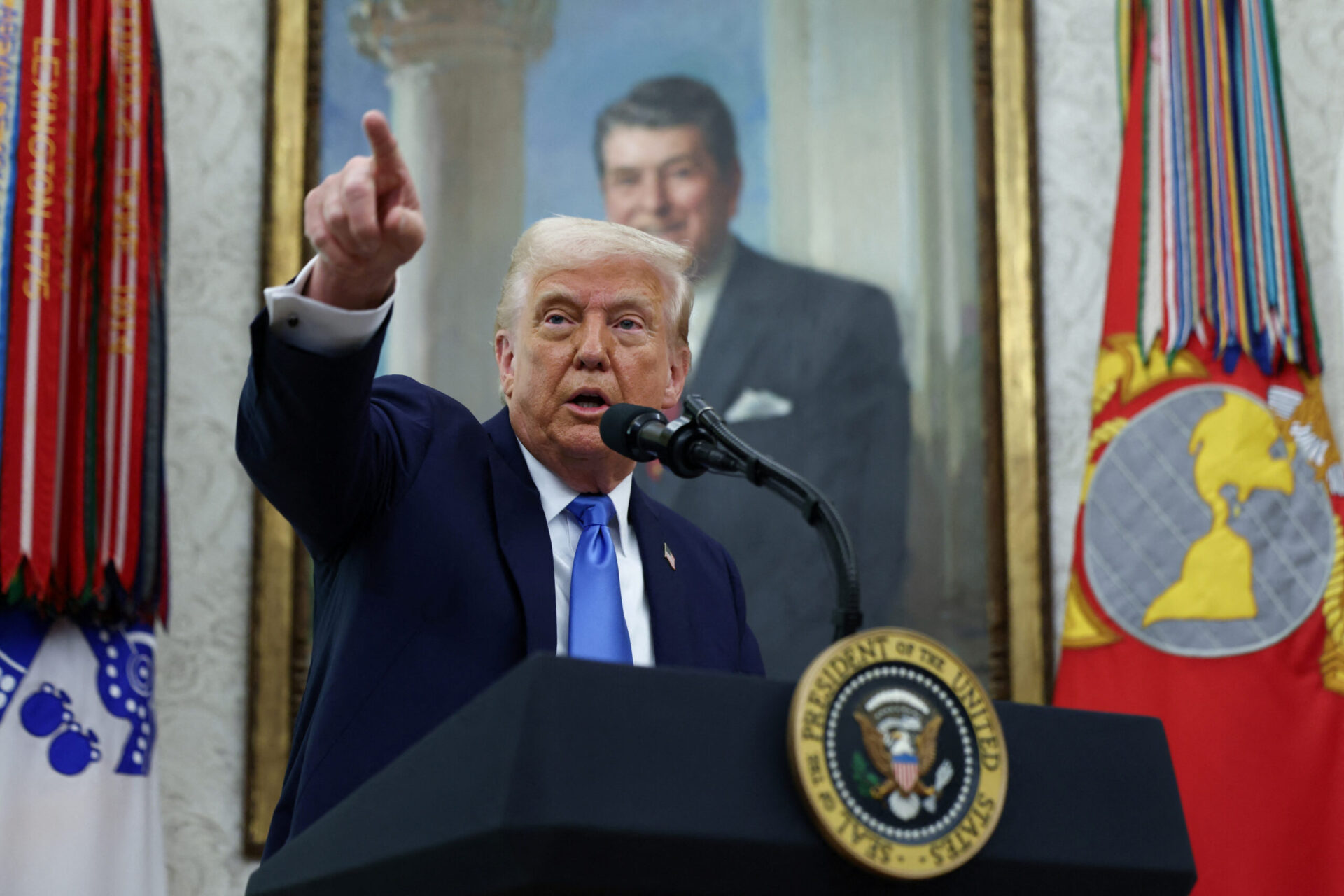
Trump approaches the midterms lacking significant achievements in foreign policy
As the Iran war reaches a costly standoff and crises in Ukraine and Gaza remain unresolved, President Donald Trump’s ambitious foreign policy agenda appears stalled as he approaches the midterm elections in November.
The setbacks are notable for a president who returned to office last year vowing to be a “peacemaker” and made the resolution of international conflicts a focal point of his second-term agenda.
Here’s a look at what’s ahead for U.S. and global markets with the
Trump has become increasingly frustrated with the questions that reporters and even U.S. allies have posed. This week, he expressed his frustration toward reporters who were questioning him about foreign policy matters and reiterated his threat to bomb Oman, a U.S. ally that is in talks with Iran regarding the reopening of the Strait of Hormuz.
Labor Day, occurring on September 7 this year, traditionally marks the point when election campaigns intensify. Republicans face the possibility that ongoing international conflicts and their economic repercussions domestically may jeopardize the party’s control over Congress.
Iran’s stalemate is exacting a political price.
Trump has terminated discussions with Tehran after weeks of advocating for a diplomatic resolution and declared on Wednesday a new initiative of “economic warfare” against the Islamic Republic, seemingly recognizing that months of military actions have not yielded the concessions desired by the U.S.
As inflation continues and the conflict in Iran leads to rising gasoline prices, Trump’s approval rating has dropped to a new low, with only 33% of Americans in the most recent Reuters/Ipsos poll expressing approval of his performance.
Other attempts to negotiate peace have also stalled.
On Monday, Trump’s negotiator and son-in-law Jared Kushner returned without any progress from discussions aimed at advancing a Gaza peace deal. Kushner and Trump envoy Steve Witkoff have not yet made their anticipated visit to Kyiv to rejuvenate the long-stalled negotiations aimed at ending Russia’s war in Ukraine.
Following a series of initial successes in foreign policy, such as a ceasefire in Gaza and the capture of Venezuela’s leader, Trump’s record has increasingly come to be characterized by his halted diplomatic initiatives.
Trump has effectively questioned and unsettled the established foreign policy consensus in Washington, yet he has not converted that upheaval into a strategy that yields tangible benefits for Americans,” stated Asli Aydintasbas, a fellow at the Brookings Institution think tank in Washington.
Iran’s conflict poses a significant challenge for Trump domestically.
The conflict with Iran has significantly burdened the president, and there is a lack of agreement within the White House regarding a resolution, according to a Trump ally who spoke on the condition of anonymity.
The pressure may rise if investors determine that the war will continue, leading to higher U.S. borrowing costs and further limiting Trump’s domestic agenda. Trump has stated that the economic costs are justified to prevent Iran from acquiring a nuclear weapon, despite Iran’s assertions that it does not seek one.
“President Trump has restored America’s respect on the global stage, and the outcomes are evident—nine wars have concluded, hostages have been released from Gaza, trade agreements are more equitable, and measures are in place to ensure Iran will never acquire a nuclear weapon,” stated White House spokeswoman Anna Kelly.
A senior official from the Trump administration stated that U.S. sanctions and a naval blockade have severely damaged Iran’s economy, leaving it “completely broke.” The official also mentioned, “There are many levers the president can crank harder in the weeks ahead.
An unconventional approach yielding varied outcomes
Some experts commend Trump for his readiness to confront issues that they feel previous presidents have struggled to address. “The president seeks a more stable world, which involves trying to resolve disputes, whether they are time-sensitive like Ukraine or more subdued like trade and overcapacity,” stated Nick Snyder, a senior fellow at the Hudson Institute, noting that Trump also made efforts to mediate conflicts between Rwanda and the Democratic Republic of Congo, as well as Thailand and Cambodia.
Trump has disrupted conventional diplomatic practices of peacemaking, utilizing America’s economic and military power, including with U.S. allies, yet this unconventional approach has produced varied outcomes.
He convened parties to discuss the resolution of Russia’s invasion of Ukraine, yet the protracted conflict in Europe since World War Two shows no signs of conclusion, as recent Russian airstrikes resulted in the deaths of 16 individuals in the Ukrainian capital on Thursday.
In Gaza, mediators are concerned that escalating Israeli strikes on the enclave are hindering efforts to resolve the conflict, as both Israel and Hamas hesitate to meet the conditions necessary to progress with the peace plan established by Trump in October of last year. On Sunday, Israeli airstrikes in Lebanon resulted in the deaths of 11 individuals, despite the ongoing U.S.-mediated peace framework between the two nations.
One significant achievement occurred in Venezuela, where the U.S. military apprehended President Nicolas Maduro without incurring any U.S. casualties. Analysts suggest that the operation played a role in persuading Trump that collaborating with Israel to attack Iran would unfold without complications.
However, they also claim that the operation demonstrated a miscalculation. They contend that Trump has depended excessively on coercive pressure, although Iran’s leaders have minimal motivation to relent and reopen the Strait of Hormuz, even with the nation’s declining economy. “He is fixated on using coercion and, at times, flattery to manipulate others, yet remains unaware of their strategic objectives and internal political dynamics. As a result, he continues to struggle and stumble,” stated Stephen Wertheim, a senior fellow at the Carnegie Endowment for International Peace.
Meanwhile, as Trump’s Republican Party approaches elections that could jeopardize its control of one or both chambers of Congress, his ability to advance his agenda during the last two years of his presidency is significantly limited.
Analysts indicate that Trump’s dependence on coercive pressure can lead adversaries to engage in negotiations, yet it frequently does not result in enduring agreements, which may lead rivals to wait for a more favorable moment.
U.S. adversaries recognize that his political timeline is more limited than theirs, and while the United States can exert significant coercive pressure, it may ultimately run out of patience,” Aydintasbas stated. ” Consequently, Putin, Xi, and Iran might choose to bide their time in relation to Washington. Following November, the motivation to endure Trump’s presidency will become increasingly evident.