Hyundai workers have initiated their first complete strike in ten years, advocating for increased wages, reforms in retirement age, and safeguards against job losses due to AI advancements.
Workers at Hyundai Motor have initiated their first complete strike in ten years following a breakdown in wage negotiations with management. The union is advocating for higher wages, an extended retirement age, and safeguards against job losses associated with artificial intelligence and automation.
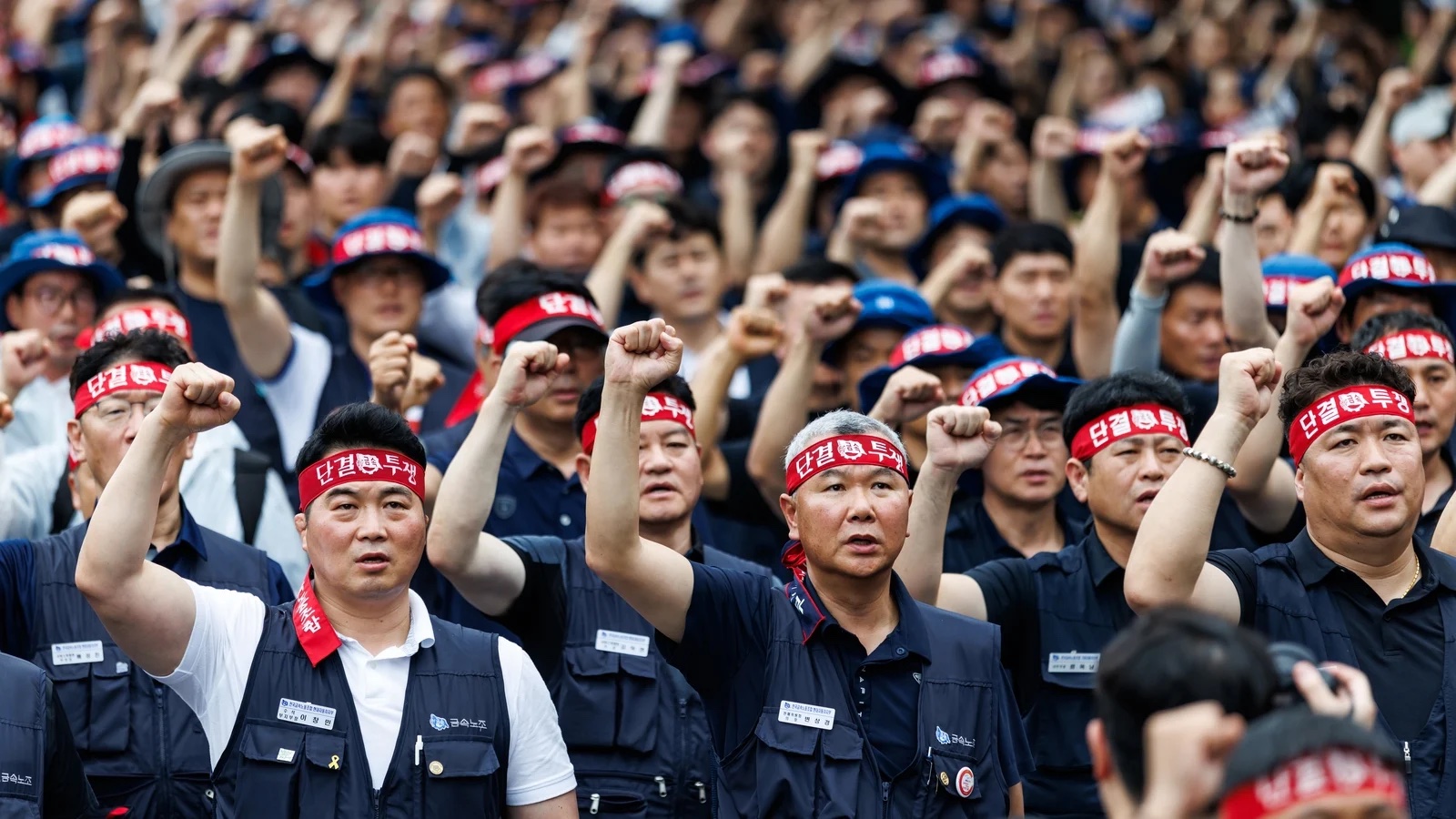
Approximately 40,000 members of the Hyundai Motor union are anticipated to participate in a one-day walkout on Friday, as striking workers from Hyundai, its affiliate Kia, and parts suppliers convene outside Hyundai’s headquarters in Seoul.
The protesters donned red headbands and chanted their demands, which included direct wage negotiations between parts suppliers and automakers, as well as an increase in the mandatory retirement age from 60.
“The key figures who have established Hyundai and Kia as the world’s strongest company for 35 or 40 years are now being relegated to contract positions,” stated Hyundai union leader Lee Jong-cheol at the rally.
A union official stated that approximately 1,200 to 1,300 Hyundai workers were anticipated to attend the demonstration in Seoul. Members from various unions and affiliates of the umbrella union were also anticipated to be present, bringing the total attendance to approximately 3,000.
The strike comes after a sequence of partial walkouts that started in late July, causing disruptions in the production of approximately 55,200 vehicles valued at over 2.3 trillion won ($1.67 billion), as reported by estimates from Yonhap News Agency.
The union’s demands arise as Hyundai encounters increasing pressure to adjust to swift developments in artificial intelligence, automation, and future mobility.
The workers are aiming to raise their bonuses to 800% of their monthly base salary from the current 750%, while also insisting on assurances that the implementation of AI and automated systems will not result in job losses.
Hyundai has acquired the humanoid robotics company Boston Dynamics and announced its plans to implement humanoid robots at its manufacturing plant in Georgia starting in 2028, with aspirations to broaden their application throughout its production facilities.
Union officials contend that the risks posed by AI reach further than just factory-floor jobs, impacting research and engineering roles as well.
“Even with the introduction of AI, we stand ready to confront it—and ready to prevail.” “We are concerned about the future generation,” stated Kim Byung-chul, a Hyundai worker and vice president of the Korean Metal Workers’ Union.
The union’s request for an increased retirement age coincides with President Lee Jae Myung’s commitment to progressively elevate the retirement threshold as South Korea faces one of the globe’s most rapidly aging demographics.
The industrial action compounds the challenges confronting Hyundai, which indicated in July that it anticipated falling short of its global sales target for the year due to increasing competition from Chinese automakers in Europe and declining sales in South Korea.
Hyundai union spokesperson Kim Jin-wook stated that workers are willing to resume wage negotiations but may contemplate additional strike action if management does not provide what he referred to as “forward-looking proposals.”
Hyundai expressed its dedication to addressing the dispute through conversation.
“Strike action can affect our customers, partners, and operations.” “We are at a pivotal moment where collaboration between both parties is essential to effectively manage the global shift toward future mobility,” the company stated.