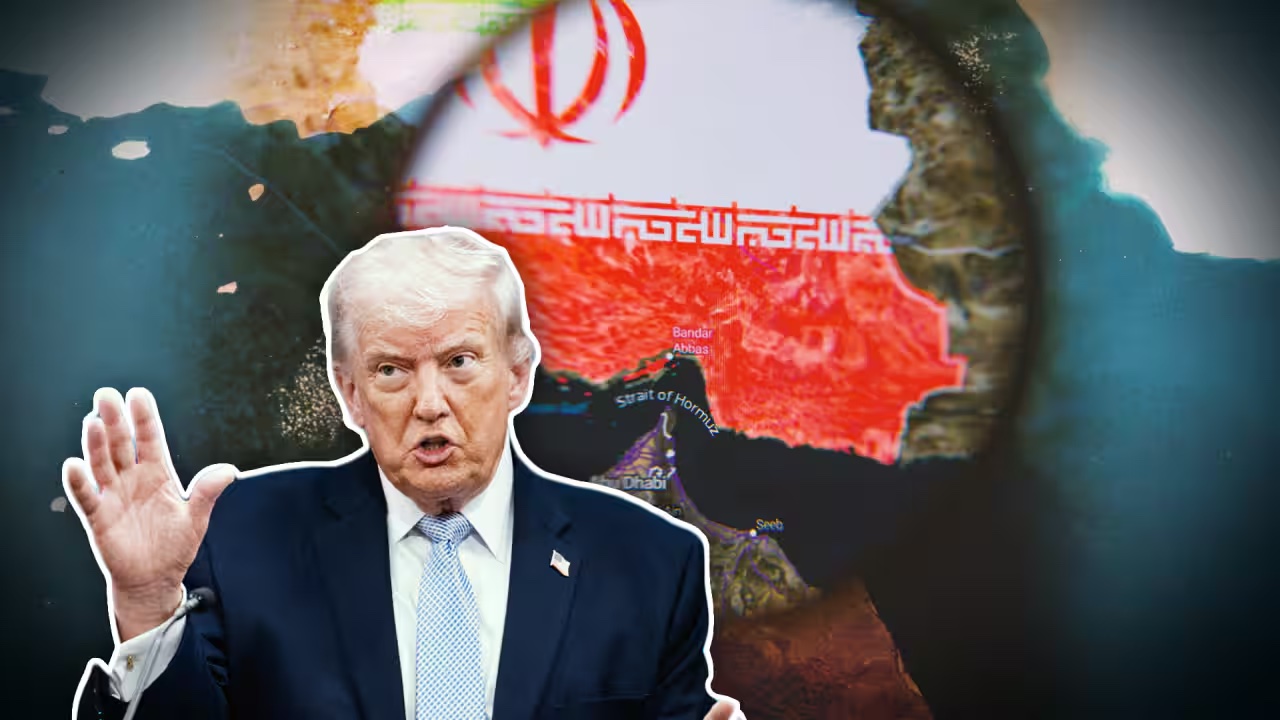
Trump asserts that the US has complete control over Hormuz as ship traffic declines to its lowest level in a week
Trump asserts that the US has control over the Strait of Hormuz as shipping traffic declines, while Iran dismisses this claim and pledges to maintain its blockade.
On Wednesday, US President Donald Trump asserted that the United States possesses “total control” over the Strait of Hormuz, as shipping traffic through the vital waterway decreased to its lowest level in a week due to the ongoing conflict with Iran.
Trump asserted in a post on Truth Social that the United States would maintain control of the waterway, which typically sees about one-fifth of global oil supplies passing through it.
The U.S.A. maintains complete control over the Strait of Hormuz. I believe we will hold onto it! Trump characterized the US naval blockade as a “wall of steel,” asserting that Iran had limited capacity to contest it.
Iran, however, dismissed the assertion, insisting that the strait continues to be obstructed.
The Persian Gulf Strait Authority stated that “claims and repeated posts by U.S. officials that the Strait of Hormuz is no longer blocked do not change the reality,” emphasizing that the waterway will not be reopened until Iran’s conditions are accepted.
The disagreement arose as commercial shipping through the strait continued to deteriorate. On Tuesday, only eight vessels were recorded transiting the waterway, as per Kpler data reported by Reuters. This figure is below the 10-day average of approximately 12 vessels and marks the lowest daily count since August 5.
Prior to the onset of the war on February 28, approximately 130 vessels navigated the crucial waterway daily.
The disruption has raised worries regarding global oil supplies and energy prices, prompting the International Energy Agency (IEA) to revise its 2026 oil demand forecast downward as the extended closure of the waterway impacts consumption.
Brent crude was priced at approximately $89.08 a barrel early Wednesday, while the US benchmark West Texas Intermediate (WTI) was at $83.53.
The IEA reported that global oil supplies increased by 2.4 million barrels per day in July, reaching 101.5 million bpd; however, this figure is still 6.3 million bpd lower than the level noted a year prior.
It now anticipates a decline in global oil supply by an average of 4.3 million bpd this year, referencing renewed hostilities and maritime disruptions that occurred in July and early August.
“The continued closure of the Strait of Hormuz and rising fuel prices are impacting oil consumption,” the agency stated.
The crisis has extended beyond the strait, as renewed assaults by Iran-backed Houthi rebels on shipping in the Red Sea heighten concerns of additional disruptions along another vital global trade route.
At least six individuals were reportedly killed aboard a cargo vessel off the coast of Yemen in an attack attributed to the Houthis. This incident marks the first known fatalities resulting from Houthi attacks on shipping in the region amid the latest escalation.
The United States has further strengthened its enforcement of the blockade on Iranian ports. US Central Command reported that an American military helicopter launched two Hellfire missiles at the engine room of the Panama-flagged vessel, the Vela Nova, after the crew reportedly disregarded multiple warnings and tried to navigate toward Iran.
CENTCOM reported that the vessel was no longer en route to Iran in breach of the blockade. They also noted that US forces had disabled three non-compliant vessels, boarded two, and redirected 55 commercial vessels that were attempting to circumvent the blockade as of Tuesday.
At the same time, diplomatic efforts to reduce tensions in the conflict continue to be unpredictable. A senior Iranian source informed Reuters that there had been no conversations regarding the extension of a ceasefire, as Tehran believes that no ceasefire had been put in place.
The source indicated that discussions via mediators were centered on the potential for Washington to revert to an interim agreement and set a timeline for fulfilling commitments; however, it was noted that there had been “absolutely no progress” on the matter.
On Tuesday, Yemen’s transport ministry reported that four crew members and two rescuers lost their lives in an attack by Iran-backed Houthis on a cargo ship in the Bab el-Mandeb strait. Meanwhile, the U.S. military stated that it targeted a container ship that was trying to head toward an Iranian port.
The deaths aboard the Egyptian-owned Tihamah would represent the first fatalities in a Houthi attack on shipping since the onset of the Iran war on February 28.
Later in the day, the Houthis confirmed their attack on a ship in the Bab el-Mandeb, claiming it was transporting Saudi military equipment, though they did not disclose the name of the vessel.
The agency UK Maritime Trade Operations (UKMTO), affiliated with the British Navy, reported an incident in the strait on Tuesday, indicating that a ship was struck by an unknown projectile.
Reuters confirmed the cargo ship as Tihamah by analyzing the shape of the deck and mast, which corresponded with archived imagery of the vessel. Visuals from the dock were confirmed to align with satellite imagery and topographical mapping of the region.
Ship-tracking data indicated that the vessel Tihamah was located near Murad, Yemen, on August 11. The date was confirmed by two sources from the Yemeni coast guard and two military officials within the government, who reported that a small cargo ship was attacked by Houthis. British maritime security company Ambrey reported that there was an attack on the vessel on August 11.
Three individuals from Pakistan lost their lives in the attack, as confirmed by the country’s foreign minister. The Yemeni ministry reported that one Indonesian was also killed, stating that the crew lost control of the vessel following the attack.
Two rescuers from the National Resistance Forces (NRF), an anti-Houthi force, were killed when the Houthis launched another attack after rescue crews arrived, according to the Yemeni Coast Guard.
According to the Coast Guard, ten individuals sustained injuries, comprising seven crew members, two personnel from the Coast Guard, and one member of the NRF.