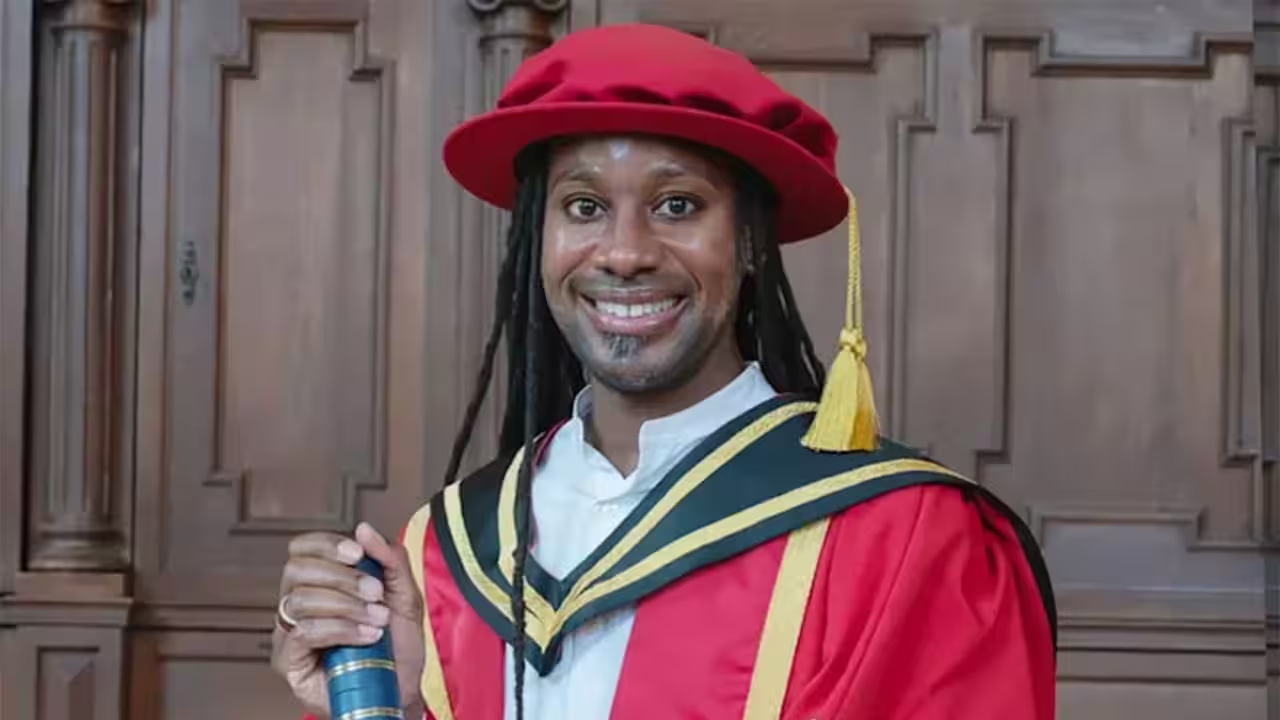
Cambridge Professor Jason Arday has stepped down during an investigation into allegations of plagiarism
Cambridge professor Jason Arday has stepped down while an investigation is underway regarding his academic qualifications, honorary appointments, and allegations of plagiarism.
Professor Jason Arday has stepped down from the University of Cambridge effective immediately, as an investigation is underway regarding his academic qualifications, honorary appointments, and allegations of academic misconduct.
The university announced on Wednesday that it has initiated an investigation into Arday following the receipt of “new information” regarding his academic qualifications and honorary appointments.
Arday, who became Cambridge’s youngest Black professor in 2023, has recognized mistakes in certain aspects of his academic work but has dismissed allegations that he intentionally misrepresented his career.
In a statement released by the Good Law Project, Arday expressed that he had chosen to resign after experiencing what he characterized as a “unrelenting level of public scrutiny and personal attack.”
He expressed that his appointment as a professor had been “without question, the greatest professional privilege of my life,” but he also noted, “There comes a point when the personal cost becomes too great.”
Arday stated that his resignation should not be seen as a dismissal of scholarship or the principles that led him to Cambridge, nor should it be viewed as an acknowledgment of the allegations against him.
“For my own wellbeing, for my family, and for those who have supported me during this challenging time, I have come to the decision that the only way to close this chapter is to step away,” he stated.
He stated that his resignation was “not the end of my work,” expressing the need for “time to heal” before reentering academia.
The controversy deepened as media reports emerged, raising questions about various elements of Arday’s academic record and allegations that parts of his PhD thesis included material taken from other sources.
The allegations of plagiarism were first brought to light by Nathan Cofnas, a researcher from the US, who asserted in a Substack post that plagiarism-detection software had flagged sections of Arday’s work that bore a striking resemblance to previously published material.
Cofnas claimed that certain passages were reproduced with little editing, including the retention of errors from the original sources.
Cambridge had earlier characterized the allegations against Arday as part of a “vile campaign to undermine his credibility.”
Arday stated to The Times that he acknowledged his responsibility for errors in his academic work, but he denied the allegations of intentional dishonesty. “I am not a liar.”
He further claimed that there had been a “very well orchestrated and coordinated campaign” aimed at ousting him from his role at Cambridge, implying that some of the criticism was racially motivated and connected to broader resistance against diversity, equity, and inclusion policies.
Arday linked certain mistakes in his initial academic endeavors to his autism, explaining that he had depended on mimicry as a method for processing information.
The controversy has also expanded beyond Arday’s academic work to allegations regarding his charitable endurance challenges.
Cofnas raised doubts regarding the assertions made by Arday concerning his completion of various marathon and long-distance running challenges, as well as his fundraising efforts exceeding £5 million for charity.
Arday later informed The Guardian that the £5 million amount had been accumulated with assistance from others over a span of 20 years, but he stated that he was unable to disclose the identities of those individuals due to non-disclosure agreements.
He also clarified that the reported 600-mile treadmill challenge was completed over 12 days instead of six, incorporating rest days due to the physical demands of earlier challenges.
Arday has consistently affirmed his support for other running records associated with him.
“I cannot compel others to believe me,” he stated to The Times. “No one goes through life keeping a record of every single thing they say or do.”
Cambridge stated that its most recent inquiry is distinct from various ongoing complaints related to purported academic misconduct, which are currently being addressed through the university’s research misconduct procedures.
The university expressed its dedication to carrying out a comprehensive process in line with its policies and employment law, while also acknowledging the personal effects of the controversy on Arday.
Jesus College, where Arday serves as a fellow, has initiated its own process concurrently with the university’s investigation.
Meanwhile, publisher Simon & Schuster, set to release Arday’s memoir later this month, stood by its relationship with him.
The publisher expressed pride in publishing Professor Jason Arday and commended the professionalism and integrity he exhibited during the publication process.
In a separate statement, the Metropolitan Police confirmed that it had conducted an investigation into a journalist after receiving a complaint of harassment related to the journalist’s email inquiries directed at Arday.
Police later determined that no offense had occurred and recognized that advising the journalist to refrain from further communication with Arday was inappropriate and could have hindered legitimate journalism.
Jovan Owusu-Nepaul, identifying himself as an associate of Arday, expressed that the controversy was “regrettable,” highlighting the intense scrutiny surrounding Arday’s career and the potential inaccuracies in some claims regarding his CV.
He stated that Arday’s request for space should be honored as he distances himself from Cambridge.