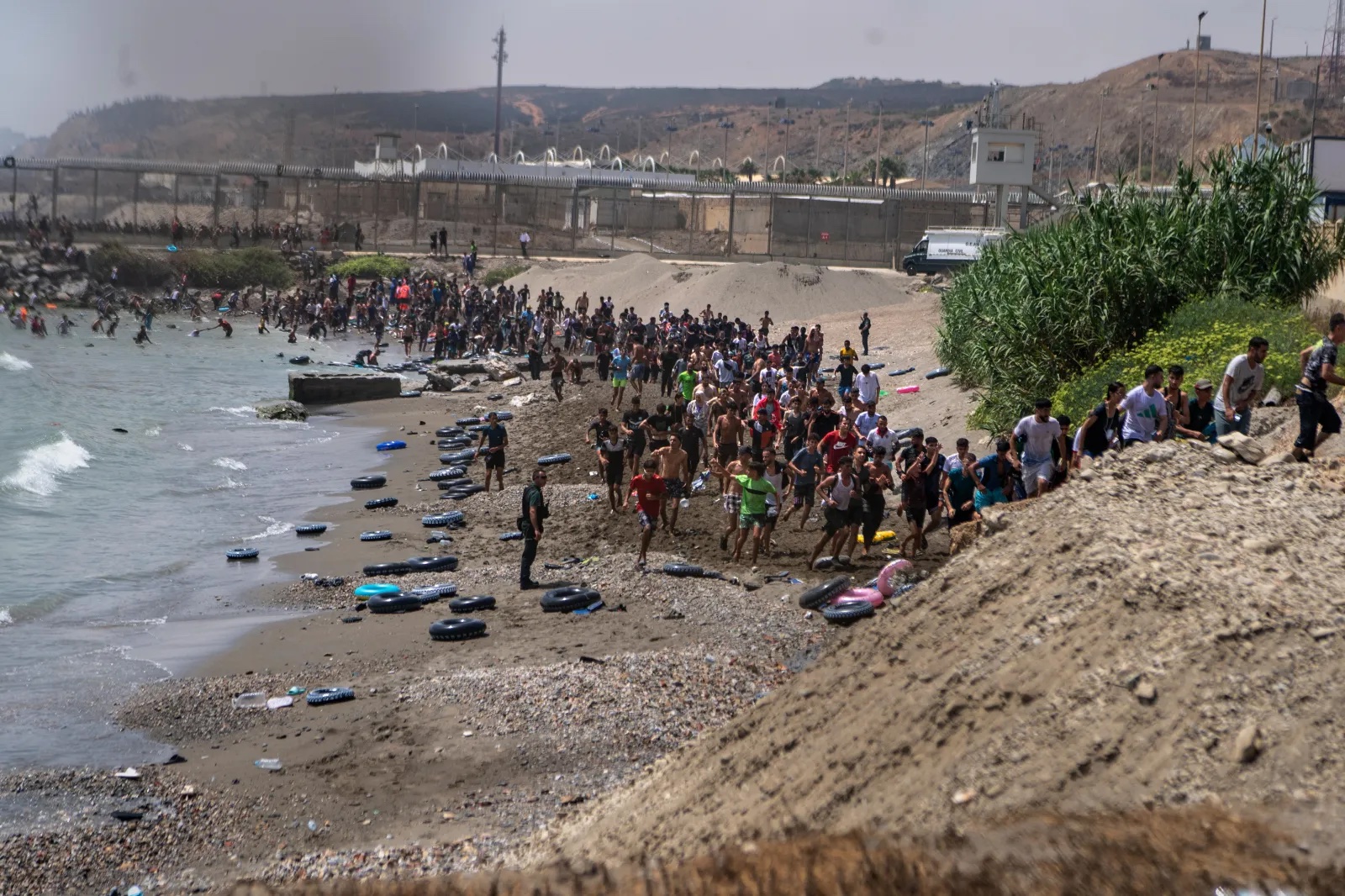
Italy has temporarily reinstated border checks with Spain following a surge of migrants in Ceuta, which has led to diplomatic tensions and raised security concerns.
Italy has put a temporary halt to the Schengen free movement regime with Spain and has ordered the closure of its sea and air borders due to a rise in migrants entering the Spanish North African enclave of Ceuta. This decision has sparked diplomatic tensions and reignited discussions on migration within the European Union.
The announcement was made on Thursday evening by Prime Minister Giorgia Meloni, accompanied by Deputy Prime Ministers Antonio Tajani and Matteo Salvini. They characterized the action as essential for ensuring national security and safeguarding the EU’s external borders.
On Friday, Italy’s Interior Ministry officially sanctioned the measure following a meeting led by Interior Minister Matteo Piantedosi, based on evaluations from the nation’s Committee for Migration Analysis and Border Security.
In outlining the government’s stance, Tajani stated on X: “The temporary suspension of Schengen with Spain is a necessary choice to safeguard the security of our citizens and defend the European borders.” A provision established by the treaties and rendered essential in the present context.
“The migrant crisis in Ceuta serves as a poignant reminder that managing the Union’s borders is a collective responsibility among our nations, one that we owe to each other. It is essential that we collaborate to manage migrant flows into EU territory, addressing the associated risks and the potential threat of terrorism, which must be confronted decisively.
France has also declared stricter regulations along its land border with Spain. French President Emmanuel Macron stated that the measures aimed to assist Spanish authorities in handling the migration crisis in Ceuta.
Spain, however, expressed strong criticism of Italy’s decision.
Prime Minister Pedro Sánchez, in a post on X, emphasized that migration challenges must not compromise European solidarity. “Solidarity and empathy are not mandatory.” “Respect for European treaties and the facts is lacking,” Sánchez wrote, referencing Frontex data that indicated Italy had seen more irregular migrant entries than Spain from 2021 to 2026. He instead called for “a strong and united European Union.”
Spain’s Foreign Minister, José Manuel Albares, condemned Tajani’s call to suspend the Schengen agreement and summoned Italy’s ambassador to Madrid to seek explanations regarding the decision.
As reported by Italy’s ANSA news agency, Spain’s Foreign Ministry asserted that the crisis in Ceuta was not connected to the nation’s migrant regularization policy. The influx was reported to have followed interpretations of a recent ruling by the Spanish Supreme Court regarding migrants who swam into Ceuta, suggesting that the situation had been taken advantage of by criminal networks and human trafficking organizations.
The development has elicited responses from various parts of Europe.
By Friday, Finland, the Netherlands, Denmark, the Czech Republic, and Sweden had openly expressed their support for Italy’s stance on enhancing border controls.
Finnish Interior Minister Mari Rantanen stated, X: “Spain has entirely failed to safeguard the external border of the Schengen Area from incursions.” This cannot persist.
European Commissioner for Home Affairs Magnus Brunner recognized the gravity of the situation but emphasized that there was no evidence of migrants advancing beyond Ceuta into mainland Europe. The circumstances in Ceuta are intolerable, and I am maintaining close communication with the Spanish authorities. I emphasize that there are no actions being taken towards mainland Europe or other member states.
He further noted that “the Schengen Borders Code contains special provisions that apply to Ceuta and Melilla, and checks on people departing from Ceuta remain in force.”