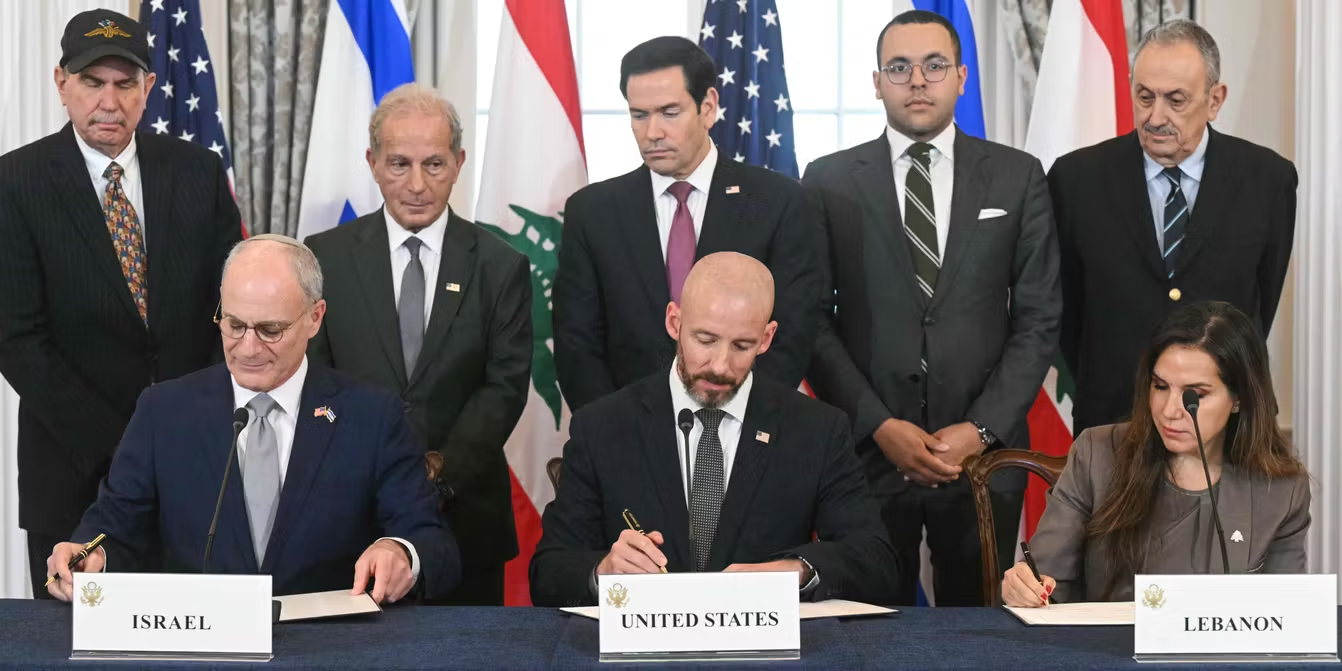
Lebanon and Israel have resumed talks in Rome, facilitated by the US, to progress on the implementation of a ceasefire and to negotiate the withdrawal of Israeli troops.
Lebanon and Israel have restarted US-brokered talks in Rome focused on executing a framework agreement intended to conclude months of conflict, with Lebanese officials aiming for tangible advancements regarding an Israeli military pullout from southern Lebanon.
The discussions, occurring over two days at the US Embassy in the Italian capital, arise amid renewed diplomatic efforts to implement a ceasefire framework established in late June. Despite the renewed engagement, officials on both sides have recognized that hopes for an immediate breakthrough are still constrained.
The recent diplomatic efforts come in response to the renewed conflict between Israel and Hezbollah on March 2, even as mediation by the United States continues. Hezbollah, supported by Iran, has maintained its opposition to the negotiations, asserting that ongoing Iranian pressure on Washington is the sole route to resolving the conflict and achieving a complete Israeli withdrawal.
Iran had earlier connected the cessation of hostilities in Lebanon to its interim agreement with the United States that was signed last month. However, that understanding has faced challenges due to renewed tensions between Washington and Tehran in the Gulf.
Israel persists in upholding military positions within what it characterizes as a security buffer zone that stretches approximately 10 kilometers into southern Lebanon. Israeli officials assert that the deployment is essential to avert future cross-border assaults by Hezbollah and to safeguard communities in northern Israel.
A framework agreement reached in Washington on June 26 outlined a cessation of hostilities, the disarmament of armed groups, the deployment of Lebanese troops throughout southern Lebanon, and the gradual withdrawal of Israeli forces. The provision on disarmament is commonly interpreted as pertaining to Hezbollah.
Nevertheless, Israeli military operations have persisted in spite of the agreement, whereas Hezbollah has dismissed appeals to disarm. Israel has asserted that its forces will continue to be present in southern Lebanon until Hezbollah ceases to present a security threat.
Lebanese officials indicated that their delegation intends to utilize the Rome talks to advocate for a phased Israeli withdrawal, with troops retreating from specified areas in stages to facilitate the deployment of the Lebanese army under a pilot implementation plan.
The pilot initiative outlines two initial zones where Hezbollah will withdraw, Israeli forces will pull back, and Lebanese troops will take over responsibility, paving the way for the process to extend to more areas.
A US official stated last week that the US Central Command (CENTCOM) is collaborating with both governments to initiate the pilot program. A US military delegation visited Lebanon over the weekend to discuss implementation details with the Lebanese Armed Forces.
Italian Foreign Minister Antonio Tajani expressed that Italy was privileged to host the negotiations, conveying optimism that the meetings in Rome would assist in bringing both sides nearer to a lasting ceasefire.
Lebanese President Joseph Aoun conveyed a sense of optimism regarding the upcoming talks, expressing his hope that they would yield practical steps toward the implementation of the agreement and facilitate the withdrawal of Israeli troops from southern Lebanon.
Since the conflict escalated in March, Israel has conducted extensive military operations throughout southern Lebanon, asserting that it has dismantled Hezbollah infrastructure, including underground tunnel networks. Lebanese authorities report that the offensive has resulted in over 4,000 fatalities and displaced more than one million residents.
Israel reports that a minimum of 32 soldiers and four civilians have lost their lives in attacks conducted by Hezbollah since the onset of the latest phase of the conflict.