Recent attacks between the US and Iran have heightened uncertainty regarding the Strait of Hormuz, resulting in a significant increase in global crude prices.
The United States and Iran have engaged in new military strikes, escalating tensions and putting their delicate interim agreement in jeopardy, while contradictory assertions regarding the situation in the strategic Strait of Hormuz have intensified concerns about a wider regional conflict.
The most recent confrontation took place following the US’s new strikes on Iranian military sites on Sunday evening, which led Iran’s Islamic Revolutionary Guard Corps (IRGC) to respond by targeting American military bases in Kuwait, Jordan, and Bahrain.
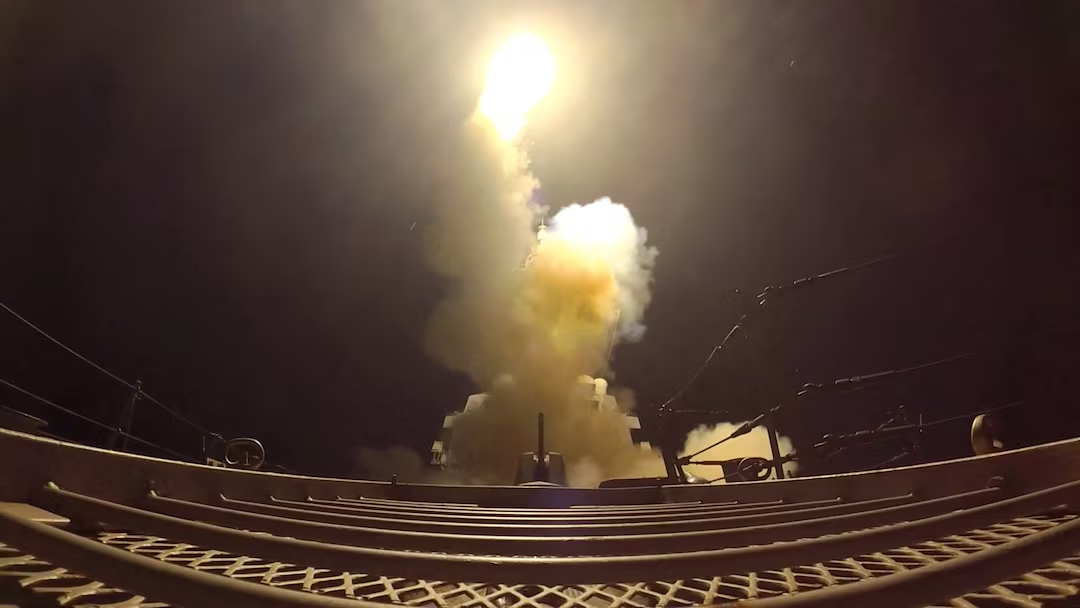
According to US Central Command (CENTCOM), the operation commenced at approximately 5:00 p.m. Eastern Time, focusing on various Iranian military locations, such as air-defense systems, coastal radar stations, missile facilities, and drone operations.
CENTCOM stated that the strikes aimed to uphold freedom of navigation in the Strait of Hormuz due to ongoing Iranian aggression. “US forces stand ready to guarantee that freedom of navigation continues to be accessible for commercial shipping in light of Iran’s ongoing, unjustified aggression, harassment, threats, and arbitrary declarations.”
Soon before the US announcement, Iranian state television reported explosions in Sirik, Qeshm, Bandar Abbas, and Jask.
Subsequently, Iran’s IRNA news agency reported that one individual lost their life and four others sustained injuries following what it described as an American attack in Khuzestan Province.
“In the wake of the assault by American forces on Monday morning, one individual lost their life and four others sustained injuries,” stated Valiollah Hayati, Deputy Governor for Security and Law Enforcement.
The recent clashes come after several days of heightened military activity from both parties, sparking concerns regarding the execution of the interim agreement established in June, which sought to ease tensions and reopen the Strait of Hormuz.
Iran asserts that it has closed the Strait until further notice, whereas the US maintains that the crucial shipping route is still open and that commercial navigation will proceed.
This uncertainty, which encompasses approximately 20% of the world’s oil and liquefied natural gas supplies traversing the waterway, has sparked renewed volatility in global energy markets.
Brent crude increased by 4.3% in Asian markets, reaching $79.26 per barrel, while US West Texas Intermediate also saw a 4.3% rise to $74.50 per barrel as investors responded to the deteriorating security situation.
The recent actions by the US military came soon after CENTCOM revealed that American forces had targeted approximately 140 Iranian military sites throughout Iran.
Iran reacted by targeting US military installations and allies throughout the Middle East, broadening the extent of the conflict.
These hostilities have further eroded trust in the interim ceasefire agreement established last month, which sought to alleviate tensions.
Previously, US President Donald Trump remarked that Iran’s recent actions had essentially terminated the ceasefire, while Iranian Foreign Minister Abbas Araghchi charged Washington with violating the agreement.
Despite the rising tensions, regional mediators continue their diplomatic efforts because there is growing worry about a larger conflict and the effects that ongoing instability could have on global energy supplies and regional security.