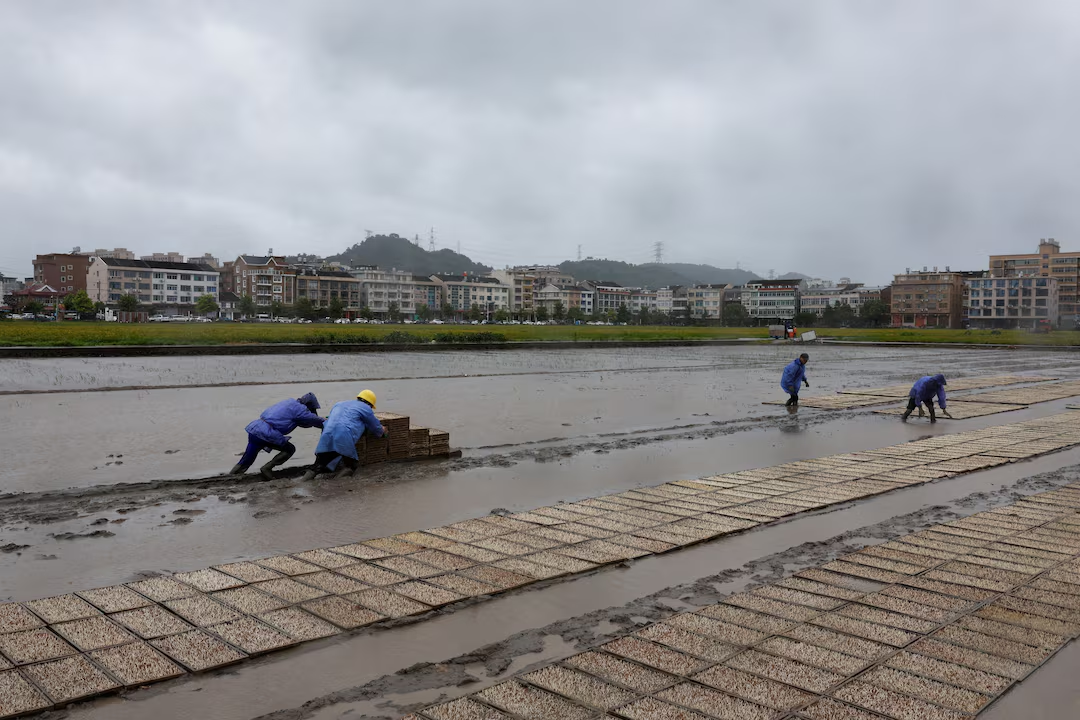
China is evacuating 1.8 million individuals as Typhoon Bavi nears Wenzhou, bringing with it heavy rainfall, strong winds, and potential flood threats across the country.
China has evacuated over 1.8 million individuals as Typhoon Bavi approaches the eastern city of Wenzhou, having already impacted Japan’s southern Sakishima island chain with intense rain and powerful winds while passing north of Taiwan.
Even though the storm has diminished in intensity and speed over cooler waters, forecasters caution that it still poses a threat due to the significant moisture present in its rain bands.
As of 0808 GMT on Saturday, Bavi was reported by China’s National Meteorological Center to have maximum sustained winds of 144 km/h and was located approximately 200 km southeast of Wenling, in Zhejiang province. The typhoon is anticipated to reach land near Wenzhou, a city with a population of approximately 10 million, early on Sunday.
State media reported that over 1.7 million individuals had been evacuated from Zhejiang Province, while more than 100,000 others were relocated to safety in the adjacent Fujian Province.
Wenzhou resident Huang Xinghuan, 50, stated that preparations were in progress prior to the market closures.
“I have some concerns, but I believe it will turn out fine.” We have experienced typhoons in the past. “We will overcomethese challengess,” he stated.
Huang mentioned that his family had prepared sufficient drinking water to last for two to three days.
“I believe that supplies are now reliably secured.” “There’s no reason to worry or hoard excessive amounts of food or other supplies,” he added.
Although Japan and Taiwan have not reported any fatalities related to the typhoon, officials in the Philippines have confirmed that 17 individuals lost their lives due to heavy rains brought on by an intensified southwest monsoon exacerbated by Bavi.
Taiwan’s fire department reported that 87 individuals sustained injuries, primarily due to falls related to motorcycles, bicycles, and airborne objects.
Taiwan evacuated over 14,000 individuals from predominantly mountainous regions as authorities readied themselves for the storm, even though predictions indicated it would not strike the island directly.
Officials cautioned that certain regions might experience close to one meter of rainfall. Over 920 international flights and all 282 domestic flights were cancelled, resulting in the closure of Taiwan’s main international airport at Taoyuan.
Many cities and counties announced a typhoon holiday, resulting in the closure of schools and government offices, while a few restaurants and convenience stores in Taipei continued to operate. The island’s north-south high-speed rail service maintained operations on a limited schedule.
In central Taipei, certain residents chose to stay outside despite the weather conditions.
“It’s OK, it’s not that serious,” remarked 68-year-old Yeh Mao-hsiung as he walked his dog. “It’s merely a touch more wind.”
In the Beitou district of Taipei, winds reaching approximately 100km/h uprooted trees and led to swollen rivers.
In Wenzhou, Chen Qiuqin mentioned that she was assisting her elderly parents in getting ready for the storm.
I was concerned about the flowerpots on my mother’s balcony, so I will assist in moving them indoors. “My parents are both elderly, and they’re home alone, so I felt uneasy,” she said.