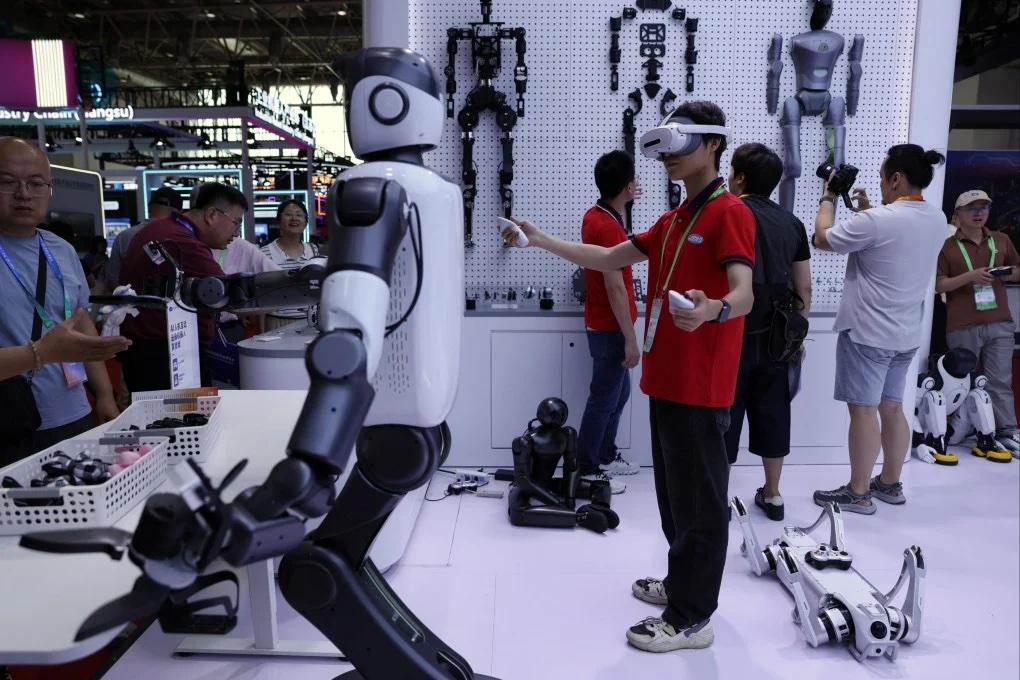
Morgan Stanley doubles its prediction for China’s humanoid robot shipments as the rate of commercial adoption speeds up
Morgan Stanley says that China’s humanoid robotics business is growing faster thanks to better policies and more sales.
The outlook for China’s humanoid robotics industry has been greatly improved by Morgan Stanley, which says the sector is going much faster than expected from testing to large-scale commercial use.
The Wall Street bank changed its prediction for China’s humanoid robot sales for the second time this year on Tuesday. Now it thinks that 50,000 units will be shipped in 2026, which is almost twice as many as its previous prediction of 28,000 units. The new estimate is also a big jump from the bank’s first guess, which was that 14,000 units would be issued in January.
Morgan Stanley now thinks that the market for humanoid robots in China will be worth about $2 billion this year and $15 billion by 2030. By the end of the decade, shipments are projected to reach 446,000 units per year.
The estimate only includes sales to outside customers. It doesn’t include robots made for prototypes, pre-order testing, or use within the company.
Sheng Zhong, an equity analyst at Morgan Stanley, said in a research note released on Tuesday that China will accept humanoid technology more quickly if there is commercial verification, policy support, and feedback from the supply chain.
The new view shows that China is stepping up its efforts to become a world leader in humanoid robotics. Chinese companies are speeding up production and putting robots to work in factories, convenience stores, restaurants, and other business settings.
As a national goal for the next five years, Beijing has also made the creation of “embodied AI” (AI built into physical systems like robots) even more important. The government has told banks to offer better loan terms and urged local governments to help robotics startups by giving them money, land, and office space.
Investors from around the world are also interested in the rising momentum.
Omdia, a research business, says that about 13,000 humanoid robots were shipped around the world last year. The five biggest shippers were all Chinese companies. Figure AI, which is based in the U.S., came in seventh, and Tesla came in ninth.
Elon Musk, CEO of Tesla, had said earlier that the public would not be able to buy the company’s Optimus robotic robot until the end of 2027.
Joe Ngai, Senior Partner and Chairman of McKinsey Greater China, said that humanoid robots could become the next big investment theme in China because of its technological progress.
Ngai said on Wednesday at the World Economic Forum’s annual meeting in Dalian, “When you walk outside [in China], you see all these startups and more advanced companies, all these robots dancing. But robotics use in industry is often a below-the-radar story.”
“If you go to any Chinese factory right now, there’s more automation and robotics in use than anywhere else in the world… “
Morgan Stanley said that its supply-chain field study showed that commercialization would happen faster than expected. It pointed to growing use in manufacturing and logistics, as well as more widespread use in unmanned stores and interactive business services.
The investment bank thought that Leaderdrive, which is listed in Shanghai, was one of the best companies to gain from the boom in humanoid robots.
Morgan Stanley raised the price they think the company will be worth in 12 months from 269 yuan to 464 yuan (US $68).
The Suzhou-based company sells precise robotic parts to Chinese companies that make humanoid robots, such as Ubtech and Galbot.
Zhong said that Leaderdrive could have a 40% share of the world market this year and keep that share at about 25% over the long term.
Zhong said, “Leaderdrive could have a 40% global market share this year and a 25% share in the long term.” He attributed this to “robust shipments and its strong customer exposure.”
It’s also becoming more common for Chinese robotics companies to look for new growth possibilities by going global.
Seer Intelligent is a robotics company based in Shanghai that started doing business in Hong Kong on Wednesday. The company has been growing outside of China since 2021.
The company’s chief operating officer, Jonathan Fan, says that operations in more than 65 countries made up 18% of all income last year.
Fan did warn, though, that global risks are still a big problem.
On Monday, he said, “The biggest headwinds are still geopolitical uncertainty and trade tensions that are still rising.”
Fan said the company was mitigating those risks by pursuing wider geographic diversification and ensuring strict compliance with regulations in every market where it works.
At the same time, worries in Washington about China’s fast progress in artificial intelligence keep growing, especially about the possibility that the world will depend more on Chinese technologies.
Suzanne Nossel, a Lester Crown Senior Fellow for US Foreign Policy and International Order at the Chicago Council on Global Affairs, said that if the US only focuses on scientific breakthroughs, it could lose control over how AI technologies are used around the world.
Nossel wrote in an opinion piece for Foreign Policy this week, “If Washington treats the contest solely as a race to hit new capability benchmarks, it could lead in invention but fall behind in influencing where and how AI is used around the world.”
“A sales campaign for the US AI stack will not jump-start adoption fast enough to keep pace with China,” she added.