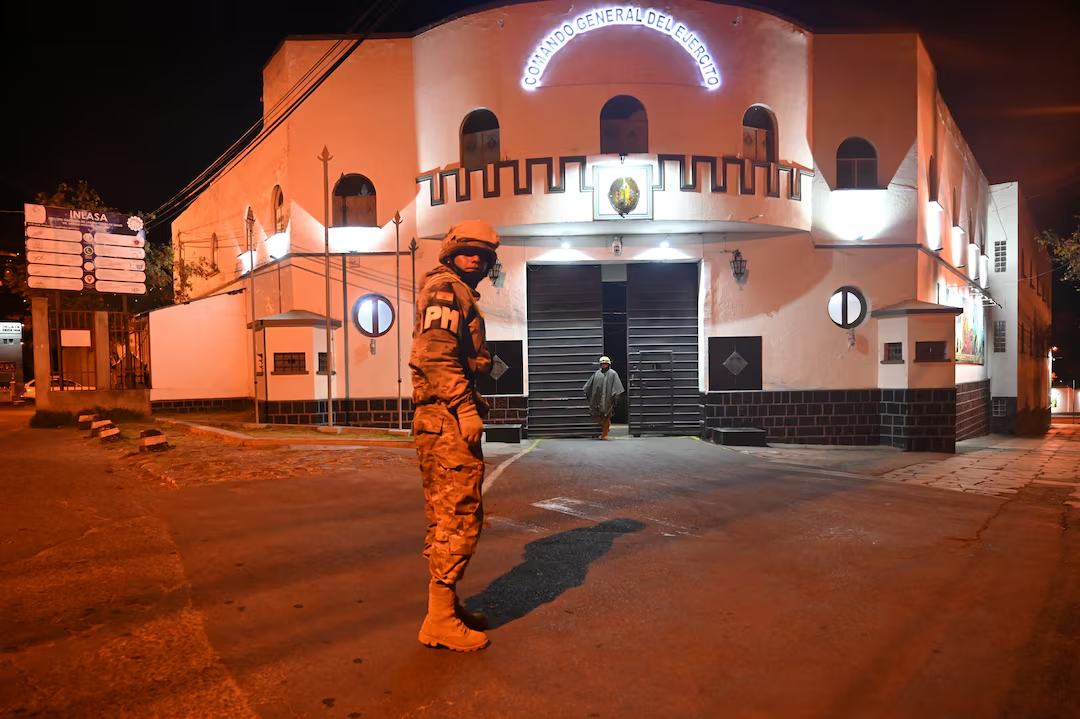
Bolivia’s political and social crisis escalated on Saturday when President Rodrigo Paz announced a state of emergency, allowing for increased military presence to dismantle blockades and reestablish order in response to protests that have paralyzed the economy for the last 50 days.
Addressing the nation early Saturday morning, Paz stated that the anti-government blockades had transitioned from a social protest to a coordinated effort to undermine Bolivia’s democracy. “There comes a moment when inaction shifts from being a sign of prudence to an act of irresponsibility. “And that moment has arrived,” Paz stated, assuring that the measure would safeguard citizens and maintain the flow of essential goods, while cautioning that those who continue to disrupt would encounter legal repercussions.
Protesting groups, many associated with former leftist President Evo Morales, have blocked essential roads, leaving trucks stranded and disrupting the supply of food, fuel, and medicines to various regions, including La Paz, the administrative capital of Bolivia.
In the early morning hours of Saturday, a significant presence of at least 200 police officers donned in tactical gear and equipped with canisters of tear gas assembled in the streets, encircling a police headquarters in El Alto, a prominent city adjacent to La Paz.
Some opposition lawmakers have cautioned that the emergency measure could escalate tensions, while analysts and legal experts have indicated that the emergency powers might exacerbate unrest if they lack public support and fail to tackle the root causes of the protests.
Paz announced the news just hours after revealing a deal reached on Friday with the main union, the Bolivian Workers’ Confederation (COB), which sought to alleviate tension.
However, numerous roads linking the main production center of the South American nation are under the control of rural associations aligned with Morales, who were excluded from the negotiations and are continuing to protest primarily in the Cochabamba area.
Bolivia’s President Rodrigo Paz has announced a state of emergency in response to the ongoing blockade crisis.
In May, Congress facilitated the emergency declaration by repealing a law that had imposed restrictions on the executive branch’s use of emergency orders, a law that was perceived to favor labor unions and social organizations.
While the order takes effect immediately, the president is required to inform Congress of the state of emergency within 24 hours of issuing the decree, which then has up to 72 hours to approve or reject the measure. “This is not a state of emergency to restrict people’s lives … It is a state of emergency to give freedom back to the people, to free Bolivia from those who use political conflict to block roads and harm the population,” Paz stated.
ORIGINS OF THE DISCONTENT
The conflict initially erupted after Paz abruptly eliminated long-standing fuel subsidies to reduce the deficit, amid a worsening dollar crunch and discussions with the International Monetary Fund. Despite subsequent measures aimed at stabilizing fuel prices and reversing unpopular land reforms, protests escalated into widespread discontent, with unions calling for wage increases, an end to fuel and dollar shortages, and the resignation of Paz.
Paz has been in power for only seven months, following nearly two decades of leadership by the leftist Movement Toward Socialism (MAS), which was led by Morales, who governed Bolivia from 2006 to 2019.
According to Bolivian law, a president may face a recall referendum after serving two and a half years in office.
Paz, who assumed office with the support of President Donald Trump as part of a wider strategy to enhance U.S. influence in the region, has held Morales—a prominent figure of the left who led for nearly 14 years – responsible for inciting the unrest.
Morales has supported the protest movement, advocated for early elections, and portrayed the unrest as a response to Paz’s economic policies. In a recent interview with Reuters, Morales denied any role in inciting dissent, asserting that economic difficulties fueled the “indigenous rebellion.”