Amazon founder Jeff Bezos states that AI will lead to a labor shortage and heighten the demand for human workers.
Amazon founder Jeff Bezos has addressed concerns regarding artificial intelligence potentially replacing a significant number of workers. He asserts that, rather than displacing jobs, the technology will enhance the demand for human labor and generate new employment opportunities.
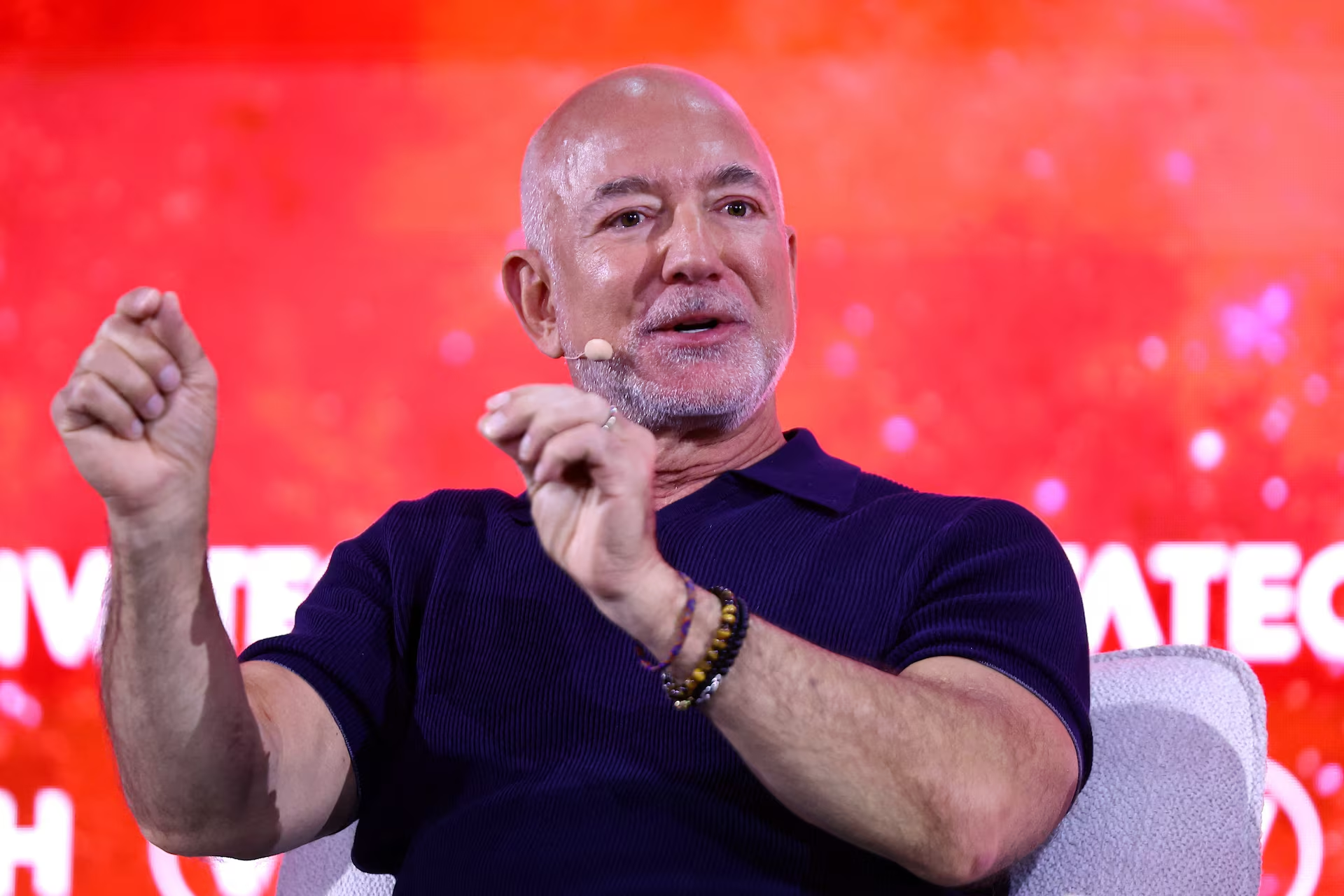
During his address at the VivaTech technology conference in Paris, Bezos contended that AI would not render individuals obsolete but would instead assist in eliminating obstacles that presently hinder human productivity and innovation.
“I understand that there are significant concerns shared by many, including numerous intelligent individuals, regarding the potential for AI to render humans obsolete and similar issues,” Bezos stated.
I completely disagree with this perspective. In my opinion, AI is likely to lead to a shortage of labor.
His comments arise during an escalating discussion regarding the effects of AI on employment, as certain political and technology figures caution that swift progress in artificial intelligence may jeopardize job opportunities, especially for younger individuals.
Bezos, however, presented a more hopeful perspective, contending that technological advancements would create new opportunities and heighten the demand for workers instead of diminishing it.
The billionaire entrepreneur discussed Prometheus, his latest AI venture aimed at enhancing physical manufacturing, a field that is rapidly becoming more automated.
Concerns regarding job displacement continue to be a significant issue, as the UK’s Trades Union Congress has previously cautioned that AI technology may replicate “the disaster of deindustrialization” if the advantages predominantly benefit shareholders while jobs are “degraded or displaced.” The organization has recognized that AI has the potential to provide substantial advantages for workers when developed in a responsible manner and paired with increases in productivity.
Beyond artificial intelligence, Bezos articulated his vision for humanity’s future in space, emphasizing that access to space serves as the primary constraint on further development.
He stated that the Moon would act as a natural launching pad for long-term human expansion beyond Earth, owing to its closeness and the resources it offers.
“We’re going to the Moon to stay, not just to visit,” Bezos conveyed to the audience.
He mentioned that technologies like electrolysis might eventually allow for the utilization of lunar resources to refuel rockets and sustain a permanent human presence beyond Earth.
The discussion also addressed Blue Origin, Bezos’ space exploration company, which experienced a setback in May when an uncrewed New Glenn rocket exploded during a ground test at Cape Canaveral, Florida.
Reflecting on the incident, Bezos remarked: “It was a gut punch for the whole team.” However, what we have discovered since that time is that we were quite fortunate.
No injuries were reported after the explosion, and Bezos highlighted that multiple essential launch systems endured, enabling recovery efforts to progress more swiftly than initially anticipated.
Blue Origin chief executive Dave Limp announced at the conference that reconstruction efforts are currently in progress and that launches are anticipated to resume before the year’s end.
The company is vying with Elon Musk’s SpaceX in the pursuit of a prominent role in commercial spaceflight and lunar exploration, as the demand for extraterrestrial infrastructure continues to rise.