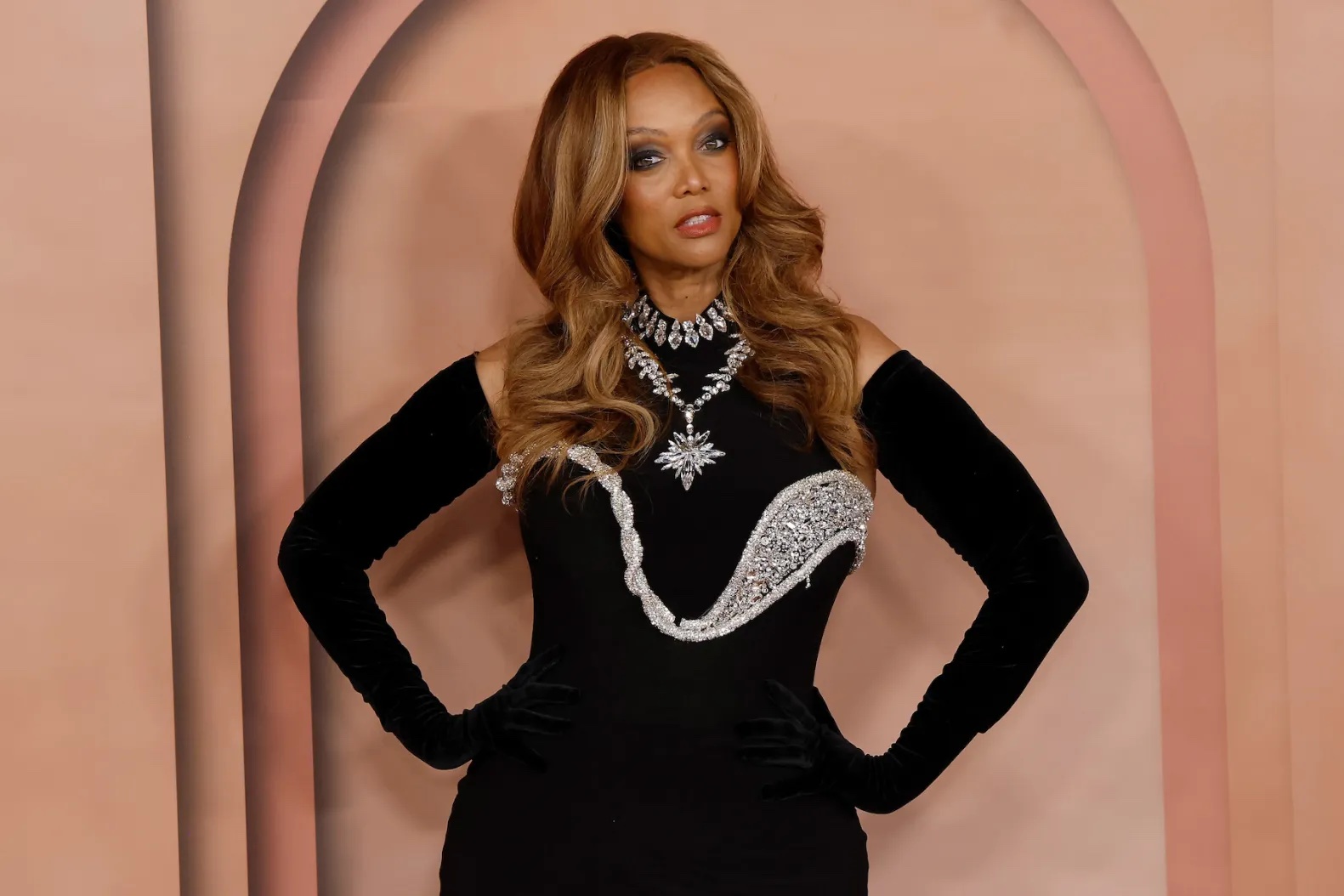
Tyra Banks has filed a lawsuit against Netflix regarding the documentary about America’s Next Top Model
The supermodel claims that the streamer condensed a three-and-a-half-hour interview into just 16 minutes, creating a narrative she never shared.
The Tyra Banks lawsuit against Netflix was dropped on Saturday, June 13, 2026, and it is as explosive as one would expect from a woman who has built an empire and is determined to maintain her narrative. Banks filed a defamation suit regarding the three-part docuseries Reality Check: Inside America’s Next Top Model, and the most outrageous claim in the entire filing is this. She claims that Netflix edited and rearranged her footage in a manner that implied she was aware of a contestant being sexually assaulted on her show, exploited that woman’s trauma for ratings, and then failed to recall the incident when questioned about it. That is the charge she is prepared to fight against.
Here is her account of what transpired. Banks participated in an interview that lasted approximately three and a half hours. She states that she did not place any topic off limits and responded to everything they presented to her, including the tough criticism and the choices she would approach differently today. She asserts that Netflix utilized merely 16 minutes of that time. The Tyra Banks lawsuit contends that those 16 minutes were taken out of context and rearranged to create a narrative she never actually conveyed. Her lawyers characterize the situation as “surgical manipulation of continuous footage,” accompanied by selective editing and intentional omission, suggesting that she feels the producers crafted a villain from various elements and presented it as her true self.
The discussion centers around a Cycle 2 contestant named Shandi Sullivan. Years ago, her storyline was presented on the show as a scandal involving infidelity. Sullivan now states that what truly occurred was a sexual assault by a guest, claiming that production did not safeguard her and-and-a-half-hour that the incident was reshaped into a degrading infidelity storyline for television. In a recent interview, she stated that Banks declines to accept responsibility and questioned how individuals could be regarded as products rather than human beings. The Tyra Banks lawsuit is closely tied to this issue, as the suit claims the documentary created a troubling impression that Banks is unable to remember the woman who was affected during her oversight. Banks describes that impression as a fabrication that Netflix subsequently broadcasted to millions of viewers globally.
Then there is the Miss J. Alexander situation, which adds a layer of intimacy to the entire scenario. The longtime runway coach mentioned in the documentary that Banks never visited him following his stroke in 2022 and that her only communication was a text message. Banks states that the framing omitted all significant aspects. She states that she was residing in Australia at that time, that she was never afforded the opportunity to present the text chains that recorded how many times she attempted to reach out, and that a family member subsequently expressed regret to her for the late response. According to the filing, she and Miss J continued to exchange voice notes, photos, video messages, and holiday greetings as recently as Christmas Day 2025. The Tyra Banks lawsuit contends that had the producers incorporated even a fragment of that information, the cold and distant portrayal they created of her would have disintegrated immediately.
There is a larger discussion occurring beneath the surface, one that should capture the attention of every individual featured in a documentary. Banks states that Netflix marketed Reality Check to the public as a documentary rather than a reality show, emphasizing that this distinction is crucial to the overall concept. Viewers of a documentary anticipate factual content rather than artificially created drama or a fabricated narrative. When the streamer promoted it as the ultimate insight into the franchise, viewers perceived what they witnessed on screen as reality. That is the essence of her assertion regarding the extent of the damage. The Tyra Banks lawsuit is not presented as a matter of emotional distress. She is requesting a jury trial and compensation related to lost future business opportunities, lost income, and the emotional distress of being portrayed as a monster to a worldwide audience.
It is important to keep in mind precisely who we are discussing in this context. Banks hosted America’s Next Top Model for nearly its entire run from 2003 to 2018, transforming the show into a global franchise. She built a career as a model, businesswoman, and television figure, paving the way for a generation of dark-skinned and Black models who had been told there was no path for them. That legacy is exactly what she claims is now at stake. The Tyra Banks lawsuit presents the issue as a matter of whether a platform can take an individual’s own words, manipulate them into something unrecognizable, and still claim it to be the truth simply because the edited version is marketable.
Netflix has consistently transformed the chaotic narratives of past reality TV into binge-worthy content, and Reality Check aligns perfectly with that trend. What sets this one apart is that the star at the center genuinely sat down, engaged in lengthy conversations, took responsibility where she believed it was necessary, and ultimately left feeling as though the final edit transformed her into someone she no longer recognizes. Whether a jury perceives surgical editing or views a tough but fair documentary will determine the outcome entirely. At this moment, Tyra Banks has firmly established her position and challenged Netflix to justify the decision to cut.