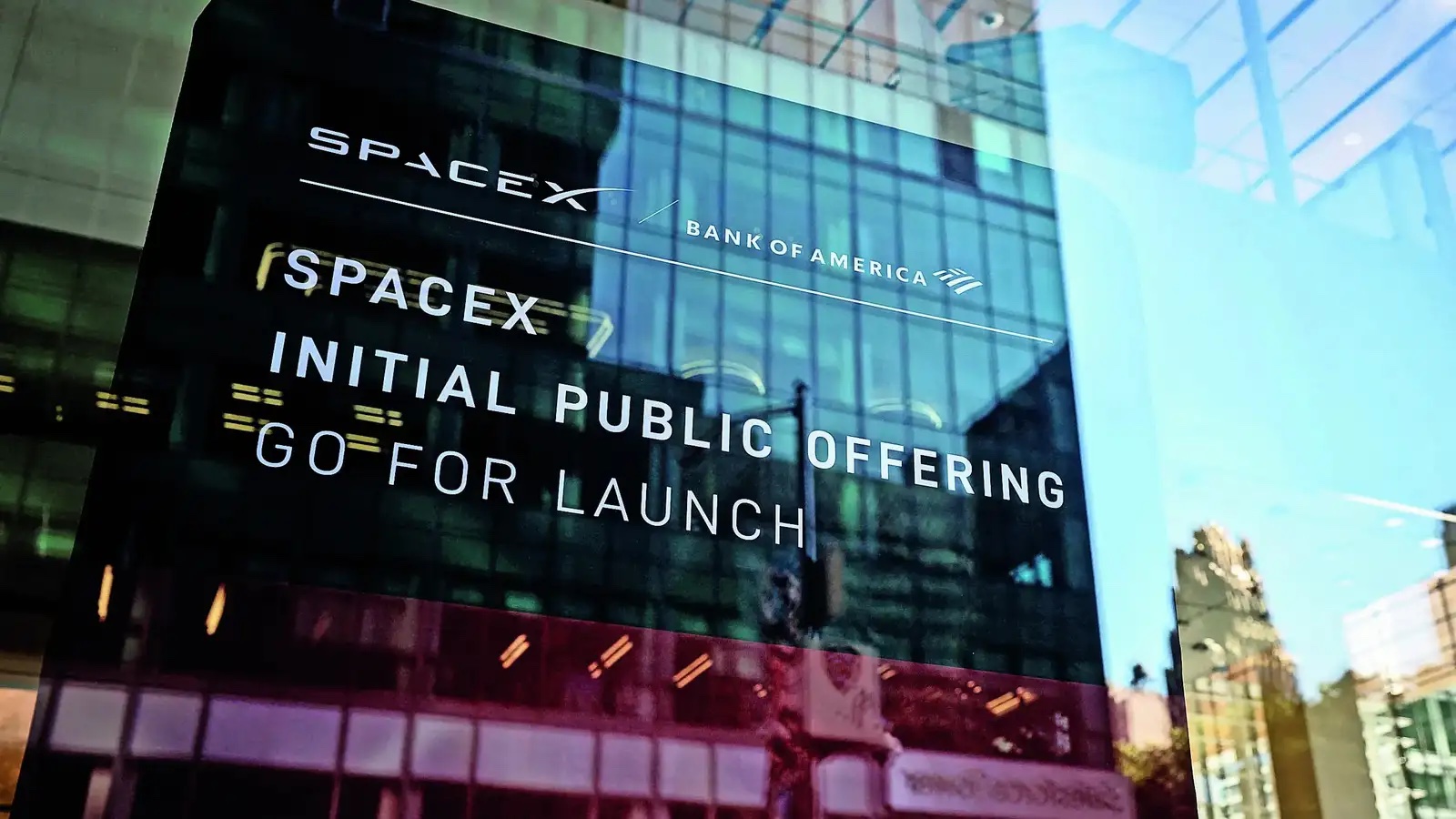
Elon Musk’s SpaceX has achieved a remarkable milestone by raising a record $75 billion in its historic IPO, positioning itself among the most valuable companies globally.
Elon Musk’s SpaceX has emerged as one of the world’s most valuable companies, having set its record-breaking initial public offering (IPO) at $135 per share and raising an extraordinary $75 billion from investors.
The offering, announced on Thursday, values the rocket, satellite, and artificial intelligence company at $1.77 trillion, establishing it as the largest IPO ever completed in the United States and surpassing the previous record set by Saudi oil giant Aramco in 2019.
The company sold 555.56 million shares in the offering and is anticipated to commence trading on the Nasdaq this Friday. With its latest valuation, SpaceX would position itself as the seventh most valuable publicly traded company in the United States, surpassing prominent firms such as JPMorgan Chase, Berkshire Hathaway, Eli Lilly, Meta Platforms, and even Musk’s own electric vehicle company, Tesla.
The blockbuster listing represents the result of months of meticulous preparations and an unconventional IPO process, during which Musk defied numerous established Wall Street traditions.
In a departure from the norm for major public offerings, SpaceX revealed its pricing while U.S. markets remained open and allocated 30% of its shares for retail investors, a notably larger share than what is usually observed in large IPOs.
Analysts indicated that the offering marked a new frontier for public markets.
“The true evaluation will come from how the market processes the IPO in the coming weeks, rather than focusing on just a single day,” stated Adam Sarhan, chief executive of 50 Park Investments in New York. The pricing was perfectly balanced, neither excessively high nor excessively low.
Rick Meckler, a partner at Cherry Lane Investments, noted that the process diverged significantly from conventional IPO practices.
“The pricing for SpaceX is truly in unexplored territory.” “I’ve only witnessed the price being determined through the usual process of price discovery based on orders,” he stated.
After the IPO, Musk will maintain significant control over the company, possessing around 82% of SpaceX’s voting power.
Established in 2002, SpaceX has evolved into the leading commercial space enterprise globally. The firm claims to have accounted for over four-fifths of all mass launched into orbit in the last three years, and its Starlink satellite internet service currently caters to millions of customers across 164 countries and territories.
Starlink currently accounts for the bulk of SpaceX’s revenue, while the company is also ramping up its investments in artificial intelligence via its xAI division. SpaceX has recently entered into a multi-year cloud computing agreement with Google, ensuring they have extra computing capacity as competition in the AI sector heats up.
Despite investor enthusiasm, some analysts have raised concerns about whether the company’s high valuation is warranted, especially considering its dependence on government contracts and anticipated growth projections.
“The financial forecasts remain uncertain due to the dependence on substantial government contracts,” stated Kim Forrest, chief investment officer at Bokeh Capital Partners. “Individuals purchasing the stock are investing in the future and humanity’s departure from Earth, rather than truly investing in a company.”
The IPO arrives alongside indications of a wider resurgence in the US public offerings market. Goldman Sachs has predicted that IPO proceeds may hit a record $160 billion in 2026, fueled by a robust pipeline of listings featuring significant artificial intelligence companies.