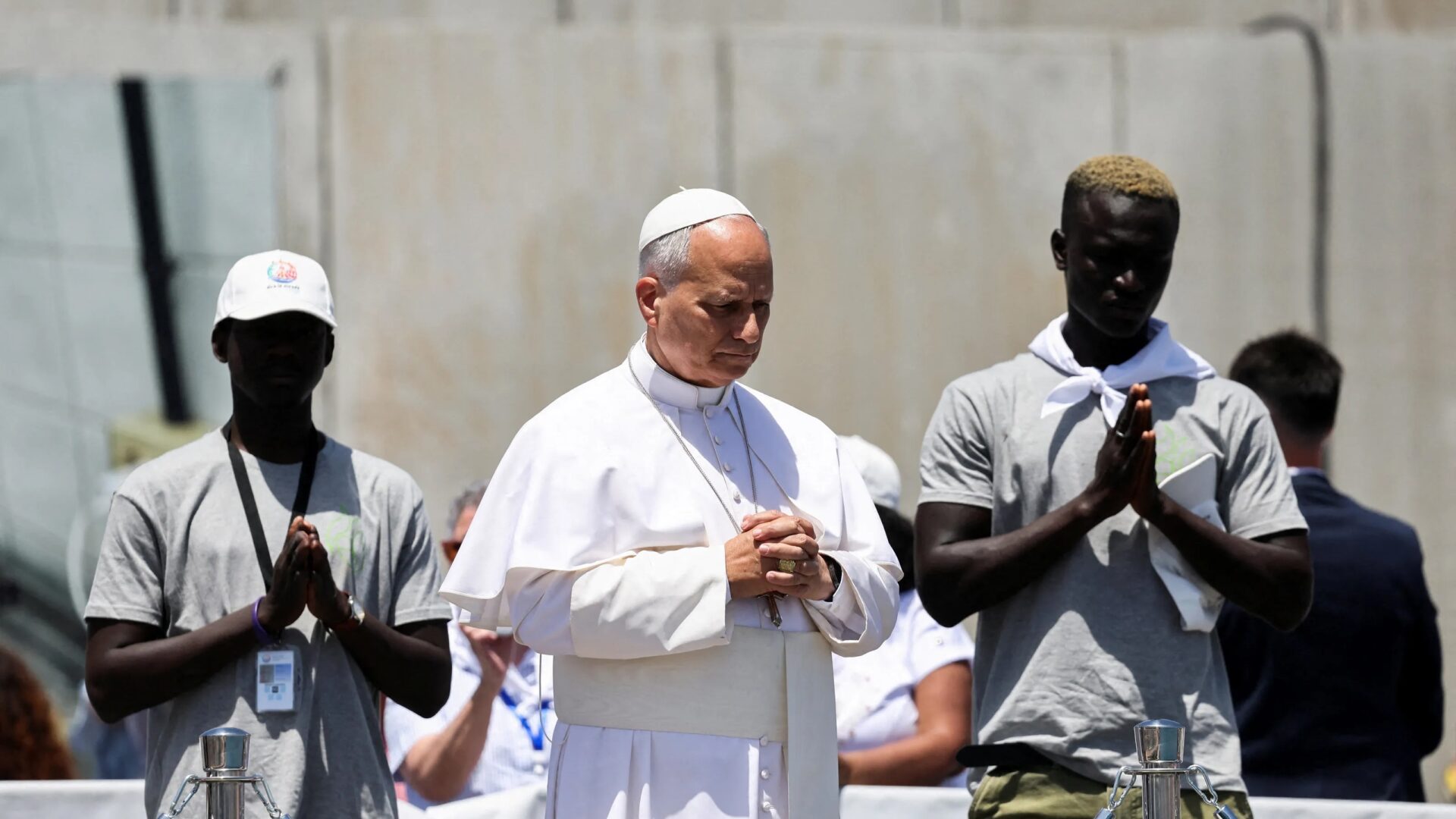
Pope Leo cautions Europe’s migrant traffickers to seek repentance or confront dire consequences
Pope Leo on Friday delivered a strong admonition to human traffickers and criminal organizations that prey on vulnerable migrants attempting to reach Europe via Spain’s Canary Islands, urging them to “repent” before God or risk facing eternal damnation.
On the last day of a week-long tour of Spain, during which the pontiff has called on global leaders to treat migrants with greater compassion, Leo expressed his desire to directly confront those who “exploit people’s desperation or orchestrate death routes.”
“Cease. Repent,” declared the first U.S. pope. For every life lost, every family deceived … you will have to stand before divine justice.
Repent while there is still time,” he urged, drawing on the Catholic belief that those who commit wrongdoings in life must confess their sins and seek forgiveness or face eternal damnation after death.
TEARS AND BLOOD OF MIGRANTS ‘CALL OUT TO GOD’
Leo, who has recently become more vocal in his critique of global leadership, is visiting the Canary Islands, a Spanish archipelago located off the western coast of Africa, as the final stop on his three-city tour of Spain.
The islands serve as a primary entry point into Europe for migrants, who undertake perilous journeys across the Atlantic, frequently on makeshift and overcrowded vessels.
On Thursday, during his initial day on the islands, the pope cautioned world leaders that history would judge those who permitted individuals escaping war or poverty to endure hardship.
During a meeting with charities assisting migrants on Friday, Leo expressed that the “tears and blood” of migrants who have been exploited in their attempts to reach Europe “cry out to God.”
He was speaking on the day the EU’s Migration Pact, which enforces stricter regulations on asylum, comes fully into effect.
Situated over 1,000 km (620 miles) from the mainland of Spain, the Canary Islands experienced a surge in migration in 2024, receiving 46,843 irregular migrants, in stark contrast to fewer than 1,000 in 2015, as per official statistics.
According to the NGO Caminando Fronteras, over 3,000 individuals lost their lives in 2025 while attempting to reach the islands.
Migrant smugglers and human traffickers are increasingly adept at exploiting geopolitical instability and economic pressures, adapting their business models to include online tools for recruitment and exploitation, according to a report by Europol in 2025.
This year, law enforcement dismantled a criminal network from Nigeria involved in human trafficking in Spain, as well as another operation exploiting vulnerable Ukrainian women who had received protection status in the country, according to Europol.
Last year, Spanish authorities dismantled a human trafficking ring that enticed over 1,000 women to the country with deceptive job offers, subsequently coercing them into sex work.
Migrants request ‘respect and humanity.’
Leo, who began his tour in Madrid, became the first pope to speak before the Spanish parliament, where he cautioned that rising conflicts were driving the world into a deep crisis.
He also visited Barcelona, where he inaugurated the latest of the towering geometric spires of the Sagrada Familia, now recognized as the tallest church in the world.
Crowds during Leo’s visit have been substantial. Over 1.2 million people gathered in one of Madrid’s main squares under intense heat on Sunday to see the pontiff, marking the largest event of his year-long papacy.
On Friday, the pope spent time in Tenerife, the largest of the Canary Islands, where he listened to testimonies from several migrants during his visit to an interim housing center that has welcomed approximately 70,000 migrants since its opening in 2021.
One woman, Bousso Diouf, expressed to the pontiff that migrants seek not special privileges, but rather “respect, humanity, and the opportunity to live with dignity.”
Leo was scheduled to leave for Rome at approximately 3 p.m. (1400 GMT).
Unlike much of Europe, Spain has taken a more welcoming approach towards migrants, implementing a program to provide residency to over half a million undocumented individuals.
The initiative has faced criticism from far-right leaders, and the country is grappling with the sluggish pace of granting legal status to thousands who remain in limbo.