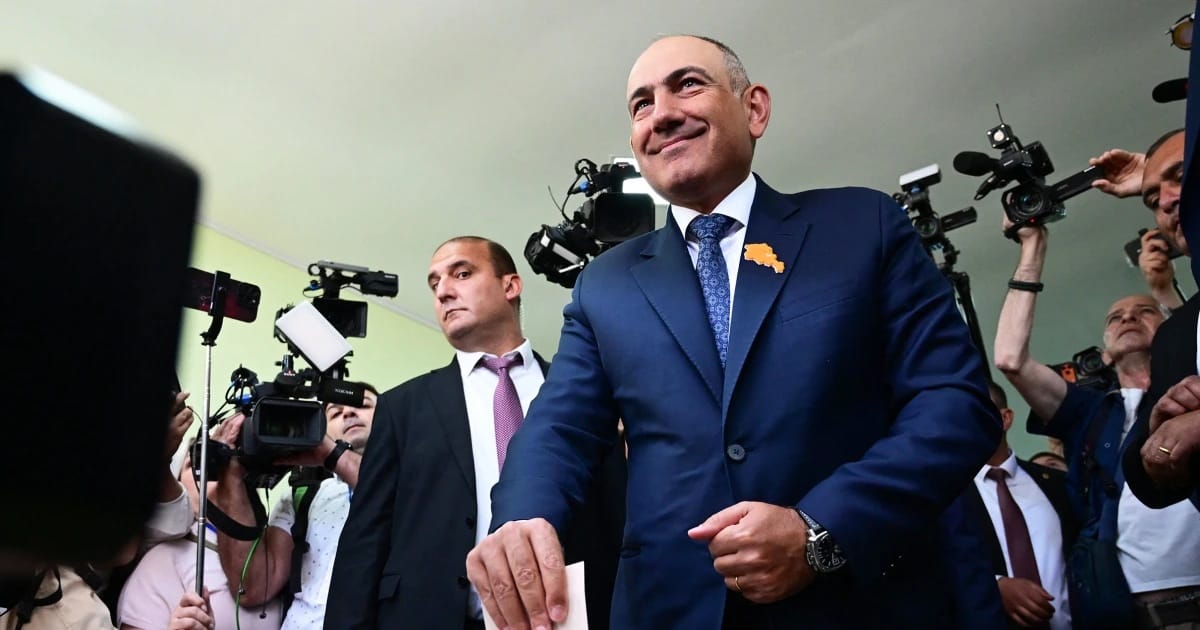
Pashinyan’s ruling party secured victory in Armenia’s election, solidifying the nation’s gradual movement towards stronger connections with the West.
The Armenian Prime Minister Nikol Pashinyan has solidified his political standing following a significant triumph by his Civil Contract Party in a national election, which was broadly regarded as a crucial evaluation of the nation’s foreign policy trajectory.
Official results indicated that Civil Contract secured 49.8 percent of the vote, leading the Strong Armenia Alliance, which garnered 23.2 percent, and the Armenia Alliance, which received 9.9 percent.
The election, conducted on Sunday, marked the first since Armenia’s military defeat to Azerbaijan in 2023 and was perceived as a referendum on Pashinyan’s attempts to align the country more closely with Western partners while preserving ties with Russia.
On Monday, Pashinyan proclaimed victory, stating that voters had opted for a future focused on peace, cooperation, and regional development.
“The Armenian people expressed their desire for peace, regional prosperity, and collaboration,” he stated.
France and the European Union positively received the outcome, commending Armenia’s increasing involvement with the West.
Despite a decrease in his popularity in recent years, Pashinyan’s party achieved a significant lead in an election involving 19 parties and alliances. According to electoral authorities, voter turnout was recorded at 59 percent.
Multiple opposition groups, such as the Strong Armenia Alliance and the Armenia Alliance, advocated for platforms that support stronger connections with Russia.
After the election, Pashinyan stated that Armenia would persist in enhancing its ties with Western nations while still being a member of the Russian-led Eurasian Economic Union.
The vote occurred in the context of escalating pressure from Moscow, which has cautioned Armenia about the economic repercussions of seeking closer ties with the European Union.
Recently, Russia has implemented restrictions on the importation of various Armenian products, such as flowers, fruits, vegetables, mineral water, and cognac.
Pashinyan has aimed to guide Armenia toward Europe by promoting legislation related to potential EU membership and endorsing a peace process with Azerbaijan, supported by the United States.
While Armenia has increased its interactions with Western countries, it is still quite distant from achieving European Union membership or candidate status.
Domestic criticism of Pashinyan persists, focusing on the Nagorno-Karabakh conflict, as opponents claim he has made excessive concessions to Azerbaijan in his quest for peace.
Public opinion continues to be split regarding the proposed peace agreement, highlighting the persistent discussion about Armenia’s future trajectory both domestically and internationally.