A Black talent manager introduced her creators to a fast fashion swimwear brand, and she received written evidence of the discrimination. Cupshe terminated one employee, issued an unsigned apology, and remained silent in public.
Cupshe was exposed for stating that it would not collaborate with Black individuals, with evidence coming directly from the brand’s own inbox.
On June 4, Niasia Boykin, the founder and chief executive of the Philadelphia-based influencer agency The Brownstone Collective, presented a selection of her creators to the swimwear label Cupshe for an upcoming campaign. The response she claimed to have received was quite direct and did not attempt to obscure its meaning with euphemisms. A representative named Sophie, writing from the company’s Influencer Relations team, informed her that the brand “would not collaborate with Black individuals for this campaign.” Boykin shared the screenshot on Threads and accurately labeled it for what it is. Racial discrimination serves as an unlawful justification for rejecting a business proposal.
Screenshot of a social media post claiming racial discrimination by Cupshe, accompanied by a preview of a follow-up message below.
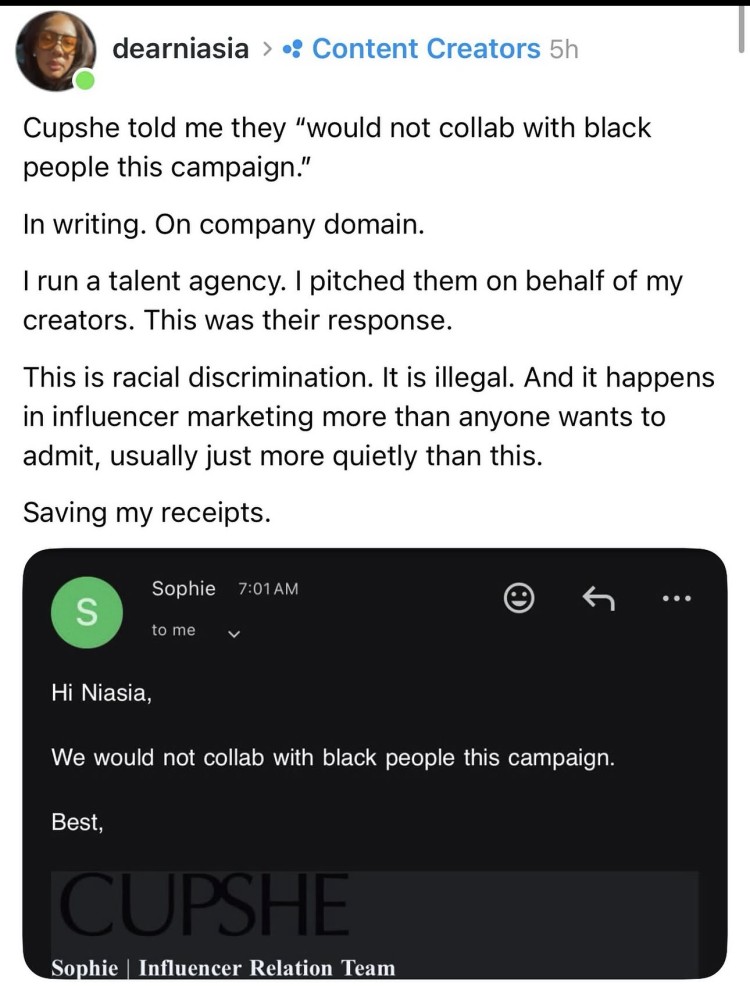
Cupshe faced backlash after allegedly stating it would not collaborate with Black individuals.
Trump addresses the topic of employment opportunities for the Black community.
As the post gained traction and individuals began to doubt its authenticity, Boykin remained steadfast in her position. She mentioned that she needed to read it three times to ensure her eyes weren’t deceiving her, and she highlighted that the message originated from a verified cupshe.com company domain rather than a fake account. That detail is significant, as it shifts the narrative from the straightforward possibility of someone faking an email to the more complex inquiry of how such a line appears in a brand’s official outbound communication initially.
Cupshe’s response to that question reveals a great deal about the operational practices of these companies. A few hours later, Boykin received another email. The brand expressed its shock and devastation, offered apologies for any harm caused, emphasized that the message did not align with its values or its partnerships with creators, and revealed that the employee responsible was no longer with the company. The apology lacked a signature. It originated from a shared inbox. As the calls for a boycott gained traction on Threads and other platforms, the brand remained silent on its own public social media channels.
So take a moment to embrace its entirety. A fast fashion swimwear brand established in Nanjing, China, in 2015, with its US headquarters in Manhattan Beach, California, has dedicated years to developing its American market through influencer marketing, a sector significantly driven by Black creators and Black consumers on a large scale. When a Black talent manager entered with that audience in tow, a member of the brand’s own team documented the rejection in writing, explicitly linking it to race. After going public, the company’s entire accountability strategy consisted of removing one individual from the payroll and issuing a nameless private apology.
That does not reflect accountability. That is merely an attempt at damage control masquerading as a sense of conscience.
Here is the section designed to help everyone move on from the past. A decision to exclude an entire race from a marketing campaign is not something that a solitary junior employee concocts on a Tuesday afternoon. Campaign casting mirrors the intended direction. It showcases the brand’s perception of its customer, the individuals it aims to feature in its imagery, and those it subtly determines are not worth the investment. Perhaps Sophie was the one who typed the sentence. The mindset that allowed the sentence to be articulated extended beyond her desk. Letting go of the messenger allows the system that generated the message to escape unscathed.
And the silence speaks for itself. A brand that genuinely perceived this as a singular betrayal of its core values would express that sentiment clearly and openly, with a recognizable name and face to support it. Instead, Cupshe addressed it like one would manage a leak rather than how one would rectify a wrongdoing. The communication to Boykin was confidential. The solution was internal. The public received nothing. The wager is that the news cycle shifts, the swimsuit images continue to circulate, and the summer promotions arrive before anyone recalls what the company stated when it believed no one beyond that conversation was paying attention.
Black spending power is not a favor that these brands offer us. It is a market they vie for, and one they forfeit the instant we choose to shift our focus elsewhere. Boykin transformed the private into the public. What occurs next determines if informing her that her clients were not the right fit for the campaign will cost Cupshe nothing or if it will result in losing the very audience it believed it could benefit from without ever showing them the respect they deserve.