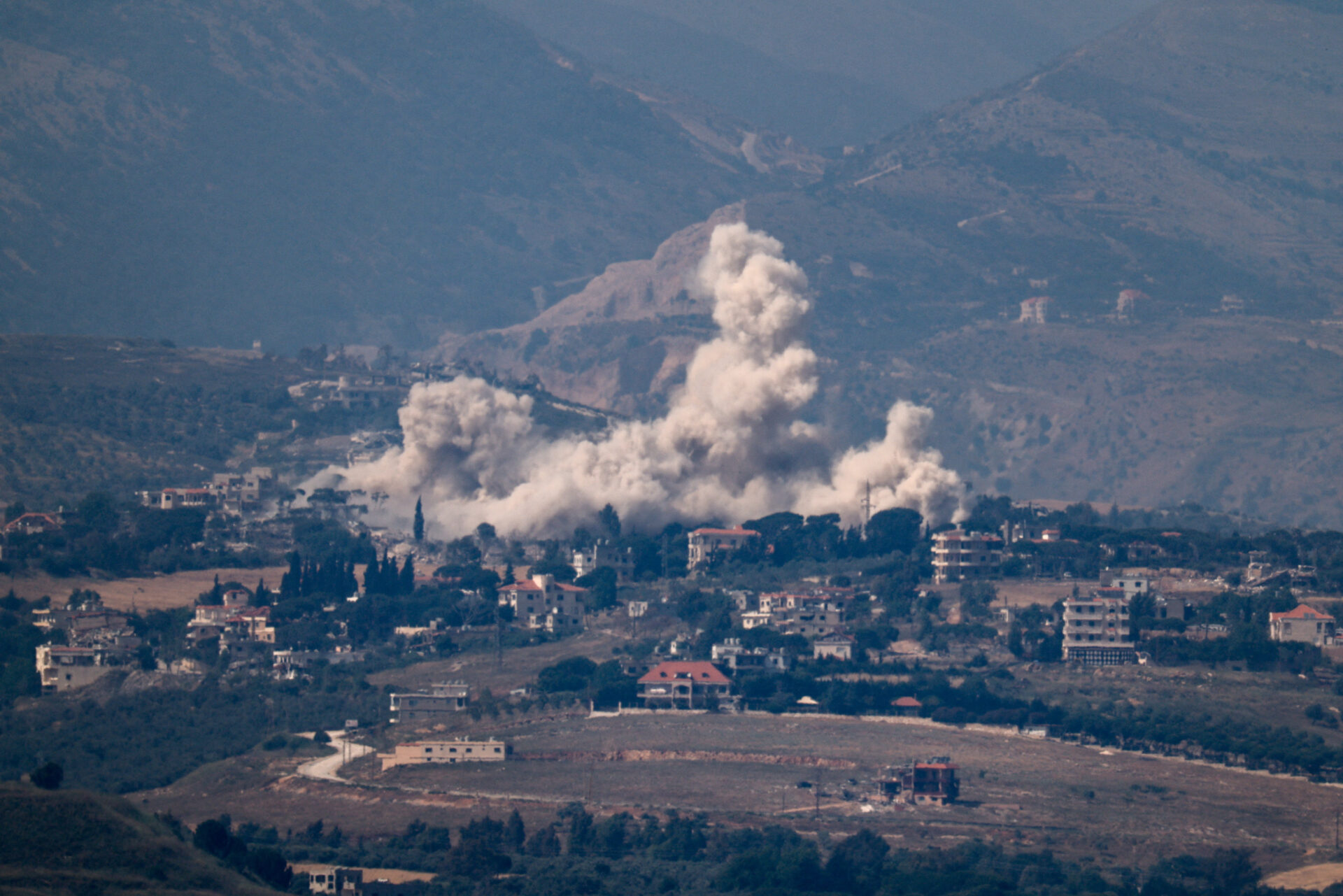
Lebanon announced a partial ceasefire between Hezbollah and Israel on Monday, marking a limited de-escalation of a conflict that has resulted in thousands of deaths and heightened tensions in the broader U.S.-Israeli war with Iran.
As stated by Lebanon’s embassy in Washington, the agreement will not resolve the conflict in that nation. It urges Israel to avoid conducting strikes on Beirut and its Hezbollah-controlled suburbs while the Iran-aligned group would cease its attacks on Israel.
Hostilities in southern Lebanon, where Israel launched an invasion in March, persisted on Monday evening. On Tuesday morning, the Israeli military announced that it had intercepted two projectiles that had crossed from Lebanon into northern Israel, with no injuries reported.
U.S. President Donald Trump, who initially revealed the agreement, stated that Hezbollah, via intermediaries, had committed to refraining from attacking Israel. No U.S. president has ever engaged in conversation with Hezbollah, whether directly or through intermediaries. The U.S. has classified the group as a terrorist organization.
Trump also stated that Israeli Prime Minister Benjamin Netanyahu consented to withdraw any troops that were preparing to launch an attack on Beirut.
Following Trump’s announcement, Netanyahu stated that Israel would persist with military operations in southern Lebanon, where ground forces are advancing toward the Zaharani River, marking their most significant incursion into Lebanon in 25 years.
Hezbollah lawmaker Hassan Fadlallah stated that the militia would advocate for a complete ceasefire throughout Lebanon as a prerequisite for the withdrawal of Israeli forces. He did not indicate whether the group would cease its strikes on Israeli territory.
Lebanon announced its intention to pursue an expansion of the ceasefire during discussions with Israel in Washington on Wednesday.
That may pave the way for renewed attempts to conclude the three-month-long conflict that commenced with U.S. and Israeli strikes on Iran. The process has remained in a state of uncertainty for weeks, held in place by a delicate ceasefire, as negotiators struggle to reach consensus on a foundational framework for peace discussions.
The Israel-Hezbollah war began on March 2 because of the larger conflict and has remained intertwined with it since that time.
Iran has demanded a cessation of Israeli assaults in Lebanon as a prerequisite for any agreement to conclude the war, while the U.S. maintains that the two conflicts are distinct. “Iran and the U.S. have a clear ceasefire that applies to all fronts, including Lebanon,” stated Iranian Foreign Minister Abbas Araqchi.
Iran has issued a warning regarding the potential cessation of negotiations.
Iranian state media reported earlier on Monday that Tehran is suspending indirect peace negotiations with the U.S. and may terminate a ceasefire that has mostly been maintained since early April, referencing the conflict in Lebanon.
There was no direct confirmation of the reports from Iranian officials, and Trump informed an NBC reporter that he had not received any communication from Iran. In a CNBC interview on Monday, he remarked that the peace talks had “started to get dull” and expressed indifference regarding their conclusion.
I really don’t care; I couldn’t care less,” Trump stated. Since mid-March, he has consistently claimed he is on the verge of signing a peace agreement, yet he has not followed through. Despite the ceasefire, Iran and the U.S. have engaged in multiple exchanges of strikes over the past week.
Meanwhile, the head of Iran’s Revolutionary Guards Quds Force, Esmaeil Qaani, issued a threat to extend its blockade of the Strait of Hormuz to the Bab El Mandeb Strait, another critical chokepoint at the mouth of the Red Sea.
Iran has effectively restricted maritime traffic in the Gulf, which prior to the war accounted for one-fifth of the global oil and liquefied natural gas supply, resulting in a significant increase in prices.
Oil prices increased by 4% on Monday due to the escalating tensions.