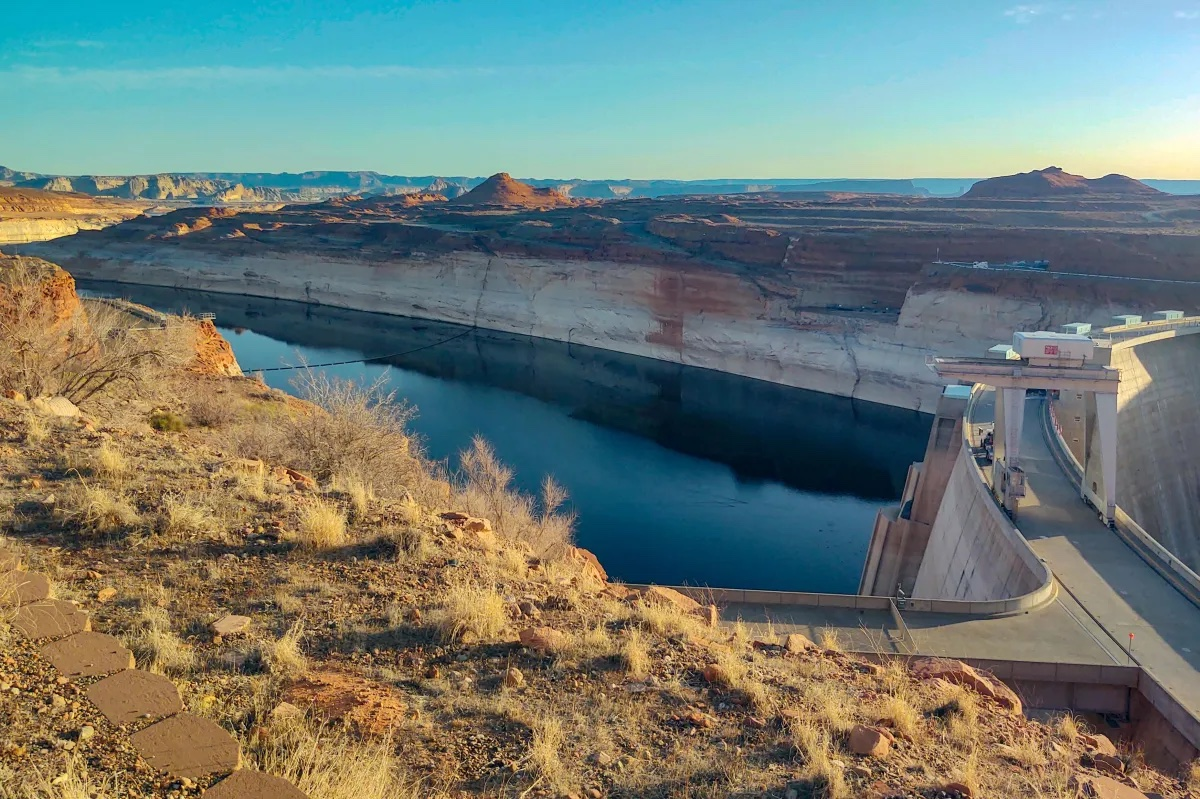
The US government has proposed significant reductions in Colorado River water allocations as an escalating drought jeopardizes water supplies in Arizona, California, and Nevada.
The United States government has put forth significant reductions to Colorado River water allocations for Arizona, California, and Nevada, as escalating drought conditions and excessive use persist in putting pressure on the river system.
According to the proposal from the US Bureau of Reclamation, the three lower-basin states may need to cut water usage by as much as three million acre-feet each year over the next ten years to maintain stable water levels at Lake Mead and Lake Powell.
The suggested cuts, potentially reaching close to 40 percent of existing water supplies, are nearly twice the 1.6 million acre-feet reduction previously put forth by the three states on May 1.
During a meeting of Arizona water stakeholders on Wednesday, Tom Buschatzke, the director of the Arizona Department of Water Resources, shared details of the federal plan.
He characterized the suggested cuts as “sobering,” cautioning that the Central Arizona Project (CAP), responsible for transporting Colorado River water throughout central and southern Arizona, might encounter significant disruptions.
“That’s us, that’s Arizona, and it’s possible that the Central Arizona Project could reach zero,” Buschatzke stated.
The proposal indicates that water releases from Lake Powell and Lake Mead would vary from five million to 12 million acre-feet each year, contingent upon the conditions of the reservoirs.
Buschatzke cautioned that if weather conditions do not improve substantially, water releases are expected to stay close to the lower end of that range.
“I believe we all understand that unless Mother Nature fulfills her role, it will likely be nearer to the lower end of this range,” he added.
The Colorado River provides water to seven western states in the US, supporting millions of households, farms, and businesses.
Federal officials indicated that the new framework aims to ensure stability while permitting flexibility for future consensus-based agreements among the states that share the river.
The Bureau of Reclamation indicated that the strategy might be executed either in accordance with current Colorado River laws or via negotiated agreements among the states.
This year marks the expiration of the existing water-sharing framework for the river, and the seven basin states are currently at an impasse in their negotiations.
According to the 1922 Colorado River Compact, California possesses the highest priority rights to allocations of river water, a consideration anticipated to influence the distribution of future reductions.