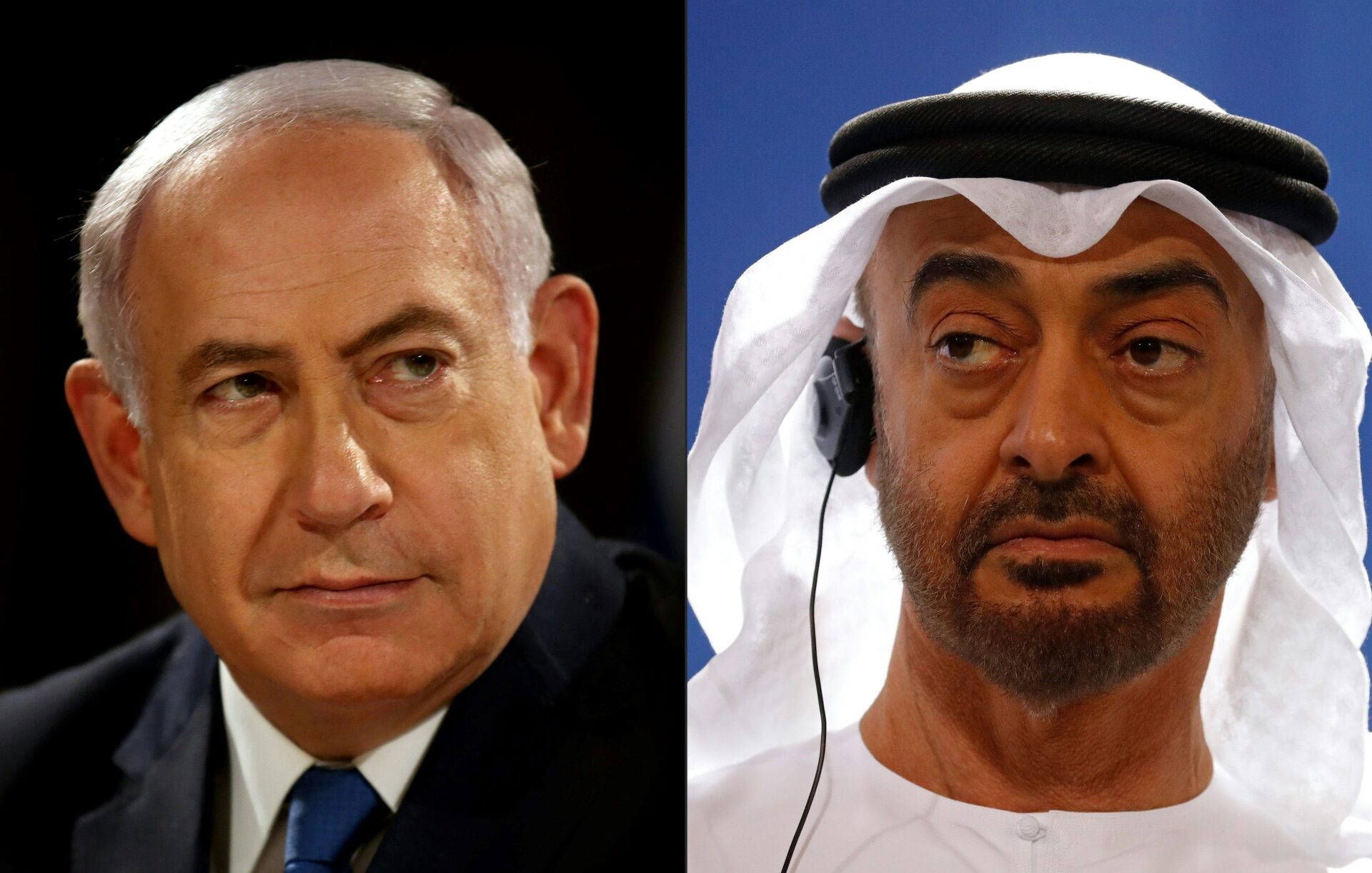
The UAE refuted Netanyahu’s assertion of a covert visit, deeming the reports of undisclosed arrangements completely baseless.
The United Arab Emirates has firmly rejected a statement from the office of Israeli Prime Minister Benjamin Netanyahu alleging that he secretly visited the country and met privately with President Sheikh Mohammed bin Zayed Al Nahyan, calling these claims “entirely unfounded.”
On Wednesday, the UAE’s Ministry of Foreign Affairs issued a statement denying any claims of undisclosed diplomatic engagement occurring.
“Any claims regarding unannounced visits or undisclosed arrangements are entirely unfounded unless officially announced by the relevant authorities in the UAE,” the ministry stated, emphasizing that Emirati relations with Israel “are public” and “based on transparent and official arrangements.”
The clarification came after a statement from Netanyahu’s office that implied he had visited the UAE during the recent conflict with Iran and had met with Sheikh Mohammed bin Zayed. The Israeli Prime Minister’s Office stated that the purported meeting resulted in what it termed a “historic breakthrough” in the relationship between the two nations.
A source familiar with the matter reported that Netanyahu and Sheikh Mohammed convened in the oasis city of Al-Ain, close to the Oman border, on 26 March, with their discussions extending over several hours. According to the same source, Mossad chief Dedi Barnea conducted at least two visits to the UAE during the conflict with Iran to coordinate military-related actions. The Wall Street Journal was the first to disclose the reported intelligence visit.
The diplomatic dispute arises amid the evolving yet delicate relationship between the UAE and Israel, which has developed following the normalization agreement established by the 2020 Abraham Accords. Even with public cooperation, the relationships continue to be politically sensitive, especially in times of regional conflict.
Following the attacks during the Iran War, the UAE has significantly bolstered its strategic partnerships with the United States and Israel. It perceives its connection with Israel as a means of exerting regional influence and as a direct diplomatic link to Washington.
In the course of the conflict, it has been reported that Israel dispatched Iron Dome missile defense batteries, along with personnel for their operation, to the UAE, as stated by U.S. Ambassador to Israel Mike **Haukkabee**.
The UAE continues to be a significant regional business and financial center, as well as one of Washington’s important alliRecentlyears, it has adopted a bold foreign policy, broadening its influence throughout the Middle East and certain regions of Africa.
Iranian strikes on Gulf states in response to US-Israeli actions reportedly impacted the UAE more significantly than some of its neighbors, targeting civilian infrastructure and energy facilities.
In contrast to many Gulf nations, the UAE has developed pipeline infrastructure that enables it to circumvent the Strait of Hormuz for certain oil exports, thereby lessening its susceptibility to maritime disruptions. Analysts caution that extended instability could jeopardize its status as a global economic hub recognized for security, connectivity, and a favorable business environment.