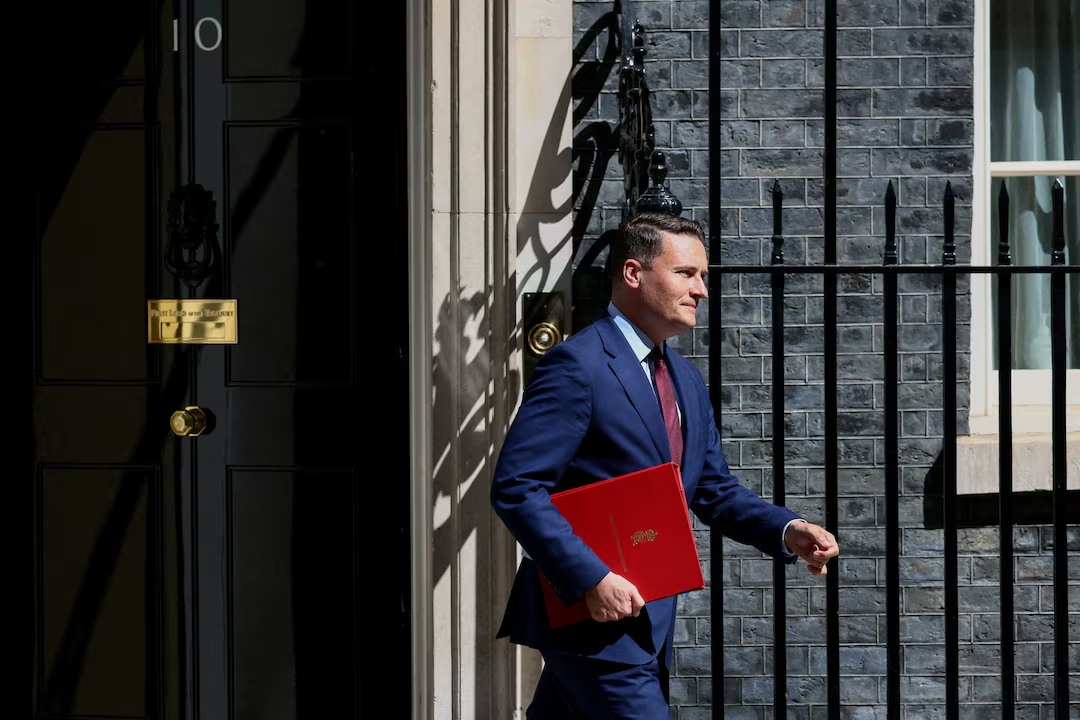
Senior UK minister has stepped down and is demanding a leadership contest to remove Prime Minister Starmer
Wes Streeting, a member of Labour, stepped down from his position as health minister on Thursday, urging for a leadership contest aimed at removing Keir Starmer. He criticized the British prime minister for presiding over political stagnation and shifting the responsibility for his government’s shortcomings onto others.
The recent local elections yielded disastrous outcomes for the governing Labour Party, plunging Britain into yet another crisis, nearly two years after Starmer secured a significant majority with promises of stability and an end to a decade of political turmoil.
Following days of increasing pressure from Labour lawmakers urging Starmer to either resign or provide a timeline for his departure, Streeting emerged as the first senior minister to publicly address the situation, stating he was stepping down because “it is now clear you will not lead the Labour Party into the next general election”.
However, he did not initiate a formal challenge, and other senior cabinet ministers either voiced their support for Starmer or chose to stay in their government roles, at least for the time being.
“It is now evident … that Labour MPs and Labour Unions desire the forthcoming debate to focus on ideas rather than personalities or trivial factional disputes,” he stated in his resignation letter. “It must be inclusive, and it requires the strongest possible pool of candidates.”
The announcement does not meet the criteria for initiating a formal contest.
Although his announcement did not compel the initiation of an official leadership contest, Streeting’s critique was sharp.
“In the absence of vision, we find ourselves in a void.” “Where we require guidance, we find ourselves adrift,” Streeting stated. “Leaders assume accountability, yet frequently this has resulted in others bearing the brunt of the consequences.”
A source close to Streeting indicated that the former health minister possessed the necessary support to initiate a formal leadership challenge; however, he chose not to prompt an immediate contest, believing it would be more advantageous for Starmer to establish a structured timetable.
Starmer has consistently expressed his commitment to retaining his position, and insiders indicate that he is resolute in facing any potential contest, which may involve challenges from Streeting as well as from prominent left-wing ministers within the party.
Sterling declined following Streeting’s resignation.
It brings us nearer to a challenge for Labour leadership. “How many steps are between here and there is still uncertain,” said Nick Rees, head of macro research at Monex Europe in London.
PROSPECTIVE CANDIDATES
On Thursday, Angela Rayner, the former deputy of Starmer, announced that she had been cleared of any deliberate wrongdoing regarding her tax affairs, which had posed a barrier to any leadership contest. However, she refrained from indicating whether she intended to pursue a formal bid.
Additional possible candidates from the “soft left” faction of the party, who advocate for increased state involvement in essential industries and support workers’ rights, include Greater Manchester mayor Andy Burnham and Ed Miliband, the minister for energy security and net zero.
Burnham currently lacks the required seat in parliament to initiate a challenge. Even if a lawmaker were to step aside to accommodate him, the process could extend over weeks or even months, potentially disqualifying him from any race.
Another potential candidate is armed forces minister Al Carns, a relatively unknown ex-Royal Marine regarded by some in Labour as a new face that could rejuvenate the party.
As potential candidates seek to attract supporters, Starmer has his own base of backing.
Bridget Phillipson, the education minister, expressed her disappointment over Streeting’s decision to resign, while reaffirming her support for Starmer and indicating that the remainder of the prime minister’s cabinet was also in agreement. “This is now an opportunity for us to pause, take a breath as a party, and attempt to move forward from all of this,” she conveyed to reporters.
Starmer, a 63-year-old former lawyer, has embraced a “business as usual” stance, while his finance minister, Rachel Reeves, cautioned lawmakers on Thursday about the dangers of “plunging the country into chaos” at a moment when Britain’s sluggish economy was beginning to improve. The economy experienced an unexpected growth in March.
BOSS STATES THAT BUSINESSES ARE AFFECTED BY TURMOIL
Although the calls for him to resign diminished on Wednesday, as his government looked to King Charles to outline its agenda for a new parliamentary term, Thursday presented yet another challenging day for Starmer.
The possibility of yet another leadership contest to select Britain’s seventh prime minister in approximately a decade has frustrated business leaders, who caution that it will discourage investment—an area the Labour government has indicated needs to enhance in order to revitalize the country’s prospects.
The recent political instability has led to an increase in borrowing costs, causing some investors to feel apprehensive about the potential election of a more left-leaning, tax-and-spend Labour prime minister.
The head of Aviva, one of the largest financial firms in Britain, expressed concerns about the negative impact of ongoing turmoil on businesses. “In my six years as CEO, there have been too many shifts in government strategy and leadership,” Amanda Blanc shared with Reuters. “I believe this is detrimental to a significant economy like the UK and affects our international reputation.”($1 is equivalent to 0.7398 pounds)