British Prime Minister Keir Starmer will try to regain control over his Labour Party on Wednesday, when his government releases 37 bills for the next sitting of parliament. These bills include ones to improve national security and economic growth.
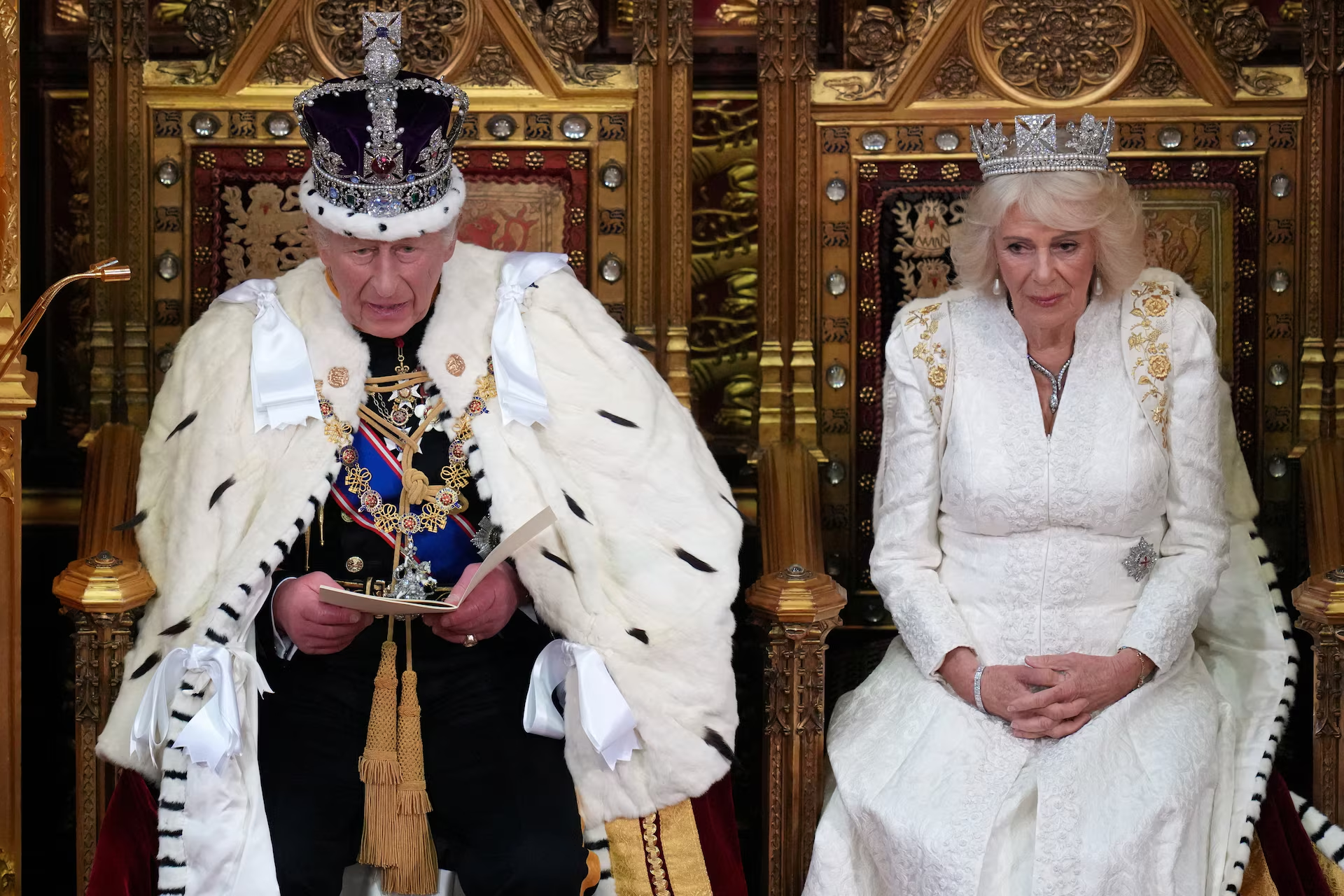
The monarch gave the king’s speech, but it was written by government officials. It came after nearly a quarter of Starmer’s lawmakers asked him to step down because of last week’s disastrous local election results.
Here are a few of the government’s most important plans:
LINKS WITH THE EU
The European Partnership Bill gives the government more power to carry out current and future agreements with the European Union. The goal is to improve trade and investment ties between Britain and the EU, which is its biggest trading partner.
The government said the laws would be necessary to carry out deals that were just reached with the EU regarding energy, trading emissions, and the food and drink industry.
The government was told to pay attention to economic growth.
A bill regulating growth will tell officials in charge of things like health and safety, the environment, and economic growth that they need to put these things first.
This will let companies in fields like AI, defense, and medical services try new products in a controlled environment before putting them on the market.
The government said that Britain’s rules are “often complicated, risk-averse, and slow to adapt.”
SAFETY FROM OTHER COUNTRIES INTERFERING
The Tackling State Threats Bill will make it easier to figure out which groups are working for unfriendly foreign states and punish them.
Under the National Security Act, the legislation will let the police and judges look into and bring to justice people who do sabotage and spying on their behalf.
CHANGES TO STRIP PEERAGES
The Removal of Peerages Bill will make it easier to take away the titles of disgraced former House of Lords members.
Politicians who quit or are kicked out of the upper house can still use the term “Lord” for now.
The bill comes after it was revealed that Peter Mandelson, who was arrested earlier this year on suspicion of misconduct in public office because of his ties to disgraced financier Jeffrey Epstein, could still use the term “Lord” even though he had quit Parliament.
NEW ASYLUM RULES THAT ARE TOUGHER
The government wants to pass a new immigration bill that will make it harder for people seeking protection to come to Britain.
Asylum seekers will only have one chance to question claims that were turned down, so the two-tiered appeals system will be replaced with a single appeals body.
The law will also make it harder for judges to understand Articles 3 and 8 of the European Convention on Human Rights. These articles safeguard individuals from cruel or degrading treatment and grant them the right to a family and private life.
ENERGY SAFETY
To make Britain’s energy security better, the government wants to pass several bills, such as ones that increase the use of nuclear energy and break the link between unstable gas prices and rising power prices.
This includes an energy independence bill that aims to speed up the switch to clean energy by making it easier to use technologies like offshore wind, hydrogen, and smart grids.
LOWERING THE AGE TO VOTE TO 16
A Representation of the People Bill will carry out a plan to lower the voting age in all UK elections by two years to 16. This will be a big change to the country’s democratic system.
The government stated that the change aimed to increase voter participation and foster trust in the electoral process.
NO WELFARE LAWS IN PLACE
The government spends more than 400 billion pounds ($300 billion) a year on welfare reform, but no laws are passed to deal with it.
A plan to lower the cost of welfare was shelved in July after Starmer’s lawmakers rose up against it.