Saudi Aramco Reports 25% Increase in Profits During Strait of Hormuz Crisis
Saudi Aramco reports significant quarterly profits as tensions in Hormuz impact global oil supply and lead to a sharp increase in fuel prices.
On Sunday, Saudi Aramco announced a 25 per cent increase in its first-quarter profit, demonstrating its resilience amid U.S.-Iran war tensions that are affecting shipping in the Strait of Hormuz. The state oil giant’s East-West crude pipeline is operating at full capacity to help offset the impact on supplies.
The leading oil exporter in the world reported a net profit of $32.5 billion for the three months ending March 31, surpassing the LSEG consensus estimate of $30.95 billion.
Total revenue increased by almost 7 percent compared to the previous year, reaching $115.49 billion, driven by higher prices and sales volumes of crude oil, refined products, and chemicals.
Iran’s blockade of shipping through the vital Hormuz waterway, in light of the U.S.-Israeli conflict that has restricted energy supply and driven prices up, has led Aramco to increase crude flows from its east coast to the Red Sea port of Yanbu, according to Reuters.
“Our East-West Pipeline, which has achieved its peak capacity of 7.0 million barrels of oil per day, has demonstrated its importance as a vital supply line, assisting in alleviating the effects of a global energy crisis,” stated Aramco Chief Executive, Amin Nasser, who emphasized that “a dependable energy supply is essential.”
The pipeline has the capacity to deliver approximately 2 million barrels per day to refineries located on the west coast of Saudi Arabia, while reserving 5 million barrels per day for export purposes.
In the course of the war, Saudi Arabia reduced its output by 2 million barrels per day following Iran’s blockade of Hormuz, a crucial waterway that transported a fifth of the world’s oil supply prior to the conflict. The line primarily transports Arab Light and a limited amount of Arab Extra Light, while heavier grades have been reduced.
Aramco reported an adjusted quarterly net profit of $33.6 billion, surpassing the median analyst estimate of $31.16 billion provided by the company. The figure excludes $1.06 billion in non-operational accounting items.
Additionally, capital expenditure decreased modestly to $12.1 billion in the quarter, down from $12.5 billion the previous year, and significantly lower than the $13.4 billion recorded in the fourth quarter. Aramco has detailed a capital expenditure of $50-55 billion for this year.
Aramco announced a first-quarter base dividend of $21.9 billion, reflecting a 3.5 percent increase year-on-year, which will be payable in the second quarter. This aligns with the anticipated total dividends of $87.6 billion for 2026. In 2023, it also introduced a performance-linked dividend associated with free cash flow.
The Saudi government depends significantly on Aramco’s revenues to finance domestic expenditures and address budget shortfalls. The government possesses nearly 81.5 percent of the company, whereas the Public Investment Fund (PIF) controls 16 percent.
Similarly, free cash flow decreased to $18.6 billion from $19.2 billion the previous year, affected by a $15.8 billion increase in working capital. As of March 31, Aramco’s gearing, which assesses its debt in relation to equity, increased to 4.8 percent from 3.8 percent at the close of 2025.
Trump: Iran Engaging in Deceptive Tactics with the US and the Entire World
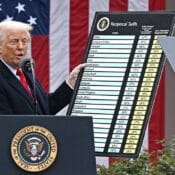
On Sunday afternoon, President Donald Trump released a statement on Truth Social, asserting that Iran “has been playing games with the United States, and the rest of the World, for 47 years.” The president refrained from discussing an Iranian response or indicating whether he or his administration officials were considering any options; however, he cautioned, “They will be laughing no longer!”
Trump has consistently maintained that the ceasefire is still in effect, even in light of the ongoing hostilities and corresponding naval blockades. Last week, the U.S. executed strikes against Iran in response to an attack on U.S. Navy destroyers, with Trump initially downplaying the situation as merely “a love tap.”
In a comprehensive interview broadcast on Sunday during “Full Measure,” Trump stated that the U.S. has achieved “probably 70 percent” of its objectives, asserting that Iran possesses “no leaders” and “no military.” However, he noted that combat operations are still ongoing.
Iranian President Masoud Pezeshkian stated in a post on X Sunday, “We will never bow our heads before the enemy, and if discussions of dialogue or negotiation come up, it does not signify surrender or retreat.”
Additionally, Iran’s Deputy Foreign Minister for Legal and International Affairs, Kazem Gharibabadi, cautioned that “any deployment and stationing of extra-regional destroyers around the Strait of Hormuz, under the pretext of ‘protecting shipping,’ is merely an escalation of the crisis, the militarisation of a vital waterway, and an effort to obscure the true root of insecurity in the region.”
The ongoing war is shaking the global economy, and Americans are experiencing the impact at the gas station.
The current average price of petrol per gallon stands at $4.52 and is on the rise, as reported by the motorist group AAA. The average from last year stood at $3.14.
The Strait of Hormuz, a crucial trade route responsible for 20 percent of the world’s oil flow, remains closed by Iran, despite global appeals for the safe passage of cargo ships.