The economies of the Gulf Cooperation Council (GCC) are facing their most severe economic crisis since the pandemic, with several nations anticipated to experience contraction this year due to the spillover effects of the U.S. The Israel conflict, which is occurring close to their borders, looms large.
The war’s repercussions have profoundly impacted the energy market, which serves as the lifeline for Gulf economies. The conflict has led to a significant increase in oil prices and initiated a historic supply shock, reminiscent of the events of the 1970s.
Consequently, economists significantly reduced their 2026 growth forecasts in the poll conducted from April 8 to 24, with certain countries shifting from anticipated growth to outright contraction. A partial recovery is anticipated next year.
Past instances of elevated oil prices have provided an economic boon to nations in the region, which are all significantly dependent on energy exports.
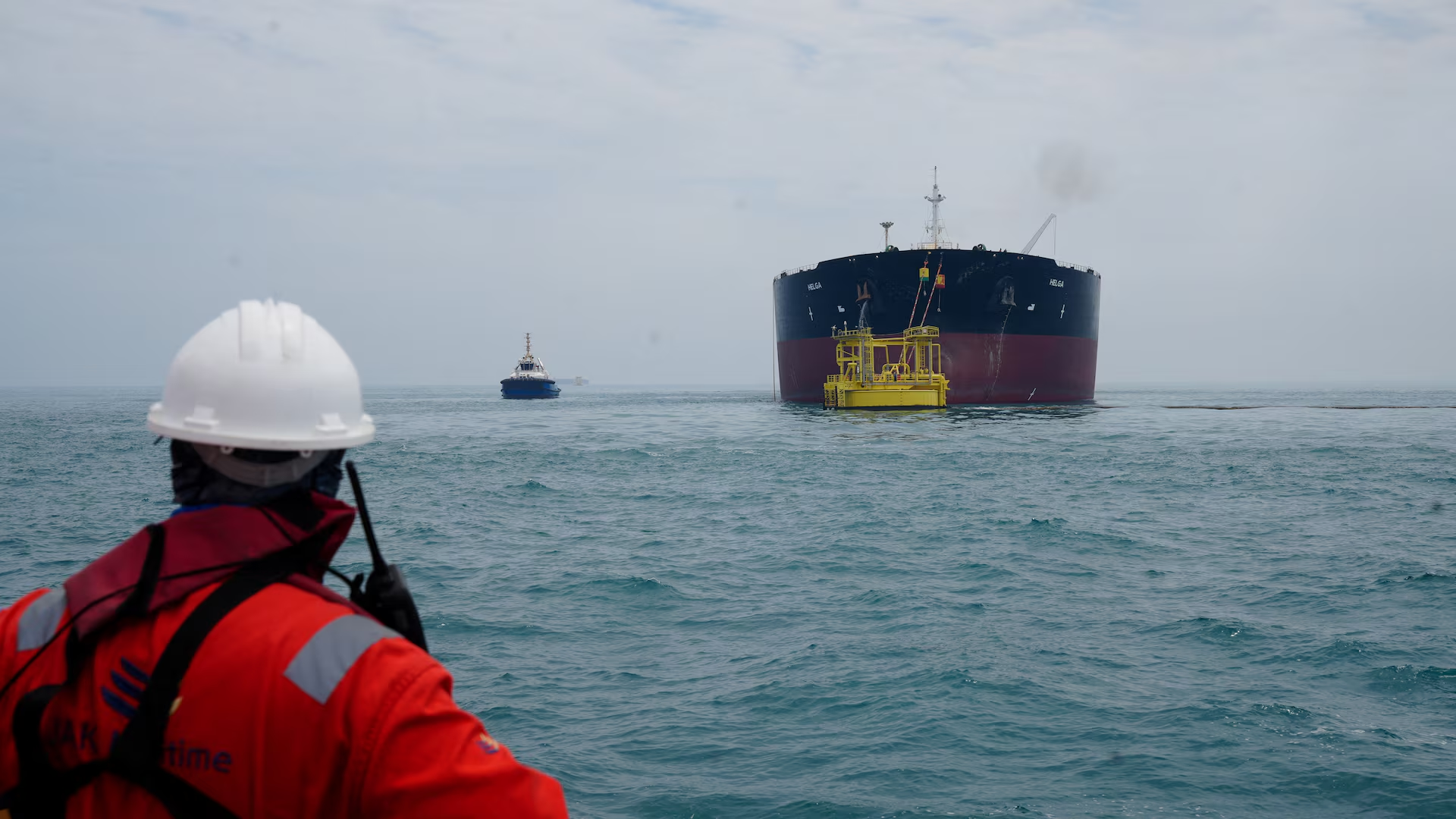
The near-total closure of the Strait of Hormuz, a vital passage for one-fifth of the global energy supply, combined with damage to refineries and gas plants in Saudi Arabia, the United Arab Emirates (UAE), Kuwait, and Qatar, has severely impacted the economies of the region.
Despite oil prices remaining approximately 40% higher than prior to the onset of the war nearly two months ago, the economies of Qatar, Kuwait, and Bahrain are now projected to contract by 6.0%, 4.4%, and 2.9%, respectively, this year. This marks a complete turnaround from the anticipated growth rates of 4.9%, 3.4%, and 2.9% projected in January.
Growth in the UAE is now perceived as stagnating, in contrast to the 5.0% expansion forecasted three months prior.
“We do not anticipate a straightforward return to the growth trajectory seen before the war,” stated Ralf Wiegert, head of MENA economics at S&P Global Market Intelligence. “The GDP level that will result post-war is evidently lower for the coming years, even with a relatively quick recovery…The complete rebuilding of damaged assets and re-establishment of supply chains will require the entirety of the second half of 2026.”
Experts anticipate that Saudi Arabia, the largest crude exporter globally, along with Oman, will navigate the shock with a bit more resilience. The survey of 18 economists predicts that their economies will grow by 2.6% and 2.2% this year. However, both figures are significantly lower than the January forecasts of 4.3% and 2.8%.
“The second layer of shock is the non-oil economy, particularly significant for Saudi Arabia, the UAE, and Qatar,” stated Lluis Dalmau Taules, an economist at Allianz. “The Middle East has been the fastest-growing region in terms of tourism over the past few years, so the situation is clearly going to evolve, which will affect retail and other sectors.”
Rapid Recovery in 2027
Economists anticipate a swift recovery next year, contingent upon the assumption that the conflict concludes promptly. Qatar, the UAE, and Kuwait are projected to experience growth rates of 7.8%, 5.4%, and 5.0% in the upcoming year, respectively.
Saudi Arabia, Bahrain, and Oman are projected to grow by 4.5%, 4.3%, and 2.8%, respectively.
The perspectives expressed largely coincide with the International Monetary Fund’s forecast that energy production and transportation in the region will recover and stabilize in the upcoming months. Economists at Goldman Sachs observed, “The extended delay in achieving full production capacity due to damage and shut-ins will have a considerable yet uneven effect on GCC economies and public finances.”
“In the longer term, we anticipate a strong rebound in economic activity overall, supported by significant public investment, which will be financed by a recovery in hydrocarbon revenues and substantial government savings.”
Rising oil prices are fueling inflation worldwide, and the Gulf economies are not exempt.
The median poll indicated an expected average inflation rate of 2.4% in Bahrain for 2026, a significant increase from the 1.4% forecast made in January.
In the UAE, Qatar, Kuwait, and Oman, inflation is projected to average 2.6%, 2.6%, 2.9%, and 1.7%, respectively, in contrast to the predictions of 1.9%, 2.0%, 2.3%, and 1.4% made three months ago. The forecast for Saudi Arabia remained steady at 2.0%.