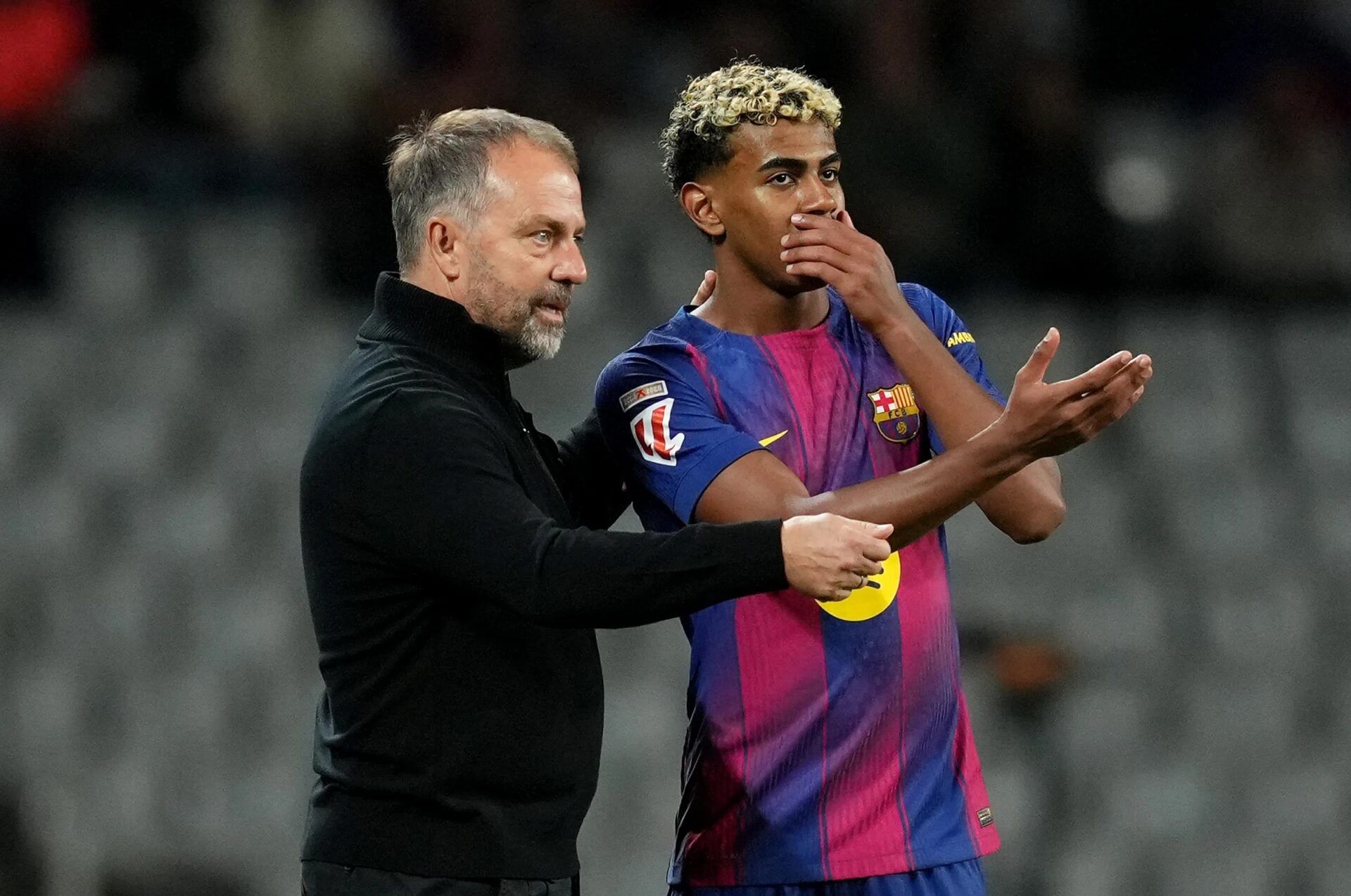
Lamine Yamal and Barcelona: How He Alters the Preparation of Defenders
Certain attacking players contribute beyond merely enhancing a team’s offensive capabilities. They compel adversaries to modify their defensive strategies prior to the start of the match. Lamine Yamal undoubtedly fits into that category. Barcelona’s official profile highlights him as a player who excels at taking on opponents, generating opportunities, and providing the flexibility to play as a striker, attacking midfielder, or right winger.
The significance of that combination lies in the fact that defenders are not gearing up for a typical touchline winger when they encounter him. A typical right winger can usually be managed with a well-known strategy: direct him wide, postpone the cross, rely on the full-back, and safeguard the box. Yamal presents a unique challenge. He is capable of maintaining width, receiving the ball at his feet, driving inside, combining swiftly, or releasing the ball early and repositioning himself. Opponents face a challenge not just from his skill with the ball, but also from the unpredictability he introduces before the contest even starts.
Why Yamal Stands Apart From a Typical Right Winger
Most analyses of Lamine Yamal commence with a common observation: he begins on the right, yet he is not confined to a singular role. He has the ability to extend the field from the sideline, then move into the half-space where it becomes increasingly challenging for defenders to make decisions. Barcelona gains an advantage as that movement alters the angles of the attack, providing the team with multiple pathways into the final third.
That is what distinguishes him from a more conventional right winger. If a defender anticipates him remaining outside, Yamal has the ability to move inward and create a combination play. If the defender closes in too soon, he may allow the attacker to exploit the width and move into the open space directly. Barcelona’s description of his dribbling and versatility illustrates why his role cannot be easily confined to a single defensive strategy.
His style encompasses more than just flair. Timing is also a crucial factor. He frequently requires minimal time or space to unsettle a defender, which underscores the significance of the initial duel.
The Initial Dilemma for Defenders: Guide Him Outside or Allow Him to Cut In?
This represents the core tactical challenge. Every defender aims to eliminate the attacker’s favored move, yet when facing Yamal, the straightforward solution often becomes less apparent once the duel begins.
If you allow him outside too easily, he gains the opportunity to accelerate, combine, or deliver ahead of time. If you excessively guard the outside lane, he can pivot onto his left foot and advance into more perilous central territory. A left-footed attacker receiving the ball from the right presents a challenging profile for defenders, but Yamal’s exceptional balance and control make the subsequent action particularly difficult to anticipate.
The Reasons Behind the Constant Uncertainty Created by His Left Foot
The issue extends beyond his preference for coming inside. Defenders are often unable to foresee the consequences of their actions. He might take the ball forward, deliver a pass to a teammate, or orchestrate the play in a manner that momentarily immobilizes the defender. Barcelona’s profile characterizes him as a chance creator and a player who enjoys outmaneuvering opponents, reinforcing the image of a wide attacker capable of posing a threat in multiple ways.
At the highest level, hesitation is significant. A single late adjustment of the hips or a mistimed step can create an opening in the inside lane, which is frequently sufficient for a skilled attacker to transform a controllable situation into a perilous one.
Reasons Why Barcelona’s Structure Makes Him More Difficult to Contain
Yamal presents a challenge on his own, yet the attacking framework of Barcelona amplifies the difficulty in managing him. He is not participating in a fixed system where the winger receives the ball and everyone else remains inactive. Barcelona’s attacking unit operates through dynamic movement and synchronized runs, complicating the task for defenders who struggle to focus on a single threat without inadvertently creating opportunities for others.
That is significant since defenders seldom encounter Yamal in a straightforward 1v1 for an extended period. When additional focus is directed at him, new opportunities can arise. If the full-back remains close and the nearest midfielder moves over, Barcelona can exploit the open channel. When support is delayed, Yamal frequently possesses the ability to evade pressure or distribute the ball effectively at the opportune moment.
For supporters, this aspect contributes significantly to the intense viewership of Barcelona matches. The tactical duel on Yamal’s side seldom confines itself to a single winger-versus-full-back confrontation, and numerous fans engage with the broader match dynamics, team updates, and pre-game discussions via platforms like 7bet as part of the overall anticipation.
How Rapid Combinations Create Space Around Him
One of the crucial aspects of Barcelona’s offense is the dynamics that unfold around Yamal once defenders respond to him. His dribbling draws attention, yet the true impact arises from the subsequent chain reaction: a one-two, an underlapping run, or a short passing triangle that transforms an attempted overload into a vulnerability in another area.
That is why restricting him goes beyond merely winning tackles. It also involves overseeing the environments that his presence contributes to shaping. Barcelona’s offense becomes increasingly challenging to coordinate when a single player can attract attention while swiftly linking up with the runners and passers in his vicinity.
How Top Defenses Attempt to Mitigate His Impact
Leading adversaries often seek to diminish their impact through layered strategies instead of complete isolation. A frequent reaction is to postpone action instead of engaging immediately, allowing defenders to reach the scene in time. Another strategy is to secure the inside lane early, making his preferred route into central areas less straightforward. Teams might also attempt to congest the half-space surrounding him, making his receiving areas feel more crowded.
Those measures can mitigate the risk, but they may not eliminate it entirely. The current Champions League stats page from UEFA highlights Yamal’s impressive performance at this level, showcasing 10 matches, 6 goals, 4 assists, 35 total attempts, and 117 dribbles in the 2025/26 competition.
The Insufficiency of a Single Defender
Defending Yamal often emerges as a collective issue rather than solely an individual concern. The full-back initiates the confrontation, yet the closest winger, midfielder, and occasionally the centre-back can all integrate into the same defensive scenario.
The shared concentration proves beneficial for Barcelona. When one attacker commands that level of respect, the rest of the front line can enjoy greater freedom. One reason Yamal’s influence can extend beyond goals, assists, or highlights is that his presence can alter the spacing of the entire defensive structure.
The Implications of Yamal’s Ascendancy for Barcelona in Major European Matches
Major European matches are frequently determined by slight differences: a defender advancing too far, a recovery run arriving just a moment late, or an overload causing the defensive line to shift in the wrong direction. That is the reason Yamal holds such significance. His worth lies not just in the end result, but in the influence he exerts on a defense’s structure and their choices.
Barcelona’s profile highlights his versatility, and his performances at the elite level showcase both his role in a coordinated front line and his increasing significance in high-pressure matches. In practical football terms, this indicates that opponents must consider their support, spacing, and coverage on his side of the pitch with great care.
That represents a significant benefit for Barcelona. When an attacker compels a defense to adapt prematurely and approach his zone with increased caution, the entire team becomes more challenging to manage. In the most significant matches, that level of tactical pressure can be nearly as crucial as the final pass or the finish itself.