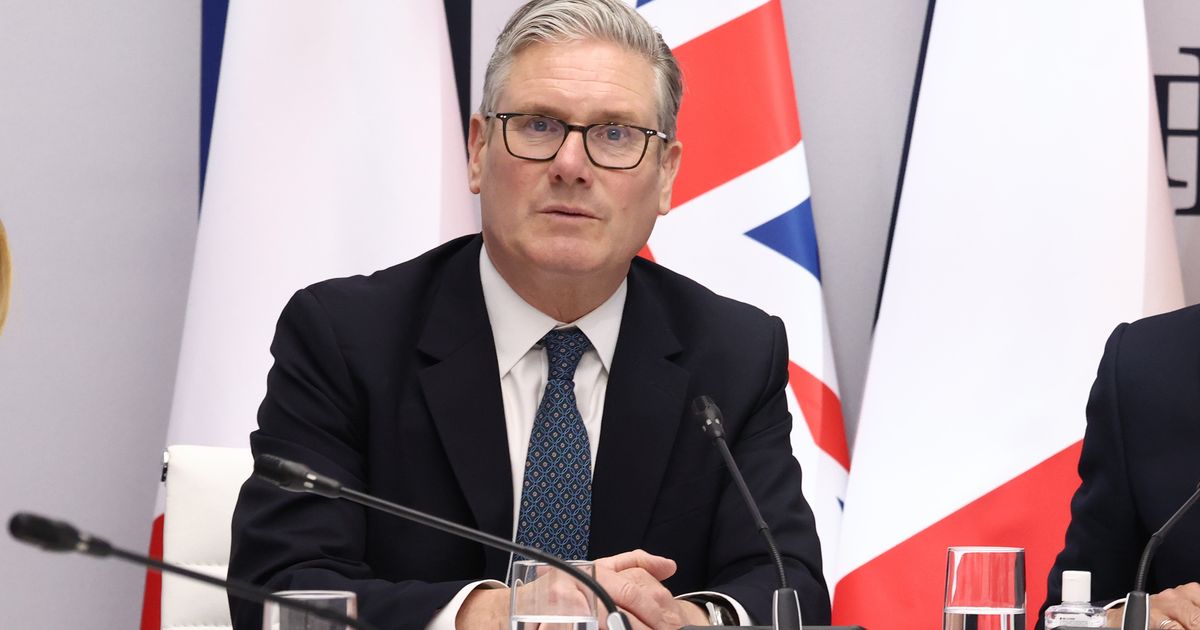
Excerpt: British Prime Minister Keir Starmer informed parliament that it “beggars belief” that officials kept crucial information from ministers.
On Monday, British Prime Minister Keir Starmer attributed the controversial appointment of Peter Mandelson as US ambassador to foreign ministry officials, stating that crucial information that might have prevented the decision was not disclosed to him.
Under increasing pressure from political rivals to step down, Starmer informed parliament that he was unaware officials had been cautioned against granting Mandelson security clearance. He maintained that, had he been aware, the appointment would not have proceeded.
The prime minister expressed his regret once again regarding the selection of Mandelson, who was dismissed in September after details emerged about his connections to the disgraced financier Jeffrey Epstein. The controversy has sparked wider worries regarding Starmer’s judgment, which grew more pronounced last week when the government revealed that Mandelson had not passed a security vetting process.
Starmer voiced significant frustration that officials from the Foreign Office failed to reveal that, in January 2025, they had disregarded advice and granted Mandelson “developed vetting” clearance—a designation permitting access to top-secret information.
“It is astonishing that, throughout the entire timeline of events, officials in the foreign office deemed it appropriate to withhold this information from the highest-ranking ministers in our government,” Starmer stated to lawmakers. “This conduct is not aligned with the expectations of the vast majority of people in this country regarding politics, government, or accountability.”
Mandelson’s appointment was initially lauded as a strategic decision, viewed as an opportunity to utilize his trade expertise and political experience to enhance relations with incoming U.S. President Donald Trump. Nonetheless, the choice has evolved into a political burden for Starmer.
Trump addressed the controversy directly on Truth Social, stating that the appointment was a “really bad pick” but also mentioning that there was still “plenty of time to recover.”
Starmer recognized that he had been mistaken in judgment, clearly stating that he would not have endorsed Mandelson’s appointment had he known that the UK Security Vetting unit recommended against granting him clearance. He stated that he has since put measures in place to ensure that officials do not override such advice moving forward.
The scandal has intensified difficulties for Starmer, whose popularity has waned since Labour’s overwhelming triumph in the 2024 general election. His office now claims that he acted without complete awareness of the facts, despite his previous assurances to parliament regarding due process.
“The prime minister would never intentionally mislead parliament or the public,” stated his spokesperson. “It is evident that he lacked this information during his prior address to parliament.”
In light of the recent revelations, Starmer last week terminated the employment of Olly Robbins, the leading official in the UK foreign ministry, who had endorsed a statement suggesting that Mandelson had successfully passed the vetting process. Robbins has remained silent on the matter, although associates indicate that he adhered to the standard protocols permitting officials to bypass vetting recommendations.
Opposition figures have capitalized on the crisis, charging Starmer with dishonesty and incompetence. Kemi Badenoch, the leader of the Conservative Party, expressed her criticism of the prime minister during a session in parliament.
“The way you confront those mistakes reveals the true character of a leader,” Badenoch stated. “Rather than owning up to the choices he made, the prime minister has cast his staff and officials aside.”
As local elections approach in three weeks, Labour is anticipated to encounter considerable losses, and the renewed attention on the scandal has sparked new concerns regarding Starmer’s leadership. Although no prominent labor leaders have demanded his resignation thus far, the ongoing controversy is challenging his authority and political position.