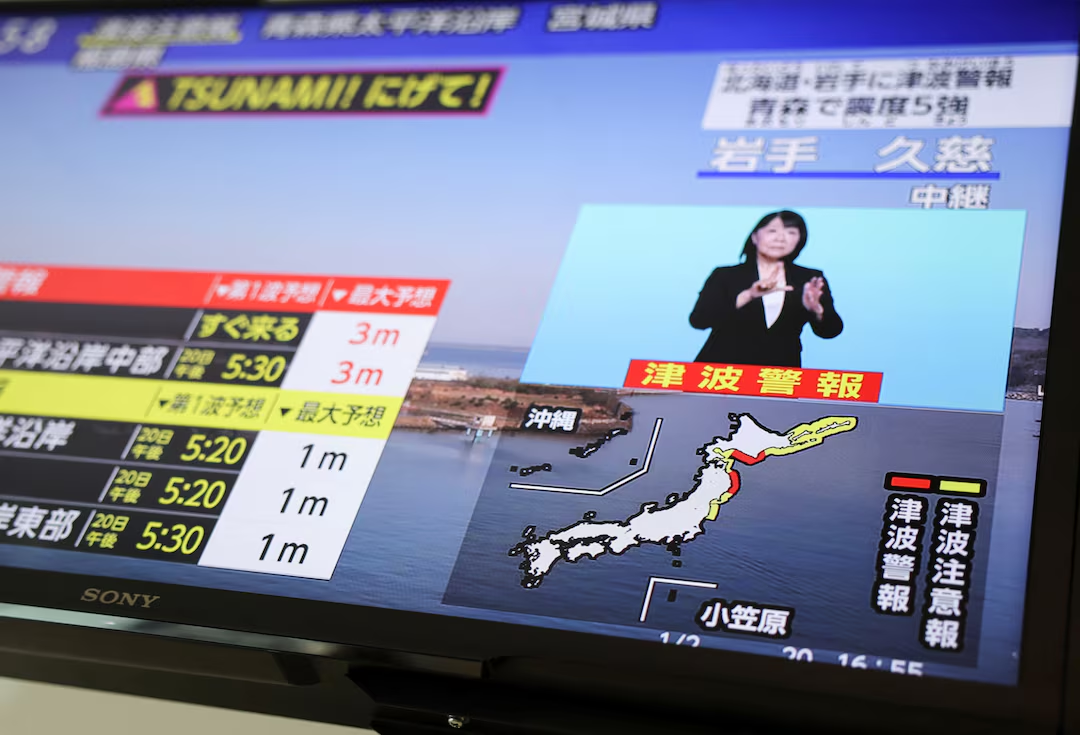
A magnitude 7.7 earthquake occurred off the northeastern coast of Japan on Monday, leading authorities to advise residents to avoid coastal areas where tsunami waves of up to 3 meters (10 feet) were anticipated.
Two hours following the tremor that occurred at 4:53 p.m. (0753 GMT), tsunami waves reaching heights of 80 cm were detected. A tsunami warning was subsequently downgraded to a tsunami advisory.
Keep informed about the important companies, data, and decisions in the ESG landscape through the Reuters Sustainable Finance newsletter. Register here.
As night descended upon the capital Tokyo, Japan’s leading government spokesperson Minoru Kihara addressed a news conference, stating that there were no immediate reports of casualties or significant damage.
Several port towns, including Otsuchi and Kamaishi, which were severely affected by a massive earthquake and tsunami in 2011, have issued evacuation orders for thousands of residents, as reported by public broadcaster NHK. Services for bullet trains were suspended, and certain motorways were shut down as a result of the tremors.
In the aftermath of the quake, the government released a warning regarding an increased risk of a megaquake.
A government official stated at a press conference that the typical probability of an earthquake measuring 8 or stronger occurring along the Japan Trench and Kuril Trench in the Pacific off northern Japan within a week is approximately 0.1%. However, in the week following Monday’s quake, this probability is expected to increase to around 1%.
Vessels are leaving a port in Tomakomai, Hokkaido Prefecture, where a tsunami warning has been issued after an earthquake. “Please take anti-disaster measures whilemeasures while understanding the importance of protecting one’s own life,” the official stated.
No abnormalities reported at idled nuclear plants.
The earthquake registered as an ‘upper 5’ on Japan’s seismic intensity scale, sufficiently powerful to hinder movement and lead to the collapse of un-reinforced concrete-block walls. The Japan Meteorological Agency reported that the tremor had an epicentre in the Pacific Ocean and occurred at a depth of 20 km.
According to JMA, a 3-meter tsunami has the potential to inflict damage on low-lying regions by inundating structures and sweeping away anyone caught in its currents.
Situated in the “Ring of Fire,” which consists of volcanoes and oceanic trenches that partially encircle the Pacific Basin, Japan stands as one of the most earthquake-prone nations globally, experiencing a tremor at least every five minutes.
Approximately 20% of the world’s earthquakes with a magnitude of 6.0 or greater occur in this region, including the catastrophic event in 2011 that led to nuclear meltdowns at the Fukushima power plant.
No nuclear power plants are currently operational in the affected areas, and Hokkaido Electric Power Co and Tohoku Electric Power Co have reported no abnormalities at their idled facilities in the region.