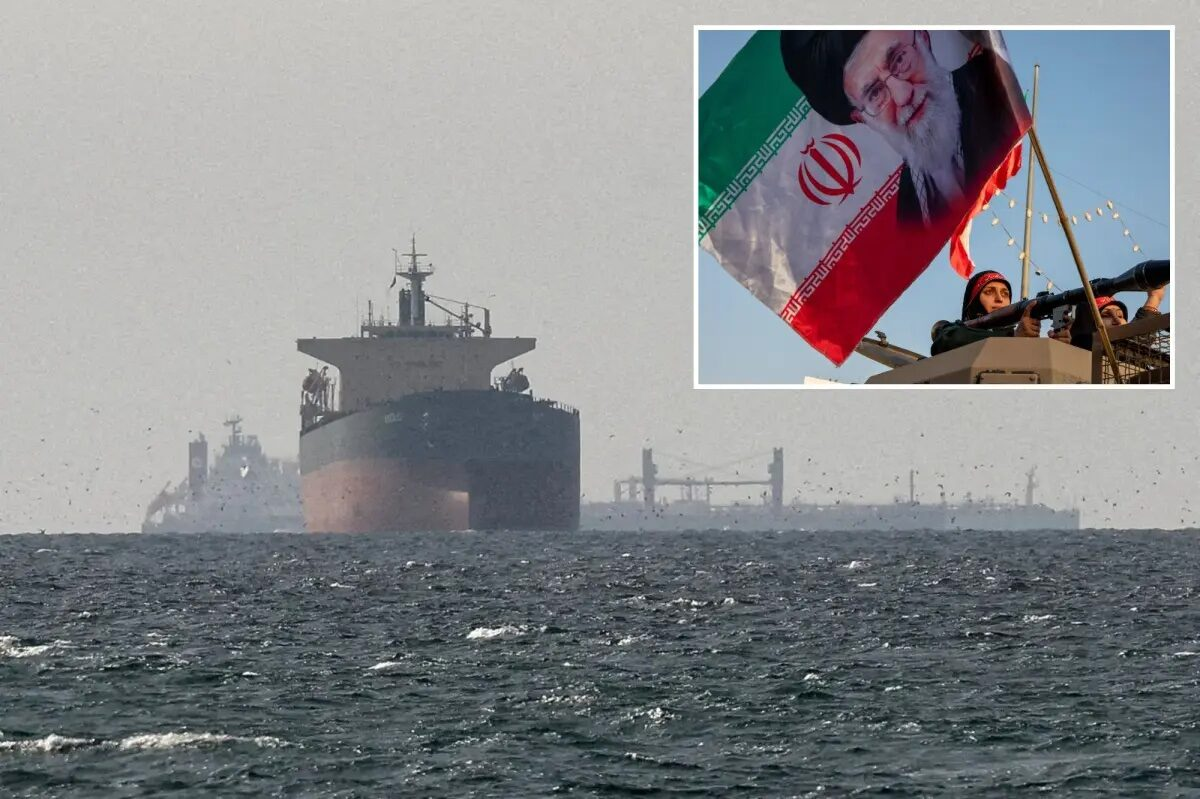
Tehran has reinstated restrictions in the Hormuz Strait, with oil tankers becoming targets amid rising tensions between the US and Iran
Iran has intensified its controls over the Strait of Hormuz following a short period of reopening, leading to tanker attacks, a backlash from the US, and a resurgence of global oil concerns.
Tension has escalated once more in the Middle East following Iran’s sudden reimplementation of stringent restrictions on vessel movement through the crucial Strait of Hormuz, just a day after declaring its reopening, raising new concerns about the potential for increased hostilities between Tehran and Washington.
This recent development has sparked fresh concerns throughout global energy markets.
In a statement from the Oval Office, President Donald Trump of the United States rejected Iran’s stance and indicated Washington’s resolve to continue applying pressure on Tehran, asserting that the US will not be coerced.
On Saturday, Iranian military authorities issued a forceful statement attributing the ongoing “blockade” of Iranian ports to the US. They asserted that this situation compelled Tehran to retract its previous decision to permit limited maritime passage through a vital oil transit corridor, emphasizing that the Strait will now only be accessible to ships that make payment.
“The Islamic Republic of Iran, in accordance with prior agreements reached during negotiations, has consented in good faith to the regulated transit of a restricted number of oil tankers and commercial vessels through the Strait of Hormuz,” the statement indicated.
“Regrettably, the Americans persist with the so-called blockade.” Consequently, the control of the Strait of Hormuz has reverted to its former condition, with this strategic passage now firmly under the vigilant oversight and authority of the armed forces.
Iran has issued a warning that the restrictions will persist indefinitely unless Washington provides guarantees for unrestricted maritime access for Iranian vessels.
“Provided that the United States maintains the unrestricted passage of vessels between Iran and their destinations, the situation in the Strait of Hormuz will continue to be closely monitored and remain unchanged,” Iranian authorities stated.
Trump Responds
From the Oval Office, Trump rejected Iran’s stance and indicated Washington’s resolve to continue applying pressure on Tehran.
“We are having excellent discussions,” Trump stated. “They have become somewhat endearing, as they have for the past 47 years.” They aimed to shut the Strait once more, as has been their practice for years. “They cannot blackmail us,” he added.
Trump further disclosed that the US would maintain its blockade of Iranian ports until a comprehensive agreement is achieved, emphasizing a hardline position that seems to have prompted Tehran’s recent action.
“We are engaging in discussions with them, and we are adopting a firm position.” A significant number of individuals lost their lives. “Many of our people have lost their lives,” he stated.
Iran’s Deputy Foreign Minister Saeed Khatibzadeh responded promptly, sharply criticizing Washington’s approach and labeling Trump’s statements as inconsistent and counterproductive.
Khatibzadeh remarked during the Antalya Diplomacy Forum, “President Trump’s statements Saturday were somewhat perplexing.”
“There is one straightforward, unequivocal principle: Security for all or security for none,” he added.
Khatibzadeh cautioned that the continuation of the current ceasefire would rely on the US relinquishing what he termed a “maximalist” negotiating stance.
“That can only happen if the other side agrees to negotiate on equal terms and sets aside its extreme stance,” he stated.
While recognizing that Iran had consented to discussions due to “the absence of alternatives,” the deputy minister adopted a resolute tone.
He proclaimed, “We will remain steadfast until the final bullet and the last soldier.”
Gunfire in the Strait
The UK Maritime Trade Operations (UKMTO) has confirmed that two gunboats from the Iranian Revolutionary Guard Corps (IRGC) opened fire on a tanker navigating the waterway. This incident marks the first attack in over 10 days, following the April 7 assault near the Gulf, where a bulk carrier was hit by ‘two unidentified projectiles.’
The advisory states that the vessel’s captain reported an encounter with “2 IRGC gun boats” roughly 20 nautical miles from the coast of Oman.
The report indicated that no radio warning was issued prior to the shots being fired, although it confirmed the safety of the tanker and its crew.
In a different incident hours later, a container ship was hit by what authorities referred to as an “unknown projectile,” resulting in damage to cargo, though there were no reported casualties or environmental impact.
On Saturday, three ships—an internationally flagged tanker, a cargo ship, and a cruise ship—were involved in incidents off the coast of Oman.
Reports indicated that at least two of the targeted vessels were Indian-flagged, raising alarm in New Delhi and further internationalizing the crisis.
India Files Protest, Calls in Iranian Ambassador
The crisis has elicited significant international concern, prompting the Indian government to summon Iran’s ambassador to India, Dr. Mohammad Fathali, in light of reports indicating that Indian-flagged vessels were caught in the crossfire.
India’s Foreign Secretary Vikram Misri expressed significant concern regarding the incident and emphasized the necessity of safeguarding merchant shipping in the region.
He called on Tehran to “promptly restart the process of enabling India-bound ships through the Strait,” highlighting the nation’s dependence on this route for energy imports. In a subsequent message, Misri confirmed the involvement of two ships flying the Indian flag in the incident.
The swift consequences of Iran’s reinstated restrictions were clear throughout global shipping routes, as ships opted to turn back instead of jeopardizing their passage through the Strait.
Marine tracking data indicated that several tankers, including those transporting liquefied natural gas and crude oil destined for Asia, were reversing course toward the Gulf.
The US blockade escalates pressure.
The US military, operating under the United States Central Command (CENTCOM), has confirmed that its blockade operations have successfully compelled numerous vessels to alter their routes.
“Since the start of the blockade, 23 ships have followed the orders from U.S. forces to turn back,” CENTCOM stated in an update.
The blockade, while not directly aimed at the Strait, has significantly influenced Iranian shipping, resulting in a ripple effect on maritime movement throughout the region.
Iran has characterized the blockade as a breach of the ceasefire, with its Supreme National Security Council cautioning that it will not permit normal passage through Hormuz under these circumstances.
“The council stated that as long as the enemy seeks to obstruct the movement of vessels and enforce its naval blockade, Iran will consider that a breach of the ceasefire.”
Iran: Access to the Strait Restricted to Vessels That Comply with Payment
A recent statement from a senior Iranian official, during an interview with CNN on Saturday, indicated that Iran will prioritize vessels that pay for passage through the Strait of Hormuz.
The official stated that vessels failing to pay the fees will have their passage “postponed.”
Under the proposed system, vessels would need to provide detailed information, secure transit certificates, and pay service fees, thereby placing one of the world’s most crucial shipping lanes under Iranian administrative control.
In a distinct communication commemorating Army Day, Iran’s Supreme Leader Mojtaba Khamenei delivered a subtle caution to opponents.
“Iran’s navy is prepared to ensure that adversaries experience the harsh reality of new defeats,” the message stated.
In light of increasing concerns about a broader conflict, regional powers have intensified their diplomatic initiatives to alleviate the crisis.
Foreign ministers from Pakistan, Saudi Arabia, Turkey, and Egypt gathered on the sidelines of the Antalya forum to advocate for renewed negotiations.
Egypt’s Foreign Minister Badr Abdelatty conveyed a sense of measured hope.
“We are making significant efforts to advance,” he stated, noting that a deal between the United States and Iran might be achieved “in the coming days.”
Pakistan has emerged as a crucial intermediary, with its military chief actively engaging both parties in an effort to preserve the delicate ceasefire before it expires, which is vital for maintaining regional stability and preventing further escalation of conflict.