Oil prices plummet by 11% as Iran reopens the Strait of Hormuz, while Trump maintains the naval blockade
Crude prices decline following Iran’s reopening of a crucial shipping route, yet Trump upholds the blockade as markets experience a rally and shippers exercise caution.
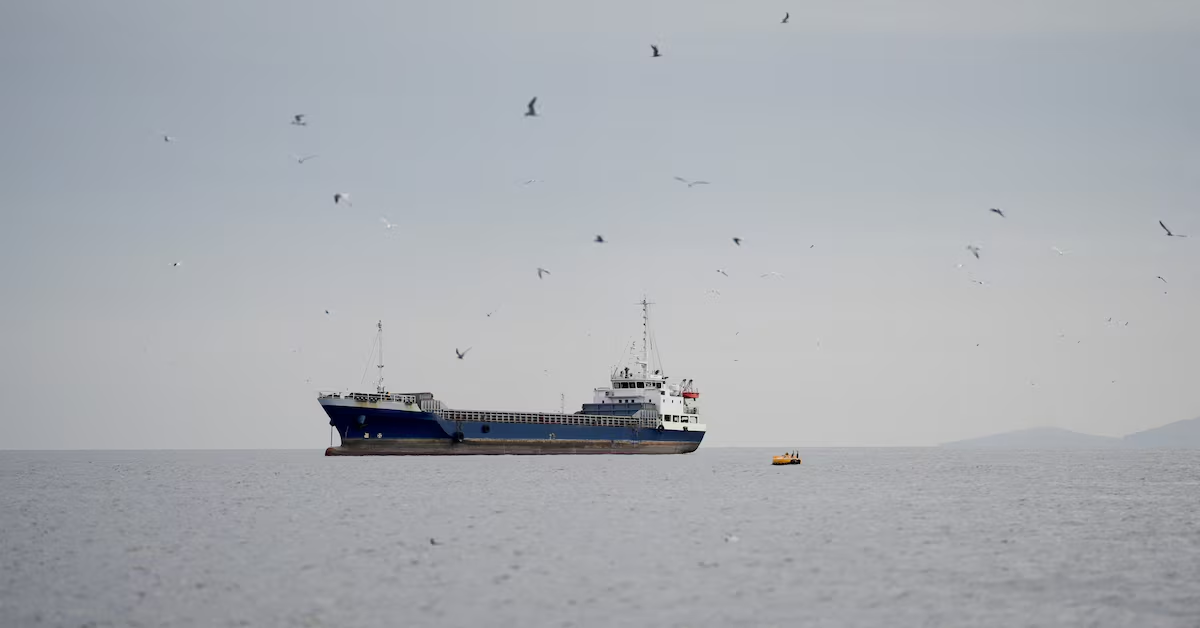
Oil prices dropped significantly, while two US stock indexes reached record highs on Friday, following statements from Iran’s foreign minister confirming that the Strait of Hormuz was accessible to commercial vessels.
US crude oil fell 11.4 percent to $83.85 per barrel, marking its lowest level since March 10, while Brent crude decreased nine percent to $90.38 per barrel.
On Friday, there was a significant one-day drop in both US and Brent crude oil, marking the second-largest decline since the war began.
“In accordance with the ceasefire in Lebanon, the passage for all commercial vessels through the Strait of Hormuz is officially declared fully open for the duration of the ceasefire, along the coordinated route previously announced by the Ports and Maritime Organization of the Islamic Republic of Iran,” NBC News reported Abbas Araghchi as stating in a post on X on Friday.
The reference to a “coordinated route” did not immediately clarify whether ships would be required to pay a toll to Iran, as has been reported in recent weeks. It was not immediately clear whether ships in the region, which have faced threats and attacks, would have confidence in this announcement.
Following the Iranian minister’s announcement, President Donald Trump took to Truth Social to express his approval, stating: “IRAN HAS JUST ANNOUNCED THAT THE STRAIT OF IRAN IS FULLY OPEN AND READY FOR FULL PASSAGE. THANK YOU!”
In a subsequent post, Trump stated that “the naval blockade will remain in full force and effect as it pertains to Iran, only, until such time as our transaction with Iran is 100 percent complete.”
Patrick DeHaan, an analyst at GasBuddy, stated on X that the change in oil prices may swiftly lead to a decrease in gas prices.
“Such changes may lead to a decrease in fuel prices beginning this weekend, with the national average expected to drop below $4 per gallon, potentially reaching $3.65 to $3.85,” De Haan stated.
As of Friday afternoon, the average price per gallon was $4.09, according to AAA, and has been decreasing by a few cents each day this week.
Oil prices continue to be high, despite the decline observed on Friday. Since the onset of the war, the price of US crude oil has increased by 25 percent, and it has risen over 45 percent since the beginning of the year.
The S&P 500 concluded trading on Friday with an increase of 1.2 percent, achieving a weekly gain exceeding 4.5 percent. The Nasdaq Composite concluded the trading day with a rise of 1.5 percent, achieving a total weekly gain of 6.8 percent. Both reached new record highs.
On Friday, the Dow surged, finishing the day up by 868 points, which is an increase of 1.8 percent, while the Russell 2000 index rose by 2.1 percent. On Friday, it marked the third consecutive week of gains for all three major indexes.
US Treasury yields experienced a significant decline. The yield on the 10-year US government bond decreased to 4.24 percent, marking its lowest point since March 18.
Stocks throughout Europe surged following the announcement from the Iranian minister, with the Stoxx 600 index increasing by 1.4 percent. Germany’s DAX surged by 2.2 percent, stocks in France increased by two percent, and the benchmark FTSE 100 index in the U.K. climbed nearly one percent.
European leaders, gathered for a summit at the time of Iran’s announcement, responded to the news with cautious optimism.
“According to international law, transit through waterways such as the Strait of Hormuz should remain open and free of charge,” stated the E.U.’s chief diplomat, Kaja Kallas, in a post on X. “A pay-for-passage scheme will set a dangerous precedent for international maritime routes,” said Kaja Kallas, the E.U.’s chief diplomat, in a post on X.
French President Emmanuel Macron and U.K. Prime Minister Keir Starmer, who were at the forefront of the summit, also expressed their approval of the news. However, Macron insisted that a neutral and independent entity should manage the security of the strait.
“The strait should be reopened immediately, without any tolls or restrictions,” Starmer stated.
Two of the largest shipping companies in the world also reacted with caution.
“In light of the ongoing conflict, we have adhered to the advice of our security partners in the region, and the current recommendation is to refrain from transiting the Strait of Hormuz,” Maersk stated. “Decisions regarding transit through the strait will rely on thorough risk assessments and vigilant monitoring of the security landscape.”
Hapag-Lloyd stated that “there are still some open questions” but assured that its “crisis committee is in session and will attempt to resolve all open items” within the next 24 to 36 hours.
“Provided that all outstanding issues are resolved (such as insurance coverage and clear directives from the Iranian government/military regarding the specific sea corridor to be utilized and the order of departing ships), we would prefer to navigate the strait at the earliest opportunity,” the company’s statement indicated.