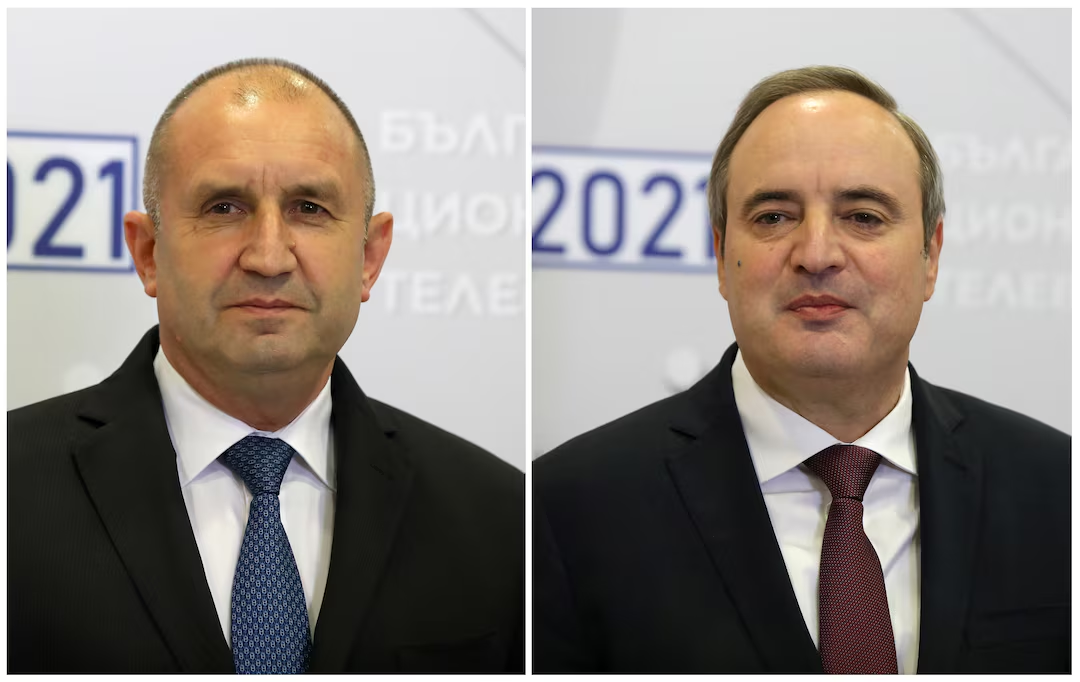
Former president of Bulgaria, who is pro-Russian, is currently leading the election race with a focus on an anti-corruption platform
In a lush valley of rural southern Bulgaria, farmer Nikolay Vasiliev yearns for transformation. He stated that for years, corrupt local officials have hindered efforts to expand his cattle-raising business. The changing administrations in Sofia have not succeeded in eliminating corruption or revitalizing the struggling economy of the region.
Now, he expresses that there is hope. Attached to a post outside his farm is an election campaign poster featuring the serious expression of Rumen Radev, a pro-Russian former fighter pilot who resigned as president in January to participate in the parliamentary vote on April 19.
Radev is ahead in the polls, supported by older, rural voters who view him as a savior capable of ending years of turmoil and dismantling what he refers to as a “oligarchy” of corrupt veteran politicians. “I see a leader who can bring about this significant change and ensure security for the people,” Vasiliev stated in an interview at his farm in the Haskovo province of Bulgaria. “It is now time for us to address the core issues facing our country.”
Bulgaria, a Black Sea nation of approximately 6.5 million on the southeastern frontier of the European Union, is set to vote on Sunday for the eighth time in five years. This comes during a political crisis characterized by fragile coalitions that have struggled to endure, leading to a decline in trust in democratic elections.
Voters expressed to Reuters that this election has a distinct feel. Radev, elected president in 2016 to a role that is primarily ceremonial, has navigated the crisis with relative ease and has committed to combating corruption and ensuring stability.
Authorities indicate that corruption is present in Bulgaria across various sectors, including public procurement contracts and local electoral processes. Bulgaria holds the 84th position in Transparency International’s 2025 Corruption Perceptions Index, sharing the distinction of being the lowest-scoring country in the EU with Hungary.
On Wednesday, Radev vowed to eliminate “the local feudal lords and strongmen who are suffocating entire regions of Bulgaria.”
A FRESH ORBAN?
A Radev victory has the potential to reshape Bulgaria’s foreign policy, which has largely been influenced by parties aligned with Brussels. Bulgaria became a member of the euro zone in January and last month entered into a security agreement with Ukraine, actions that Radev is against. “The coalition-makers brought the euro to Bulgaria without consulting you.” As you settle your bills, keep in mind the politicians who assured you that you would belong to the ‘club of the rich.’
On Wednesday, Radev addressed the public’s frustration regarding increasing bills.
Following the ousting of Hungary’s pro-Kremlin Prime Minister Viktor Orban, Radev is establishing himself as the last EU leader ready to enhance ties with Moscow, despite the ongoing conflict of Russia’s war in Ukraine.
“We are the sole member state of the European Union that identifies as both Slavic and Eastern Orthodox,” he stated during an interview with Bulgarian journalist Martin Karbovski. “We can serve as a crucial connection in this entire process…to mend relations with Russia.”
RADEV MIGHT NEED TO MAKE SOME CONCESSIONS
In December, the government stepped down in response to widespread protests concerning corruption and a budget that suggested increased taxes. A wave of demand for reform ensued. Radev stepped forward.
Polls indicate that his Progressive Bulgaria (PB) party holds approximately 30% of the vote, placing it about 10 percentage points ahead of the country’s largest party, GERB, yet still falling short of securing an outright majority.
According to data from Bulgaria’s National Audit Office, PB has garnered more than 650,000 euros in private campaign donations, which accounts for 67% of the total contributions.
Nevertheless, Radev might require coalition partners, which could moderate his pro-Russian position. One candidate is the pro-European We Continue the Change – Democratic Bulgaria (PP-DB) coalition, which holds approximately 12% and acknowledges the necessity for reform.
Radev has dismissed the possibility of forming an alliance with GERB, led by former Prime Minister Boyko Borissov, or with the Movement for Rights and Freedoms party, whose leader Delyan Peevski is currently facing U.S. and UK sanctions for corruption.
“All indications point towards…coalition-building,” remarked Tihomir Bezlov, a senior fellow at the Centre for the Study of Democracy in Sofia, noting that it remained uncertain how long any coalition would endure.
The outcome will largely hinge on voter turnout, which is anticipated to exceed 50%. The caretaker government has taken measures to restore trust by cracking down on the widespread issue of vote buying in Bulgaria and has sought assistance from the EU to combat online misinformation, particularly from sources it identifies as Russian.
Radev stated that this was a deceptive tactic to manipulate the vote.
“No one from outside has the right to dictate who or what we should vote for.” “That decision is made here, by us Bulgarians,” he stated.
Russia has refuted allegations of meddling in elections abroad.
The search for a respected leader
Bulgaria has experienced significant growth since the fall of communism in 1989 and its accession to the European Union in 2007. Life expectancy has increased significantly, unemployment rates are the lowest in the EU, and the economy has stronger protections since joining the euro zone.
The cobbled streets of central Sofia are lined with bustling cafes and bars, where people enjoy the spring evenings gathered in the city’s numerous well-maintained parks. The ski resorts draw winter tourists from all over Europe.
In the villages of Haskovo, communities have suffered due to years of neglect and the exodus of the youth. Roads require resurfacing, and sagging farm roofs need retiling.
Farmer Vasiliev rejects claims that Radev is pro-Russian. He simply seeks a decent companion.
“When I consider a leader, the first word that comes to mind is ‘dignified’,” he stated. “To embody true leadership, one must first embody dignity as an individual.”